
Sénégal FMI Programme Dette Publique: PM Confirms High Debt
Summary
- Senegal's Prime Minister Ahmadou Al Aminou Mohamed Lô presented a policy statement on September 8 amidst a national debate on public debt and an International Monetary Fund (IMF) program.
- While a previous $1.8 billion IMF program was frozen due to the discovery of previously undeclared liabilities, which pushed Senegal's debt-to-GDP ratio above 130%, the International Monetary Fund has since reached a staff-level agreement for a new $2.2 billion loan program.
- The government is pursuing a "reprofiling" strategy to extend debt maturities and reduce costs, despite an SP Global Ratings assessment of an "extremely probable" distressed debt exchange or default.
- Political critics, including Guy Marius Sagna and Abdou Mbow, have challenged the executive's approach to the IMF and its policy statement.
- The executive plans to reduce spending by containing the wage bill, limiting recruitment, cutting operating expenses, and eliminating nineteen agencies by the end of November.
Senegal Grapples with Public Debt and IMF Program
The overarching challenge for the administration of President Bassirou Diomaye Faye is to reconcile these expenditure reduction measures with his pledges of economic sovereignty and social justice, all while guiding Senegal back to a sustainable financial trajectory.
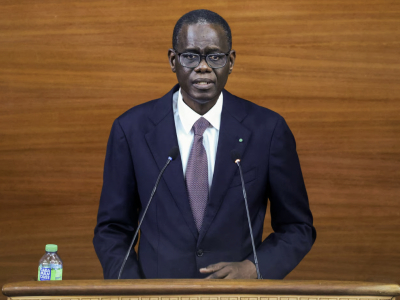
Senegal's Prime Minister, Ahmadou Al Aminou Mohamed Lô, presented his general policy statement to the National Assembly on September 8. The legislative body, where the Pastef party holds a dominant position, engaged in an eight-hour debate following the address. The Prime Minister's speech underscored continuity with the existing Sénégal 2050 framework while also signaling a new approach to governance.
This presentation occurred as the executive branch endeavors to reassure international partners and secure the release of a $1.8 billion International Monetary Fund (IMF) program. The previous $1.8 billion International Monetary Fund (IMF) program had been frozen after the discovery of previously undeclared liabilities; however, the IMF has since reached a staff-level agreement with Senegal for a new $2.2 billion loan program, bringing the issues of public debt and the IMF program to the forefront of national discourse in Senegal.
Mounting Debt Concerns and Government's Strategy
During his address, Prime Minister Lô acknowledged the nation's severe financial strain, stating that Senegal is "poor, currently very indebted." The country's public debt-to-GDP ratio has surpassed 100% since April 2024. Furthermore, the revelation of the undisclosed liabilities pushed this ratio above 130%, leading to a significant decline in the value of Senegalese government bonds.
The Prime Minister initially mentioned a "structural adjustment" but then retracted this statement the following day, asserting that no such adjustment was underway in Senegal. This inconsistency is compounded by the government's reluctance to use the term "restructuring," preferring instead "reprofiling." This strategy aims to extend debt maturities and reduce the average cost of borrowing, as the government seeks to restore macroeconomic stability and improve debt sustainability following its agreement with the IMF. However, SP Global Ratings has indicated that a distressed debt exchange or a default on commercial foreign currency debt is "extremely probable."
Political Opposition and Public Discontent
The government's handling of the debt situation and its engagement with the IMF have drawn sharp criticism from political figures. Guy Marius Sagna accused the executive of ceding Senegal's voice to the IMF without consulting the National Assembly. Similarly, Abdou Mbow dismissed the Prime Minister's statement as a "superficial summary made by a firm." Disagreement also centers on the country's future economic direction.
Senegal has previously relied on IMF loans following political transitions in 2000 and 2012, utilizing funds for infrastructure development, student aid, and salary increases. However, since April 2024, the nation has not received any loans from the Fund for at least two years. The pursuit of new financial support now clashes with the imperative to reduce expenditures, even as the Vision 2050 initiative aims to rebuild the productive model based on sovereignty, social justice, and shared prosperity. The Timbuktu-institute's analysis highlights the considerable social pressure accompanying these financial developments, exemplified by the "March of empty baskets" held in Dakar on September 5. Organized by the "Thirty days for the right price" mobilization, this protest denounced rising costs for food, electricity, fuel, and rent.
Executive's Austerity Measures Amidst Economic Vision
In response to the fiscal challenges, the executive branch plans to implement several austerity measures. These include containing the public wage bill, limiting new recruitments, and reducing operating expenses. The government also intends to better target aid towards vulnerable households, while maintaining support for domestic butane gas. Furthermore, the elimination of nineteen government agencies is slated to occur by the end of November.
The overarching challenge for the administration of President Bassirou Diomaye Faye is to reconcile these expenditure reduction measures with his pledges of economic sovereignty and social justice, all while guiding Senegal back to a sustainable financial trajectory.
Source
How does this affect you?
Get an AI analysis of this article grounded in your jurisdictions, practice areas, and any policy documents you've uploaded to Wansom.
Finish Reading the Full Story and the Expert Analysis.
Get the latest legal & regulatory intelligence in Senegal
Wansom is AI and can make mistakes.