
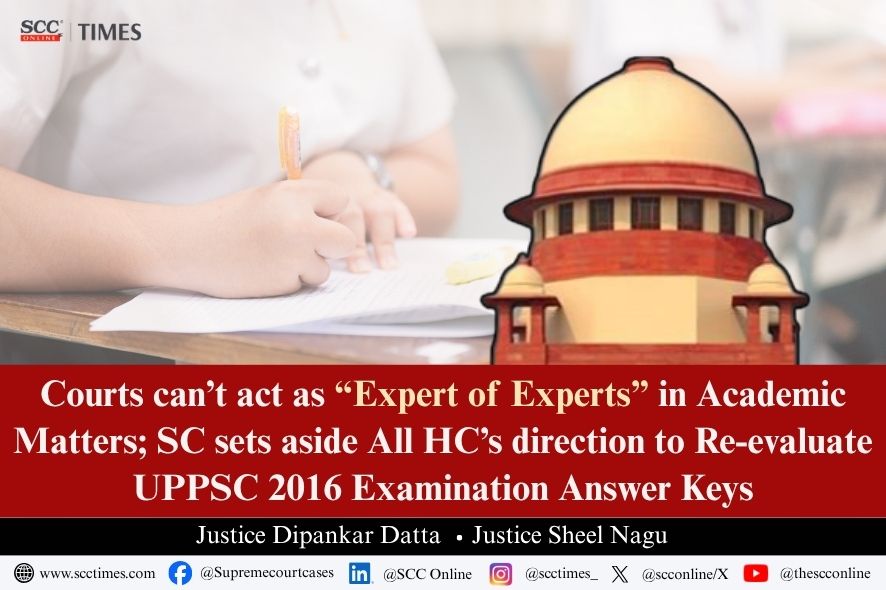
SC Sets Aside Allahabad High Court's Re-Evaluation Order for UPPSC 2016 Exam
Summary
- The Supreme Court set aside the Allahabad High Court's order to re-evaluate UPPSC 2016 examination answer keys.
- Courts cannot act as 'experts of experts' in academic matters, according to the Supreme Court's ruling.
- The decision may impact the ability of courts to review and re-evaluate examination answer keys in future cases.
What Happened
The court held that the High Court had overstepped its bounds by attempting to re-evaluate answer keys as if it were an expert in the field.
The Allahabad High Court had directed the re-evaluation of answer keys for the UPPSC 2016 examination, citing discrepancies in certain questions. However, the Supreme Court has now set aside this order, ruling that courts cannot act as 'experts of experts' in academic matters. This decision may have significant implications for future cases involving the review and re-evaluation of examination answer keys.
The Supreme Court's judgment was delivered on August 11, 2026, and is a critical development in the ongoing debate over the role of courts in reviewing expert evidence in academic matters.
Legal Context
The Supreme Court's decision is rooted in its understanding of the limits of judicial review in academic matters. The court has long recognized that expertise lies with specialized bodies and institutions, rather than with judges themselves. In this case, the court held that the High Court had overstepped its bounds by attempting to re-evaluate answer keys as if it were an expert in the field.
The judgment also highlights the importance of maintaining clear boundaries between judicial review and expert evaluation in academic matters. This distinction is crucial for ensuring that courts do not usurp the functions of specialized bodies and institutions, which are better equipped to handle complex technical issues.
Why It Matters
The Supreme Court's decision has significant implications for lawyers and judges involved in reviewing examination answer keys. The ruling clarifies that courts cannot act as 'experts of experts' in academic matters, which may impact their ability to review and re-evaluate examination answer keys in future cases. This development underscores the need for careful consideration of the role of judicial review in academic matters and highlights the importance of maintaining clear boundaries between judicial review and expert evaluation.
The decision also has broader implications for the administration of examinations and the use of expert evidence in academic matters. It emphasizes the need for specialized bodies and institutions to take the lead in reviewing examination answer keys, rather than relying on courts to do so.
Practical Implications
Lawyers should be aware that the Supreme Court has clarified that courts cannot act as 'experts of experts' in academic matters, which may impact their ability to review and re-evaluate examination answer keys in future cases.
Source
Source: Original reporting via SCC Times
How does this affect you?
Get an AI analysis of this article grounded in your jurisdictions, practice areas, and any policy documents you've uploaded to Wansom.
Wansom is AI and can make mistakes.