
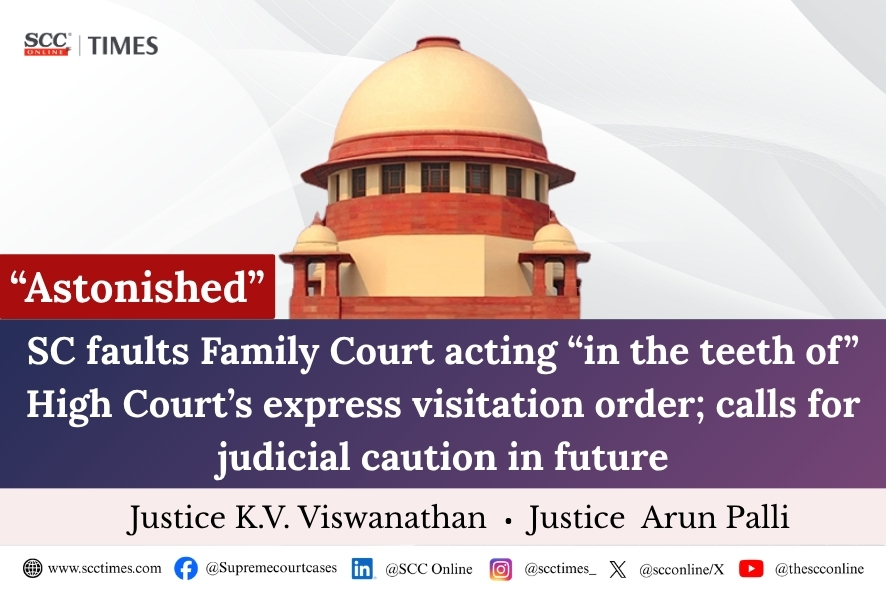
SC Faults Karnataka Family Court Visitation: Rebukes Disregard of High Court Order
Summary
- The Supreme Court of India strongly criticized a Karnataka Family Court for disregarding a higher court's order.
- The Family Court dismissed a mother's custody application based on findings that contradicted evidence and a prior High Court directive.
- The Family Court's decision was inconsistent with an express visitation order issued by the Karnataka High Court.
- The Supreme Court conveyed its significant disapproval and urged for greater judicial caution in future Family Court proceedings.
What Happened
The Supreme Court's firm stance provides a robust precedent for litigants and legal practitioners to challenge Family Court decisions that fail to uphold the directives of higher judicial bodies, ensuring accountability.
The Supreme Court of India recently intervened in a family law matter, issuing a strong rebuke to a Family Court in Karnataka. The apex court found that the Family Court had acted in direct contravention of an explicit visitation order previously issued by the Karnataka High Court. This judicial oversight prompted the Supreme Court to express significant disapproval regarding the Family Court's conduct, highlighting a serious breach of judicial protocol.
Specifically, the Family Court had rejected an application filed by the respondent-mother, which sought the restoration of custody. In reaching its decision, the Family Court relied on findings that were not only inconsistent with the evidence presented before it but also directly contradicted the clear directives of the Karnataka High Court. The High Court's earlier ruling had specifically modified the existing visitation arrangements, setting out a revised framework for parental access that the Family Court subsequently ignored.
Legal Context and Judicial Hierarchy
The Supreme Court's intervention underscores a fundamental principle of the Indian legal system: judicial hierarchy. The apex court highlighted that lower courts, including Family Courts, are unequivocally bound to respect and implement orders issued by higher judicial authorities. The Family Court's decision to dismiss the mother's application and its contradictory findings effectively constituted a disregard of higher court orders India, specifically a binding directive from the Karnataka High Court concerning child visitation. This action directly challenged the established chain of command within the judiciary.
This situation led the Supreme Court to call for enhanced judicial caution Family Court India in future proceedings. The ruling emphasizes that Family Court powers visitation rights must be exercised strictly within the bounds of established legal precedents and higher court mandates. Such a disregard of higher court orders India by any subordinate court undermines the integrity of the judicial process and can lead to inconsistent and unjust outcomes, particularly in sensitive matters like India Supreme Court family law cases involving children, where stability and clarity are paramount.
Why It Matters
This ruling carries significant weight for the practice of family law across India, particularly concerning how SC faults Karnataka Family Court visitation orders. It serves as a clear and unequivocal reminder to all subordinate courts, including Family Courts, that they cannot deviate from or contradict orders issued by High Courts or the Supreme Court. The Supreme Court's firm stance provides a robust precedent for litigants and legal practitioners to challenge Family Court decisions that fail to uphold the directives of higher judicial bodies, ensuring accountability.
The case reinforces the importance of meticulous adherence to judicial pronouncements, ensuring that the Karnataka High Court visitation order was not merely a suggestion but a binding legal command that demanded compliance. By expressing its strong disapproval, the Supreme Court has sent a clear message about the necessity of maintaining judicial discipline and consistency across all levels of the judiciary. This ultimately safeguards the rights of parties involved in family disputes and upholds the rule of law, preventing arbitrary decisions at the lower court level.
Practical Implications
This ruling reinforces the principle of judicial hierarchy, providing a strong precedent for lawyers to challenge Family Court orders that contradict High Court directives, particularly in child visitation matters. Practitioners should advise clients on the importance of citing and enforcing higher court orders in Family Court proceedings.
Source
Source: Original reporting via SCC Times
How does this affect you?
Get an AI analysis of this article grounded in your jurisdictions, practice areas, and any policy documents you've uploaded to Wansom.
Finish Reading the Full Story and the Expert Analysis.
Wansom is AI and can make mistakes.