
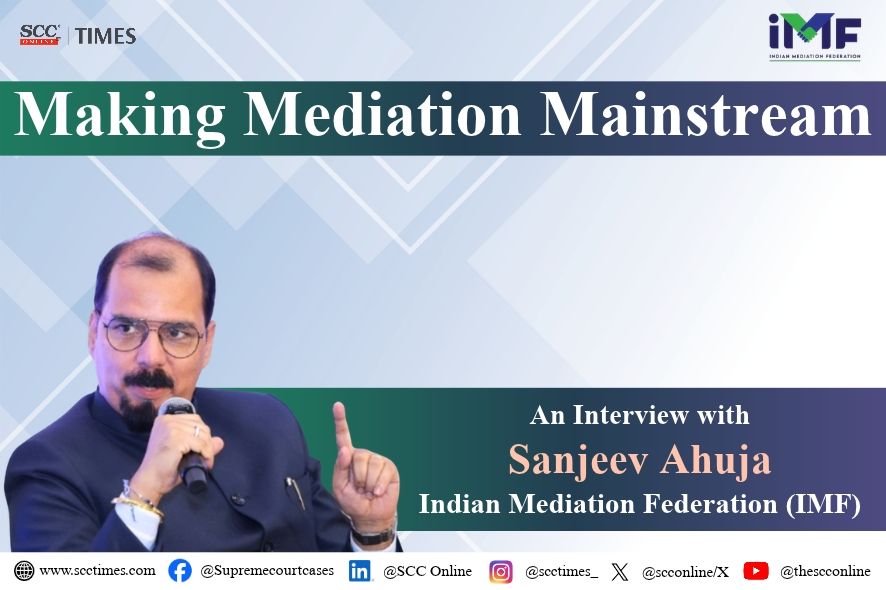
Sanjeev Ahuja: Indian Mediation Federation's Vision for Mainstream Mediation
Summary
- Sanjeev Ahuja discussed the Indian Mediation Federation's vision for mainstreaming mediation in India.
- The conversation highlighted the evolving mediation landscape and the need for its establishment as a primary dispute resolution mechanism.
- Key areas for strengthening India's mediation ecosystem include institutional support, stakeholder collaboration, and building awareness.
- The interview with SCC Times offered insights into the future of mediation and alternative dispute resolution in India.
Driving Mediation's Future in India
The overarching goal articulated by Sanjeev Ahuja and the Indian Mediation Federation is to elevate mediation to a mainstream mechanism for dispute resolution, comparable in stature and accessibility to traditional litigation.
Sanjeev Ahuja, a prominent figure, recently shared his insights regarding the trajectory of mediation in India during an exclusive interview with SCC Times. The discussion centered on the foundational principles guiding the Indian Mediation Federation (IMF) and its ambitious objective to firmly establish mediation as a primary method for resolving disputes across the nation. This conversation provided a comprehensive look into the current state and future direction of the alternative dispute resolution landscape in India, highlighting critical areas for development and strategic focus.
Ahuja's remarks underscored the imperative to integrate mediation more deeply into the country's legal and social fabric. He articulated the Indian Mediation Federation vision as one that seeks to transform how conflicts are approached, moving towards more amicable and efficient resolutions. The interview served as a platform to illuminate the evolving mediation landscape in India, identifying both the progress made and the significant work still required to achieve widespread acceptance and utilization of mediation services.
The Indian Mediation Federation's Strategic Pillars
The core of Ahuja's discourse revolved around several crucial elements necessary to bolster India's mediation ecosystem. A key focus was placed on the importance of cultivating robust institutional support, which is seen as vital for providing the necessary infrastructure and legitimacy for mediation practices. This involves governmental backing, judicial encouragement, and the establishment of standardized procedures that can instill confidence in the process.
Furthermore, the conversation emphasized the critical role of encouraging broad stakeholder collaboration. This includes engaging legal professionals, businesses, community leaders, and educational institutions to collectively champion mediation. Such collaborative efforts are deemed essential for fostering an environment where mediation is not just an option, but a preferred first step in dispute resolution. Building greater public awareness and trust in mediation also emerged as a paramount objective, recognizing that public perception is instrumental in its mainstream adoption.
Mainstreaming Alternative Dispute Resolution
The overarching goal articulated by Sanjeev Ahuja and the Indian Mediation Federation is to elevate mediation to a mainstream mechanism for dispute resolution, comparable in stature and accessibility to traditional litigation. This strategic shift requires a concerted effort to educate the public and legal community about the benefits of mediation, including its cost-effectiveness, speed, and potential for preserving relationships. The vision extends beyond mere availability, aiming for a cultural shift where mediation is instinctively considered for conflict resolution.
This push for India mediation mainstreaming reflects a broader trend in alternative dispute resolution India, where there is increasing recognition of the limitations of conventional court systems. By strengthening the mediation ecosystem, promoting institutional support, and enhancing public trust, the IMF aims to create a sustainable and effective framework for resolving disputes outside of court. The insights from the interview provide a clear roadmap for stakeholders invested in the future of the mediation landscape in India.
Practical Implications
Lawyers and compliance officers in India should recognize the growing emphasis on mediation as a primary dispute resolution mechanism. This signals a strategic shift that may require adapting client advisory services and dispute resolution strategies to leverage mediation more effectively, anticipating increased institutional support and public trust in ADR.
Source
How does this affect you?
Get an AI analysis of this article grounded in your jurisdictions, practice areas, and any policy documents you've uploaded to Wansom.
Wansom is AI and can make mistakes.