
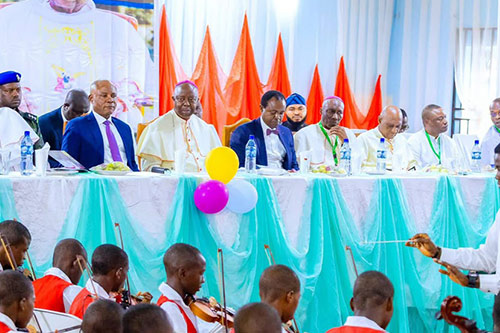
SAN Onuoma Urges Church to Advocate Justice, Not Partisan Politics
Ikechukwu Onuoma, SAN, Managing Partner of Obra Legal LP, recently urged the Catholic Church in Nigeria to actively promote good governance and defend human dignity without becoming a political party or seeking to dominate government.
This statement by a Senior Advocate of Nigeria carries significant legal and societal implications, highlighting the delicate balance between religious institutions' moral authority and their engagement in political affairs within Nigeria's secular framework. It underscores the importance for religious bodies to advocate for justice and human rights without crossing into partisan politics, thereby preserving their impartiality and moral standing. For legal practitioners, it emphasizes the constitutional principles governing the relationship between state and religion, and the boundaries of advocacy for non-state actors, particularly those with significant public influence.
The legal context is rooted in Nigeria's 1999 Constitution (as amended), which guarantees freedom of thought, conscience, and religion under Section 38, while also establishing Nigeria as a secular state. This implies that while religious bodies have the right to express views on governance and societal issues, they are generally expected to operate outside the direct partisan political arena. The Electoral Act and other relevant statutes regulate political party formation and participation, which typically exclude religious organizations. Onuoma's call aligns with the principle that civil society, including religious groups, can play a crucial role in promoting good governance and human rights, but must do so in a manner that respects the separation of powers and avoids direct political entanglement.
The key parties involved are Ikechukwu Onuoma, SAN, representing the legal profession and Obra Legal LP, and the Catholic Church in Nigeria, along with other religious leaders and institutions. The broader context includes the Nigerian government, political parties, and the general populace, all of whom are impacted by the interplay between religious influence and governance. The source, The Nigerian Lawyer, provides a platform for such legal and public interest discourse.
Attorneys advising religious organizations, non-governmental organizations, or civil society groups should carefully consider the implications of this perspective. They must guide their clients to engage in advocacy and public discourse in a manner that is consistent with constitutional provisions on secularism and freedom of religion, avoiding actions that could be interpreted as partisan political activity. This also serves as a reminder for lawyers involved in public interest litigation or human rights advocacy to understand the various stakeholders, including religious bodies, and their potential influence on policy and public opinion, while ensuring legal compliance.
How does this affect you?
Get an AI analysis of this article grounded in your jurisdictions, practice areas, and any policy documents you've uploaded to Wansom.
Finish Reading the Full Story and the Expert Analysis.
Wansom is AI and can make mistakes.