
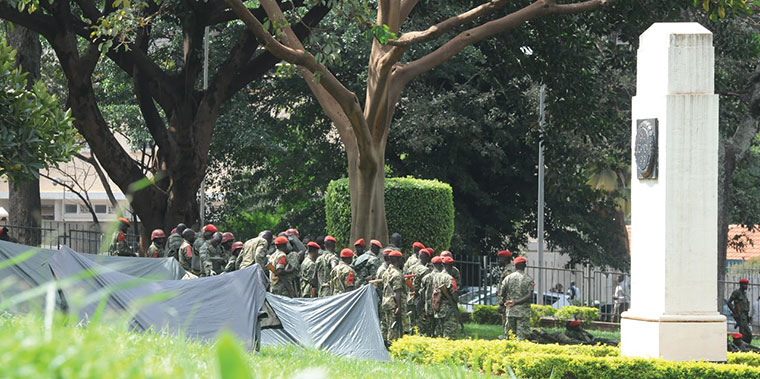
Attorney General Sam Mayanja: Government Backs Kampala City Square Redevelopment
Summary
- Attorney General Sam Mayanja has defended plans to redevelop Kampala's City Square.
- The justification for the redevelopment is that the public space has been taken over by suspected criminals.
- Mayanja stated that the square no longer serves its intended purpose as a recreational area for residents.
- Police personnel are reportedly forced to maintain a permanent presence at the square due to criminal activity.
What Happened
For legal professionals whose practice involves advising on urban development projects, public land use regulations, or property rights in Uganda, the Attorney General's unequivocal stance is particularly noteworthy.
Attorney General Sam Mayanja has publicly affirmed the government's support for the proposed redevelopment of Kampala's City Square. This prominent public space, situated in the heart of the Ugandan capital, is slated for a significant transformation, a move that the Attorney General argues is essential given its current condition. The government's endorsement of the Sam Mayanja Kampala City Square redevelopment signals a firm commitment to altering both the physical landscape and the functional utility of this key urban area.
Mayanja's defense of these plans is primarily based on the assertion that the square has been severely compromised, rendering it incapable of fulfilling its original purpose as a vibrant recreational hub for city residents. He specifically cited concerns that the area has become a gathering point for individuals suspected of criminal activities, thereby fundamentally undermining its intended role as a safe, accessible, and enjoyable public amenity. This official justification forms the cornerstone of the government's decision to move forward with a comprehensive overhaul of the City Square.
Official Justification
The Attorney General provided further details regarding the persistent challenges currently afflicting the City Square, placing particular emphasis on the pervasive issue of criminal elements. According to Mayanja, the consistent presence of suspected criminals has rendered the space largely unsuitable for its designated function as a recreational zone for the general populace of Kampala. This marked deterioration in public safety and usability has, in turn, necessitated a continuous and significant law enforcement presence within the square.
Mayanja explicitly noted that police personnel are regularly compelled to maintain a permanent watch over the area. This ongoing deployment of officers is a direct and necessary response to the persistent problems associated with criminal behavior, thereby underscoring the severity of the situation and the perceived inability of the space to function as intended without substantial security intervention. From the government's perspective, this level of constant police engagement is neither sustainable nor ideal for a public park, thus providing a compelling rationale for the proposed comprehensive redevelopment.
Implications for Urban Development
The government's decision to proceed with the Kampala public space redevelopment at City Square, strongly championed by Attorney General Sam Mayanja, carries significant and far-reaching implications for broader urban planning strategies and Uganda land use policy. The official justification, which centers on City Square criminal concerns and the erosion of its recreational purpose, suggests a potential paradigm shift in how public spaces are assessed, managed, and ultimately re-envisioned when confronted with issues of safety and functional utility. This particular initiative could very well establish a precedent for similar governmental interventions and transformations in other urban areas across Uganda that face comparable challenges.
For legal professionals whose practice involves advising on urban development projects, public land use regulations, or property rights in Uganda, the Attorney General's unequivocal stance is particularly noteworthy. It clearly signals a governmental willingness to redefine the parameters of public access and potentially undertake substantial land transformation when public safety and the intended use of a space are deemed to be critically compromised. This approach may lead to future legal challenges concerning public access rights or land acquisition processes in analogous contexts, making the Sam Mayanja Kampala City Square redevelopment a crucial case study for understanding the evolving landscape of urban development and public space management within the region. The initiative underscores the complex balance that must be struck between preserving essential public recreational areas and effectively addressing pressing urban security challenges, all within the overarching framework of national development objectives.
Practical Implications
Lawyers advising on urban development, public land use, or property rights in Uganda should note the Attorney General's strong stance on redeveloping Kampala City Square, which may signal a precedent for similar public space transformations and potential for future legal challenges regarding public access or land acquisition.
Source
How does this affect you?
Get an AI analysis of this article grounded in your jurisdictions, practice areas, and any policy documents you've uploaded to Wansom.
Finish Reading the Full Story and the Expert Analysis.
Get the latest legal & regulatory intelligence in Uganda
Wansom is AI and can make mistakes.