
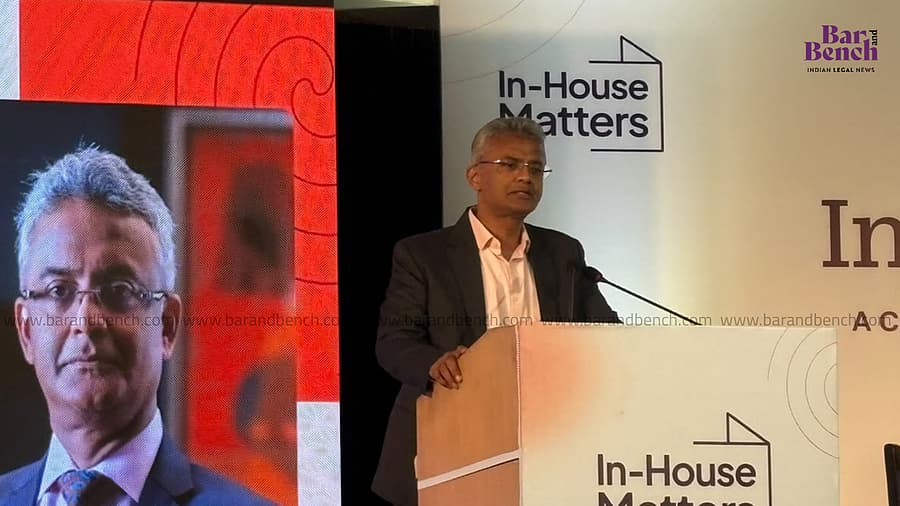
Sajan Poovayya: Challenges Supreme Court Economic Damage Scrutiny
Summary
- Senior Advocate Sajan Poovayya questioned the lack of scrutiny over the economic impact of Supreme Court judgments.
- He observed that judicial decisions are often viewed through the lens of legal progression, not their financial consequences.
- Poovayya highlighted a significant evolution in the role of general counsel, moving from legal permissibility to broader ethical considerations.
- General counsel are increasingly expected to act as "keepers of institutional morality."
- These remarks were made at the Delhi launch of "In-House Matters," a handbook for modern general counsel.
What Happened
The prevailing legal discourse, according to Poovayya, largely overlooks the financial repercussions of judicial decisions, focusing instead on the 'march of law' rather than their tangible economic consequences.
Senior Advocate Sajan Poovayya recently raised a critical question regarding the oversight of economic consequences stemming from Supreme Court judgments. Speaking in Delhi on Monday at the launch of "In-House Matters," a new handbook for modern general counsel, Poovayya highlighted a significant gap in legal discourse. He specifically questioned why the financial repercussions of judicial decisions, particularly in high-stakes commercial disputes involving governments and large corporations, receive such limited examination. This observation underscores a perceived deficiency in how the broader economic damage caused by Supreme Court rulings is assessed within the legal community.
Poovayya's remarks brought to light the often-unquestioned economic cost associated with Supreme Court judgments, even when these rulings have substantial implications for the national economy and major corporate entities. His intervention serves as a call for greater scrutiny of the India legal economic impact of judicial pronouncements, suggesting that the current framework for evaluating such decisions may be incomplete.
Evolving Legal Perspective
The prevailing legal discourse, according to Poovayya, largely overlooks the financial repercussions of judicial decisions, focusing instead on the 'march of law' rather than their tangible economic consequences. He specifically noted that there is currently little challenge to the Supreme Court regarding the financial impact or economic damage that its judgments might inflict. This perspective, he argued, stands in contrast to shifts observed in other areas of corporate law.
For instance, company directors are now expected to consider not only their strict legal duties but also the wider effects of their decisions on communities and the environment, indicating a move towards a more holistic assessment of corporate actions. This evolving standard in corporate governance suggests a precedent for extending similar comprehensive analysis to the economic cost of Supreme Court judgments, moving beyond mere legal permissibility.
The Role of General Counsel
The senior advocate further elaborated on the fundamental transformation in the role of a general counsel (GC) over the past few decades, a theme central to the "In-House Matters" book. This handbook, co-authored by Pramod Rao, Ritvik Lukose, and Balanand Menon, compiles the experiences of 30 leading general counsel across India, reflecting the evolving responsibilities within the profession. Poovayya explained that while 35 years ago the primary inquiry for a GC might have been "Is it permissible in law?", the contemporary question has evolved to "Should we do it?".
This shift signifies that GCs are increasingly becoming "keepers of institutional morality," with their mandate extending beyond mere legal permissibility to encompass broader ethical and strategic considerations. The "In-House Matters" book itself serves as a testament to this expanded role, emphasizing the general counsel's growing influence in guiding corporate decisions with a wider lens than purely legal compliance.
Broader Implications
This evolving mandate for general counsel, as described by Sajan Poovayya, suggests a growing expectation for legal professionals to consider the wider India legal economic impact of judicial and corporate decisions. The absence of rigorous scrutiny concerning the economic damage caused by Supreme Court judgments presents a challenge for legal practitioners, particularly GCs, who are now tasked with a more expansive advisory role. Their strategic input is increasingly vital in navigating not just legal compliance but also the broader societal and financial ramifications of institutional actions, including those influenced by Supreme Court judgments.
This highlights a need for legal professionals to proactively articulate and anticipate the economic cost associated with significant legal rulings. The discourse surrounding Supreme Court judgments economic cost must expand to include a thorough evaluation of their financial consequences, aligning with the modern general counsel's role as a strategic advisor focused on institutional morality and comprehensive impact assessment.
Practical Implications
Lawyers and compliance officers, particularly General Counsel, should anticipate and be prepared to articulate the economic implications of Supreme Court judgments, as the legal discourse increasingly demands scrutiny beyond mere legal permissibility. This reflects the evolving role of GCs as strategic advisors considering broader institutional and societal impacts.
Source
How does this affect you?
Get an AI analysis of this article grounded in your jurisdictions, practice areas, and any policy documents you've uploaded to Wansom.
Finish Reading the Full Story and the Expert Analysis.
Wansom is AI and can make mistakes.