
Sénégal PLFI 2027: Bourses Familiales Double to 140 Billion CFA
Summary
- Senegal's Projet de Loi de Finances Initiale (PLFI) 2027 projects a budget deficit of 1,351.7 billion CFA francs, representing 4.7% of GDP.
- The budget allocates 140 billion CFA francs for family security allowances in 2027, doubling the amount from the rejected 2026 rectifying bill.
- This social spending increase is part of broader priorities including health, education, infrastructure, and agricultural development.
- The PLFI 2027 follows a technical agreement with the International Monetary Fund for a $2.2 billion program from 2026 to 2029.
- Budgetary adjustments were made based on updated economic projections and a revised oil price assumption of $70 per barrel.
Senegal's Ambitious 2027 Budget Unveiled
The proposed budget significantly boosts social welfare, notably by doubling the allocation for family security allowances to 140 billion CFA francs in 2027, a measure set to benefit 1.649 million vulnerable households.
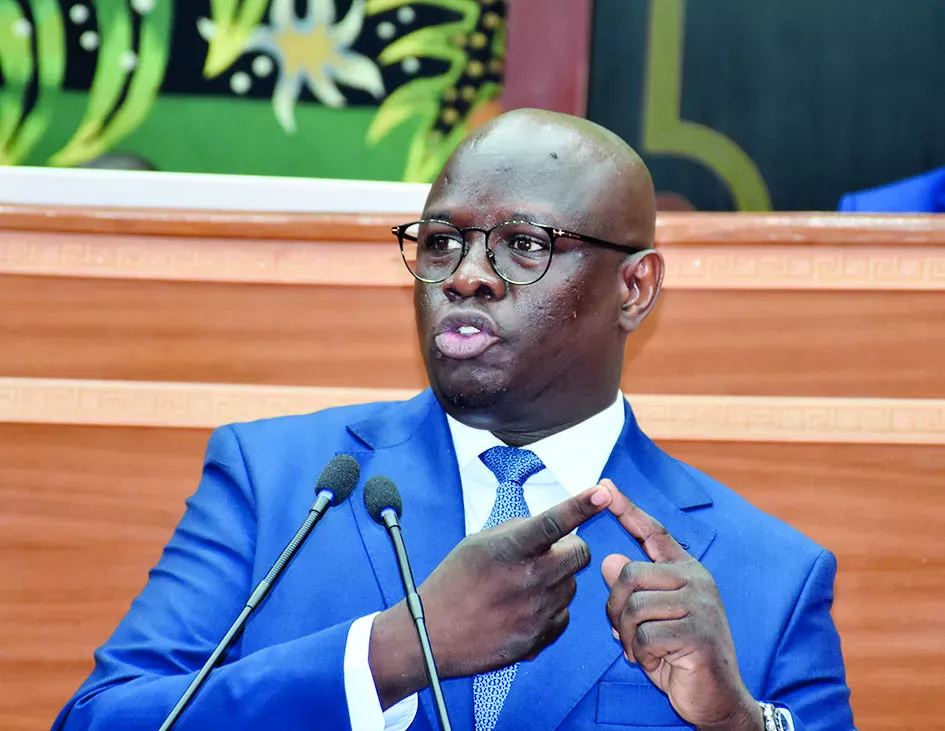
Senegal's proposed initial finance bill, known as the Projet de Loi de Finances Initiale (PLFI) 2027, was formally presented to the National Assembly on Wednesday, November 18, 2026, by Mady Danfakha, the general rapporteur for the Finance and Budget Control Commission. This comprehensive `budget Sénégal 2027` outlines a projected deficit of 1,351.7 billion CFA francs, which constitutes 4.7% of the nation's gross domestic product. The financial framework anticipates general budget revenues reaching 5,653.9 billion CFA francs, while total expenditures are estimated at 7,005.6 billion CFA francs.
Compared to the scenario outlined in the rejected 2026 rectifying finance bill (PLFR 2026), the PLFI 2027 projects a decrease in revenues by 137.2 billion CFA francs and a reduction in expenditures by 246.3 billion CFA francs. Notably, the primary deficit, which excludes debt interest payments, is set to significantly decline from 450 billion CFA francs in 2026 to just 47.7 billion CFA francs in 2027, representing 0.2% of GDP. Furthermore, the primary deficit excluding hydrocarbons is expected to fall to 1.5% of GDP, down from 2.8%, indicating a tightening of fiscal policy.
Significant Boost to Social Welfare and Development
A cornerstone of the `Sénégal PLFI 2027 bourses familiales` is a substantial increase in social welfare provisions. The allocation for family security allowances is set to reach 140 billion CFA francs in 2027. This represents a doubling of the 70 billion CFA francs initially considered in the rejected PLFR 2026 and a fourfold increase from the 35 billion CFA francs earmarked in the initial finance law for 2026. This expanded program is designed to support 1.649 million vulnerable households across the country.
Beyond `allocations familiales Sénégal 2027`, the `projet loi finances initiale Sénégal 2027` prioritizes several other critical sectors, including health, education, water and sanitation, transport, food sovereignty, and broader social protection. Key initiatives include the construction of five major hospitals, the continued expansion of universal health coverage, and efforts to bolster pharmaceutical sovereignty. In the water and sanitation sector, plans encompass 270 kilometers of water transfers, various local operations, and flood prevention programs. Infrastructure development features prominently with projects like the second Ziguinchor bridge, the Ouaki bridge, and a new railway line connecting Dakar to Tambacounda, alongside rural development and road improvement schemes. To enhance agricultural output and livestock, the government intends to implement program contracts for essential commodities such as rice, potatoes, onions, milk, and other livestock products. This agricultural push also includes establishing 100 community agricultural hubs and developing 320,000 hectares of hydro-agricultural land by 2029. Education reforms involve building 12 new schools, creating 15,000 connected classrooms, and advancing construction at universities in Eastern Senegal and Sine-Saloum.
Fiscal Adjustments and International Commitments
The `déficit budgétaire Sénégal 2027` and overall fiscal strategy are shaped by recent international agreements and updated economic forecasts. A technical agreement was reached between Senegal and the International Monetary Fund (FMI) on September 1, 2026, establishing a three-year `FMI Sénégal programme 2026-2029` valued at $2.2 billion, equivalent to approximately 1,243 billion CFA francs. This agreement is complemented by a debt treatment plan aimed at rescheduling repayment profiles and progressively reducing interest burdens.
Questions arose during commission discussions regarding comparisons with the previously rejected PLFR 2026. The government clarified that the assumptions underpinning the `Sénégal PLFI 2027` were based on updated projections compiled between June and October, reflecting economic realities distinct from those of the rectifying law. Furthermore, adjustments were made to the budget's oil price assumption. Initially set at $90 per barrel for the rectifying bill, this figure was revised to $70 per barrel following a protocol between Iran and the United States. The government had temporarily suspended the transmission of the text for 60 days, deeming it imprudent to proceed with the initial oil price hypothesis given the evolving geopolitical context, though these adjustments did not alter the fundamental budgetary balances of the initial project.
Practical Implications
Lawyers advising clients on public procurement, social welfare programs, or economic policy in Senegal should note the significant increase in family allowances and other social spending outlined in the PLFI 2027. This budget also details key infrastructure projects and agricultural initiatives, which may present opportunities or regulatory changes for businesses operating in these sectors. Compliance officers should monitor the implementation of these budgetary priorities for potential impacts on corporate social responsibility obligations or sector-specific regulations.
Source
Source: Original reporting via Rewmi
How does this affect you?
Get an AI analysis of this article grounded in your jurisdictions, practice areas, and any policy documents you've uploaded to Wansom.
Finish Reading the Full Story and the Expert Analysis.
Get the latest legal & regulatory intelligence in Senegal
Wansom is AI and can make mistakes.