
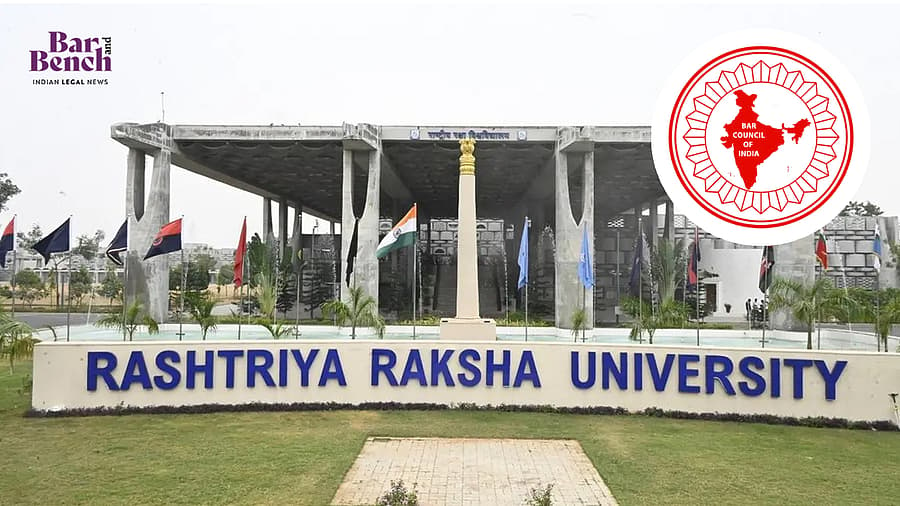
Rashtriya Raksha University: BCI Rules Violation Complaint Filed
Summary
- A student has filed a complaint against Rashtriya Raksha University's School of National Security and Law (SNSL) with the Bar Council of India (BCI).
- The complaint alleges "flagrant violation" of the BCI Rules of Legal Education, 2008, after internal remedies reportedly failed.
- The BCI had previously granted conditional approval in December 2023, requiring RRU to meet specific faculty and infrastructure mandates within six weeks.
- Key unmet conditions reportedly include the absence of full-time faculty and failure to upgrade the library and moot court facilities.
- SNSL is currently approved by the BCI for the 2026-27 academic session, despite these ongoing allegations.
Allegations Surface Against Rashtriya Raksha University
This situation underscores the Bar Council of India's active enforcement of legal education standards, which could influence the accreditation status of other law schools and the recognition of degrees.
A formal complaint has been lodged with the Bar Council of India (BCI) concerning the School of National Security and Law (SNSL) at Rashtriya Raksha University (RRU) in Gandhinagar. Filed by a student on August 31, the complaint targets the BCI's secretary, joint secretaries, and its Legal Education Committee, asserting that the law school is operating in "flagrant violation" of the BCI Rules of Legal Education, 2008. The student also indicated that all internal avenues for resolution within the university had been exhausted without success.
This BCI complaint SNSL non-compliance highlights significant concerns regarding the adherence to established legal education norms. The student's filing underscores a perceived systemic failure at the institution to meet the regulatory benchmarks set for legal academic programs, prompting an external review by the national legal education regulator.
Conditional Approval and Unmet Requirements
Despite the current allegations, the SNSL at RRU holds approval from the BCI's Legal Education Committee and is presently listed among the BCI's approved Centres of Legal Education (CLEs) for the academic session 2026-27. However, this approval history includes specific stipulations. Students have pointed out that a December 2023 approval letter, covering the academic sessions 2023-24 and 2024-25, outlined several conditions that RRU was mandated to fulfill. The university was required to submit a notarized compliance affidavit within a six-week timeframe following this communication.
The conditions stipulated by the BCI were comprehensive, addressing various aspects of academic infrastructure and faculty. These included the recruitment of full-time faculty members holding a minimum LL.M. qualification, compensated according to University Grants Commission (UGC) pay scales. Further requirements involved relocating the law library into the School of Law building and investing at least ₹5 lakh in new reference materials. The BCI also mandated the upgrade of the moot court facility with three crown chairs, to be overseen by a senior professor, and the establishment of a legal aid clinic in collaboration with the district legal services authority. Additionally, the university was directed to construct new classrooms, each capable of accommodating a minimum of 60 students.
According to the student's complaint, a substantial number of these crucial conditions remain unaddressed. A primary grievance cited is the absence of full-time faculty, with the entire teaching unit reportedly comprising contractual staff and no professors or senior professors employed in permanent positions. This alleged Rashtriya Raksha University accreditation issues could have serious implications for the institution's standing.
Enforcement of Legal Education Standards
This situation underscores the Bar Council of India's active enforcement of legal education standards, which could influence the accreditation status of other law schools and the recognition of degrees. The BCI Rules of Legal Education, 2008, serve as the foundational framework for ensuring quality and consistency across legal institutions nationwide. The complaint against RRU brings into sharp focus the BCI's role in monitoring compliance and upholding these critical norms.
The ongoing scrutiny of Rashtriya Raksha University BCI rules violation serves as a significant precedent for oversight within the legal education sector. Lawyers and compliance officers should closely observe such regulatory actions, as they establish benchmarks for institutional accountability and the rigorous application of the Bar Council of India legal education norms.
Practical Implications
This development underscores the Bar Council of India's active enforcement of legal education standards, which could influence the accreditation status of other law schools and the recognition of degrees. Lawyers and compliance officers should observe such regulatory actions as they establish precedents for oversight within the legal education sector.
Source
How does this affect you?
Get an AI analysis of this article grounded in your jurisdictions, practice areas, and any policy documents you've uploaded to Wansom.
Finish Reading the Full Story and the Expert Analysis.
Wansom is AI and can make mistakes.