
Project 39A: Indian Police Foundation MoU Bolsters Justice System
Summary
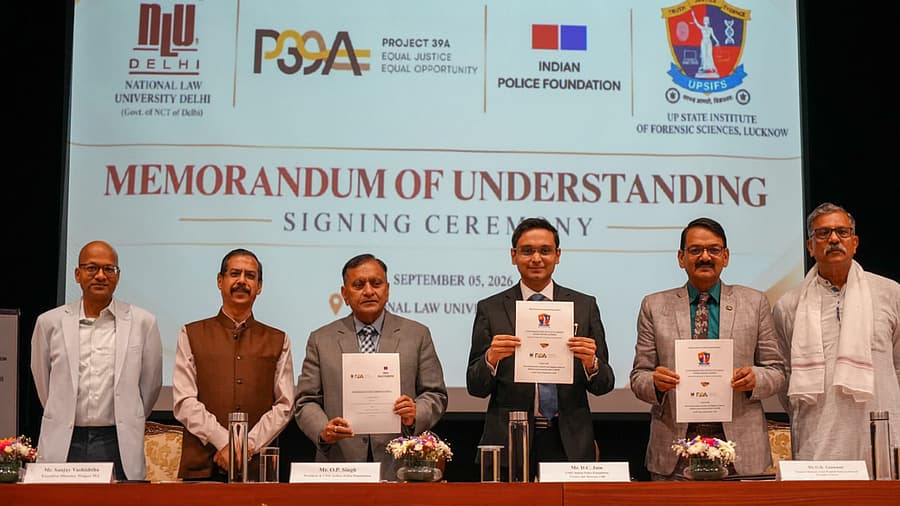
- Project 39A at National Law University Delhi (NLUD) signed a Memorandum of Understanding (MoU) with the Indian Police Foundation (IPF) and the Uttar Pradesh State Institute of Forensic Science (UPSIFS) on September 5.
- The pro-bono partnership focuses on research, capacity-building, professional training, and policy engagement to bridge law and forensic science.
- On the same date, Project 39A and IPF co-hosted a seminar titled "Disclosure and the Right to Fair Trial: An Expert Dialogue" with diverse legal and forensic professionals.
- The collaboration aims to produce joint research, publications, certificate programs, specialized training courses, and academic exchanges.
- These initiatives collectively seek to advance the constitutional vision of Article 39A by improving evidence disclosure and fair trial rights in India.
Key Collaboration for Legal and Forensic Science
By focusing on evidence disclosure and fair trial rights, the collaboration directly contributes to this foundational principle.
Project 39A, an initiative based at the National Law University Delhi (NLUD), has formalized a significant partnership by signing a Memorandum of Understanding (MoU) with the Indian Police Foundation (IPF) and the Uttar Pradesh State Institute of Forensic Science (UPSIFS). This pivotal agreement, inked on September 5, establishes a pro-bono framework designed to integrate legal scholarship with forensic scientific practice, aiming to bolster the justice delivery system in India.
The collaboration is built upon a shared commitment to several key areas: comprehensive research, robust capacity-building initiatives, specialized professional training, and proactive policy engagement. Through this multi-faceted approach, the partnership seeks to bridge the traditional divide between the legal and forensic science domains, fostering a more cohesive and effective approach to evidence and justice. The ultimate goal is to advance the constitutional vision articulated in Article 39A, which emphasizes equal justice and free legal aid.
According to a press release detailing the new alliance, the Project 39A Indian Police Foundation MoU and UPSIFS collaboration is set to yield a range of tangible outputs. These include the development of joint research projects and publications, the introduction of certificate programs, and the creation of specialized training courses. Furthermore, the agreement facilitates academic exchange between the participating institutions, promising a dynamic environment for learning and innovation in the fields of law and forensic science.
Dialogue on Disclosure and Fair Trial Rights
Coinciding with the MoU signing on September 5, Project 39A, in conjunction with the Indian Police Foundation, hosted a crucial seminar titled "Disclosure and the Right to Fair Trial: An Expert Dialogue." This event brought together a diverse group of stakeholders from across the legal and forensic spectrum, including defence counsel, police officials, prosecutors, judges, forensic experts, and academicians.
The seminar served as a vital platform for in-depth discussions surrounding the critical issue of evidence disclosure within the context of the Constitutional right to a fair trial. Participants engaged in a comprehensive analysis of existing systemic gaps that hinder effective disclosure practices. The dialogue aimed to identify and explore potential avenues for reform, seeking to enhance transparency and fairness in legal proceedings.
By convening such a broad array of experts, the seminar underscored the complex interplay between legal principles and practical enforcement. It highlighted the necessity of a collaborative approach to address challenges related to forensic evidence and its proper disclosure, ensuring that the rights of individuals are upheld throughout the judicial process. This focus on the Disclosure right to fair trial India is central to the broader objectives of the Project 39A UPSIFS collaboration.
Advancing Constitutional Vision and Forensic Science
The overarching aim of this partnership, particularly the Project 39A Indian Police Foundation MoU, is to further the constitutional vision embodied in Article 39A. This article mandates that the State shall secure that the operation of the legal system promotes justice on a basis of equal opportunity, and shall, in particular, provide free legal aid, by suitable legislation or schemes or in any other way, to ensure that opportunities for securing justice are not denied to any citizen by reason of economic or other disabilities. By focusing on evidence disclosure and fair trial rights, the collaboration directly contributes to this foundational principle.
Integrating the worlds of law and forensic science is a strategic move to enhance the quality of justice. The involvement of the Uttar Pradesh State Institute of Forensic Science ensures that the scientific aspects of evidence collection, analysis, and presentation are given due importance, while Project 39A's expertise from the National Law University Delhi partnership grounds these efforts in legal and constitutional frameworks. This synergy is expected to lead to more robust and reliable legal processes.
The commitment to joint research, specialized training, and academic exchange through this Project 39A UPSIFS collaboration signifies a long-term investment in improving India forensic science legal training. Such initiatives are crucial for equipping legal professionals and law enforcement with the necessary skills and knowledge to navigate the complexities of modern forensic evidence, ultimately strengthening the foundation of the justice system and upholding the integrity of fair trial rights.
Practical Implications
This collaboration between Project 39A, IPF, and UPSIFS aims to bridge law and forensic science, focusing on evidence disclosure and fair trial rights. Lawyers should monitor outputs from this partnership for potential new guidelines, research, or training programs that could influence the admissibility and interpretation of forensic evidence in Indian courts, impacting defence strategies and prosecution requirements.
Source
How does this affect you?
Get an AI analysis of this article grounded in your jurisdictions, practice areas, and any policy documents you've uploaded to Wansom.
Finish Reading the Full Story and the Expert Analysis.
Wansom is AI and can make mistakes.