
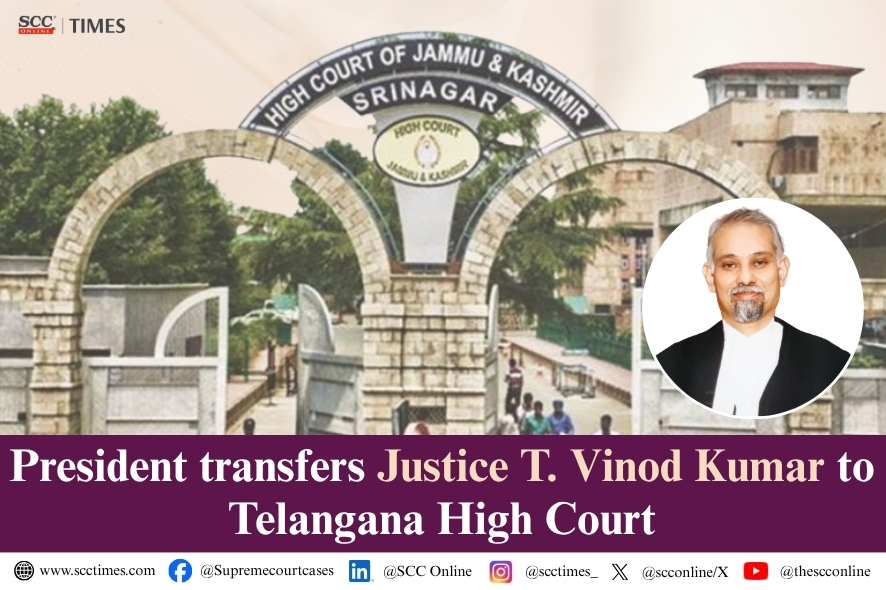
President Confirms: Justice T. Vinod Kumar Transfer to Telangana High Court
Summary
- Justice T. Vinod Kumar has been transferred to the Telangana High Court by presidential order.
- The Collegium recommended this transfer in September 2026.
- The move signifies Justice Kumar's return to his parent High Court.
- Judicial transfers are a standard part of India's legal system, initiated by the Collegium and formalized by the President.
- This transfer may impact bench compositions and case assignments at the Telangana High Court.
The Judicial Transfer of Justice T. Vinod Kumar
Lawyers practicing in the Telangana High Court should note this judicial transfer as it may impact bench compositions, case listings, or the assignment of specific matters, requiring them to be aware of changes in the court's judicial roster.
Presidential orders have confirmed the transfer of Justice T. Vinod Kumar to the Telangana High Court, marking a significant development in the judicial roster. This move sees Justice Kumar returning to his parent High Court, a common practice within the Indian judicial system that aims to align judges with their original jurisdictions or address specific court needs. The formal notification of this transfer follows a recommendation made by the Collegium, the apex body responsible for judicial appointments and transfers in India.
The Collegium's recommendation for Justice T. Vinod Kumar's transfer to the Telangana High Court was put forth in September 2026. This recommendation, once processed and approved, culminates in the President of India issuing the final order, thereby formalizing the judge's relocation. Such transfers are integral to the dynamic administration of justice across the country's various High Courts.
Understanding India's Judicial Transfer Process
The process of judicial transfers in India, such as the recent one involving Justice T. Vinod Kumar, is a multi-tiered mechanism designed to ensure the efficient functioning and impartiality of the judiciary. At its core, the Supreme Court Collegium, comprising the Chief Justice of India and four senior-most judges, initiates recommendations for the appointment and transfer of High Court judges. These recommendations are based on various considerations, including administrative requirements, the need to fill vacancies, and sometimes, requests from the judges themselves.
Once the Collegium makes a recommendation, it is forwarded to the central government for approval. Following the government's assent, the President of India, acting on the advice of the Union Cabinet, issues the final warrant of appointment or transfer. This structured approach underscores the constitutional framework governing judicial appointments and transfers, ensuring that such decisions are made through a consultative and authoritative process, impacting the composition and operational dynamics of High Courts across the nation.
Implications for the Telangana High Court
The return of Justice T. Vinod Kumar to the Telangana High Court carries several implications for the court's functioning and the legal community. His presence will undoubtedly contribute to the judicial strength of the High Court, potentially influencing the allocation of cases and the composition of various benches. Such changes are a regular feature of judicial administration and are designed to maintain judicial efficiency and address the evolving caseloads of different courts.
Lawyers practicing in the Telangana High Court should note this judicial transfer as it may impact bench compositions, case listings, or the assignment of specific matters, requiring them to be aware of changes in the court's judicial roster. The integration of a transferred judge into a High Court often leads to adjustments in the court's internal workings, which can, in turn, affect litigation strategies and case management for legal professionals.
Practical Implications
Lawyers practicing in the Telangana High Court should note this judicial transfer as it may impact bench compositions, case listings, or the assignment of specific matters, requiring them to be aware of changes in the court's judicial roster.
Source
Source: Original reporting via SCC Times
How does this affect you?
Get an AI analysis of this article grounded in your jurisdictions, practice areas, and any policy documents you've uploaded to Wansom.
Finish Reading the Full Story and the Expert Analysis.
Get the latest legal & regulatory intelligence in India
Wansom is AI and can make mistakes.