
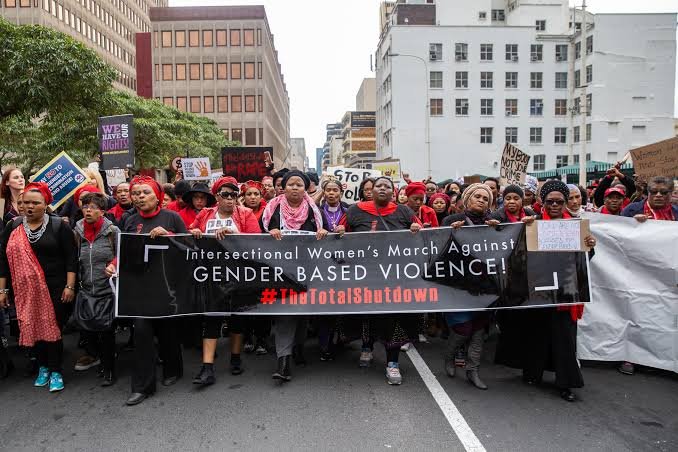
Picketers Outside City Hall Demand Safety for Women and Children
Summary
- Approximately 100 people protested outside Cape Town City Hall on Wednesday, demanding government action against femicide following recent murders in Kempton Park and Kraaifontein.
- President Cyril Ramaphosa declared gender-based violence and femicide (GBVF) a national disaster in November 2025 after widespread protests and a petition.
- The South African Police Service (SAPS) has stopped publishing disaggregated data on the murder of women and children in its quarterly crime reports.
- Parliament criticized SAPS in June 2025 for omitting this crucial data, stating it undermines efforts to assess violence and develop interventions.
- A South African Medical Research Council study found seven women are killed daily in South Africa, and hundreds of femicide dockets have gone missing over two decades.
Public Outcry Against Femicide
The absence of credible and complete data severely impedes efforts to accurately assess the scope of violence against women and children and to formulate effective, targeted interventions.
A recent silent protest outside Cape Town City Hall saw approximately 100 individuals gather to demand government action against femicide and gender-based violence. The demonstration on Wednesday was a direct response to the murders of eight women in and around Kempton Park since July, alongside the discovery of a ten-year-old girl's body in Kraaifontein on Monday. Participants, including 24-year-old Cape Town resident Selloane Jeminah Madonna, voiced strong criticism of police advice that women should exercise caution following the Kempton Park murders, asserting that women should not have to take precautions merely to exist.
Protesters conveyed their anguish through placards bearing messages such as "How many bodies?", "Leave us alone", and "Girls just want to live," with some participants symbolically taping their mouths shut. A moment of silence during the protest brought some women to tears. Madonna further underscored the gravity of the crisis by reading aloud the names of numerous femicide victims since 2017, notably Uyinene Mrwetyana, a UCT student whose August 2019 murder ignited nationwide #AmINext protests. Activists at the event reiterated calls for the presidency to directly address the ongoing femicide crisis.
Further demonstrating the widespread concern, Cape Town resident Thekiso Mokhele addressed a crowd outside Cape Town Central police station, urging men to confront violent behaviour among their peers. Mokhele implored men to cease protecting friends who commit violence, to stop ignoring such acts, and to challenge the notion that violence equates to strength. He expressed profound shame that women are compelled to learn self-protection, constantly consider their safety, and worry about their return home, emphasizing that such a reality should not be their burden.
A Deep-Rooted Crisis
For several years, there have been persistent demands for more stringent measures to combat gender-based violence and femicide (GBVF) across South Africa. Significant public demonstrations, such as the #TotalShutdown protests in 2018, highlighted widespread frustration and anger over escalating murder rates affecting women. More recently, thousands marched in Cape Town and Durban last year to seek justice following the rape of a seven-year-old child.
The severity of the situation led President Cyril Ramaphosa to declare GBVF a national disaster in November 2025, a decision prompted by extensive country-wide protests and a petition initiated by Women for Change. This declaration underscores the urgent need for comprehensive interventions. The scale of the crisis is starkly illustrated by a South African Medical Research Council (SAMRC) study, which analyzed two decades of femicide data and concluded that an average of seven women are killed every day in South Africa.
Critical Data Gaps Emerge
Compounding the challenges in addressing this crisis is the concerning **South Africa SAPS femicide data omission**. The South African Police Service (SAPS) has ceased publishing disaggregated data on the murder of women and children in its quarterly crime reports. This critical gap in **SAPS disaggregated crime reporting** has drawn significant **Parliamentary criticism SAPS crime data**.
In June 2025, Parliament publicly censured SAPS for excluding disaggregated data on crimes involving women and children, including murder, from the fourth-quarter crime statistics for 2024/25. Ian Cameron, chairperson of the parliamentary police portfolio committee, issued a statement expressing the committee's deep concern. He highlighted that the absence of credible and complete data severely impedes efforts to accurately assess the scope of violence against women and children and to formulate effective, targeted interventions. Furthermore, a recent report by Daily Maverick indicated that these vital statistics were also missing from SAPS reports detailing 2025/26 crimes.
Hindering Legal and Policy Efforts
The ongoing **South Africa SAPS femicide data omission** presents significant challenges for legal practitioners and **Femicide policy advocacy South Africa**. Without reliable and comprehensive **South Africa gender-based violence statistics**, it becomes exceedingly difficult to develop robust legal arguments, inform policy, and implement effective litigation strategies aimed at combating GBVF. The lack of transparent reporting undermines the ability of legal and advocacy groups to hold perpetrators accountable and push for systemic change.
Further exacerbating the issue, the aforementioned SAMRC study, which examined 20 years of femicide, also uncovered that hundreds of police dockets related to femicide cases have gone missing over two decades. This finding, coupled with the current data omission, paints a concerning picture of accountability and record-keeping within the justice system. The Trauma Centre, in a statement issued on September 16, condemned the Kempton Park and Kraaifontein murders, also highlighting systemic issues within SAPS. The statement conveyed the exhaustion of social workers who frequently encounter domestic violence victims being dismissed by SAPS, often told that assistance cannot be provided for a 'domestic issue,' or due to an alcohol problem, or that they must return a protection order to the area from which they fled their perpetrators. These systemic failures, compounded by the absence of credible data, severely hamper the effectiveness of legal and social interventions, despite the declaration of GBVF as a **GBVF national disaster legal implications**.
Practical Implications
The ongoing omission of disaggregated femicide and child murder data by SAPS, despite parliamentary criticism, creates significant challenges for legal practitioners in South Africa. This lack of credible data hinders effective legal advocacy, policy development, and litigation strategies aimed at combating gender-based violence.
Source
Source: Original reporting via GroundUp
How does this affect you?
Get an AI analysis of this article grounded in your jurisdictions, practice areas, and any policy documents you've uploaded to Wansom.
Finish Reading the Full Story and the Expert Analysis.
Get the latest legal & regulatory intelligence in South Africa
Wansom is AI and can make mistakes.