
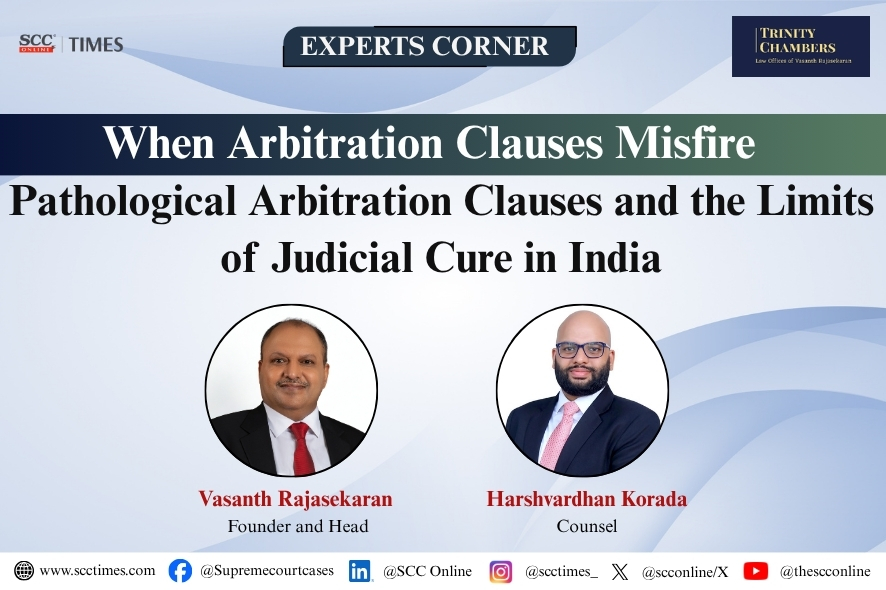
Indian Courts: Pathological Arbitration Clauses India Judicial Cure Has Limits
Summary
- Pathological arbitration clauses in India are fundamentally flawed agreements that can render dispute resolution mechanisms ineffective.
- Indian courts, while generally supportive of arbitration, have limited power to rectify these defective clauses through judicial intervention.
- The principle of party autonomy restricts courts from rewriting or supplying essential terms missing from an arbitration agreement.
- Unenforceable arbitration clauses often force parties into traditional litigation, defeating the purpose of alternative dispute resolution.
- Legal practitioners must meticulously draft arbitration clauses to ensure clarity, completeness, and enforceability, thereby mitigating risks.
Understanding Pathological Arbitration Clauses
This underscores the critical need for lawyers to meticulously draft arbitration clauses in India, as courts may not always intervene to cure 'pathological' defects, potentially rendering dispute resolution mechanisms ineffective.
The issue of arbitration clauses that fail to function as intended, often termed "pathological," presents a significant challenge within the Indian legal landscape. Legal scholars Vasanth Rajasekaran and Harshvardhan Korada have explored this critical area, shedding light on the inherent limitations faced by Indian courts when attempting to rectify such fundamentally flawed agreements. These defective arbitration clauses India often arise from imprecise language, internal contradictions, or a failure to designate a workable arbitral institution or process, ultimately jeopardizing the enforceability of the entire dispute resolution mechanism.
Such clauses, despite parties' intentions to resolve disputes outside traditional litigation, can inadvertently lead to further court battles over the very validity of the arbitration agreement itself. This defeats the primary purpose of arbitration, which is to provide an efficient and expeditious alternative to judicial proceedings. The authors' insights underscore a crucial point for legal practitioners: the initial drafting of an arbitration clause is paramount, as judicial intervention arbitration India has its boundaries, particularly when confronted with deeply flawed provisions.
The Legal Framework and Judicial Restraint
In India, the enforceability of arbitration agreements is primarily governed by the Arbitration and Conciliation Act, 1996, which largely espouses principles of party autonomy and minimal judicial intervention. While Indian courts generally strive to uphold the spirit of an arbitration agreement and facilitate dispute resolution, there are clear limits to their power to cure pathological arbitration clauses India judicial cure. The judiciary's role is typically to interpret and enforce agreements as they stand, not to rewrite them or supply missing essential terms that the parties themselves failed to define.
This judicial restraint stems from the foundational principle that arbitration is a creature of contract; its scope and procedure are derived from the mutual consent of the parties. When an arbitration clause is so vague, ambiguous, or contradictory that it becomes unworkable, courts face a dilemma. Overly expansive judicial intervention could be seen as imposing an agreement on parties that they did not explicitly consent to, thereby undermining the consensual nature of arbitration. Consequently, the interpretation of arbitration law India often leans towards upholding clear agreements, while struggling with those that are fundamentally flawed.
The Limits of Judicial Cure
The concept of a "judicial cure" for defective arbitration clauses India is not without its boundaries in India. While courts may, in certain circumstances, interpret ambiguous terms to give effect to the parties' clear intention to arbitrate, they are generally reluctant to step in when the clause is fundamentally unworkable or lacks essential elements. For instance, if an arbitration clause fails to specify the number of arbitrators, the seat of arbitration, or the procedure for appointment in a manner that can be reasonably inferred or supplemented, courts may declare it unenforceable. This highlights that the judicial cure for pathological arbitration clauses India is not a panacea.
The implications of such unenforceability are significant, often forcing parties back into conventional litigation, which is precisely what they sought to avoid. This underscores the critical need for lawyers to meticulously draft arbitration clauses in India, as courts may not always intervene to cure 'pathological' defects, potentially rendering dispute resolution mechanisms ineffective. The judiciary's role is to facilitate arbitration, not to construct it entirely from a deficient foundation.
Practical Imperatives for Drafting
The analysis presented by Rajasekaran and Korada implicitly serves as a stark reminder for legal professionals involved in drafting arbitration clauses India. To ensure arbitration agreement enforceability India, practitioners must move beyond boilerplate language and meticulously craft clauses that are clear, unambiguous, and comprehensive. This includes precisely defining the scope of disputes, the number and qualifications of arbitrators, the method of their appointment, the seat and venue of arbitration, and the governing law.
Practitioners should review existing and future agreements to ensure clauses are robust and enforceable, mitigating the risk of unenforceability. A well-drafted clause anticipates potential ambiguities and provides clear mechanisms for dispute resolution, thereby minimizing the need for judicial intervention arbitration India. The ultimate goal is to create a self-executing mechanism that can withstand scrutiny and effectively serve its purpose, rather than relying on courts to mend fundamental drafting errors.
Practical Implications
This article highlights the critical need for lawyers to meticulously draft arbitration clauses in India, as courts may not always intervene to cure 'pathological' defects, potentially rendering dispute resolution mechanisms ineffective. Practitioners should review existing and future agreements to ensure clauses are robust and enforceable, mitigating the risk of unenforceability.
Source
How does this affect you?
Get an AI analysis of this article grounded in your jurisdictions, practice areas, and any policy documents you've uploaded to Wansom.
Finish Reading the Full Story and the Expert Analysis.
Get the latest legal & regulatory intelligence in India
Wansom is AI and can make mistakes.