

Owning a Foreign Company: Legal Intelligence Guide for U.S. Citizens
What's Included in this Legal Intelligence Brief
✓ Key differences between common foreign-company structures
✓ U.S. reporting obligations that can arise from foreign-company ownership
✓Real-time country-specific regulatory intelligence across 40+ jurisdictions
✓ How foreign bank accounts and investments can create separate reporting requirements
✓ How U.S. requirements interact with local-country obligations
Establishing or acquiring an overseas operating business, holding company, or foreign subsidiary is a standard strategic milestone for expanding U.S. tech enterprises, multinational operators, and private investors. Whether scaling a regional sales entity in the UK, establishing an engineering and operational hub in Kenya or Singapore, or launching an EU distribution vehicle, offshore legal entities unlock operational efficiency and regional market access.
However, the United States exercises extraterritorial, citizenship-based tax and regulatory requirements that operate largely independent of where an entity is organized, where revenue is collected, or whether earnings are repatriated.
For U.S. citizen shareholders, officers, or directors, an overseas company cannot be treated as an isolated offshore box. Without proactive cross-border engineering, founders risk taxable deemed liquidations, phantom anti-deferral liabilities, and severe information return penalties.
1. Formation & Entity Classification: The "Check-the-Box" Rules
When establishing a foreign entity such as a UK Private Limited Company (Ltd), a Singapore Private Limited Company (Pte. Ltd.), a German Gesellschaft mit beschränkter Haftung (GmbH), or a Kenyan Limited Company (Ltd), local corporate law establishes liability protection, share capital, and director fiduciary duties.
U.S. federal tax law, however, classifies the entity independently under the Treasury Regulation § 301.7701 "Check-the-Box" (CTB) rules.
Foreign Classification Category | Common Foreign Entity Types | Default U.S. Tax Characterization | Elective Classification (Form 8832) |
"Per Se" Corporations | UK Public Limited (Plc), French Société Anonyme (S.A.), German Aktiengesellschaft (AG) | Corporation (C-Corp) per se under Treas. Reg. § 301.7701-2(b)(8) | Ineligible for pass-through treatment; treated irrevocably as a corporate entity. |
Eligible Entities (All members have limited liability) | UK Ltd, Singapore Pte Ltd, German GmbH, Kenyan Ltd, Dutch B.V. | Association Taxable as a Corporation | Can elect to be treated as a Disregarded Entity (if single-member) or Partnership (if multi-member). |
Eligible Entities (At least one member has unlimited liability) | General partnerships, unlimited liability companies | Pass-Through Entity (Partnership or Disregarded Entity) | Can elect to be taxed as an Association Taxable as a Corporation. |
The Form 8832 Strategy & Timing Constraints
Filing IRS Form 8832 allows an eligible entity to override default corporate status and achieve pass-through treatment:
The 75-Day Retroactive Window: Form 8832 can take effect up to 75 days before the filing date. If the election is not executed within 75 days of initial foreign entity formation, the default corporate classification attaches automatically.
The Deemed Liquidation Hazard: Attempting to "check the box" on an existing foreign corporation that has operated for several years triggers a deemed corporate liquidation under IRC § 332 or § 331. This can cause immediate taxable capital gains on built-in asset appreciation, even though no actual shares or assets were sold.
The SECA Tax Trade-Off: Electing Foreign Disregarded Entity (FDE) status avoids corporate anti-deferral regimes (GILTI/Subpart F), flowing active business revenue directly to the founder's Form 1040. However, this active income may become subject to U.S. self-employment tax (SECA) unless shielded by an applicable bilateral Totalization Agreement.
2. IP Migration & The IRC § 367 Capitalization Trap
A common structural error made by early-stage tech founders expanding internationally is incorporating a foreign operating company and informally assigning software code, digital platforms, trademarks, or customer contracts to the foreign vehicle without formal transfer pricing agreements.
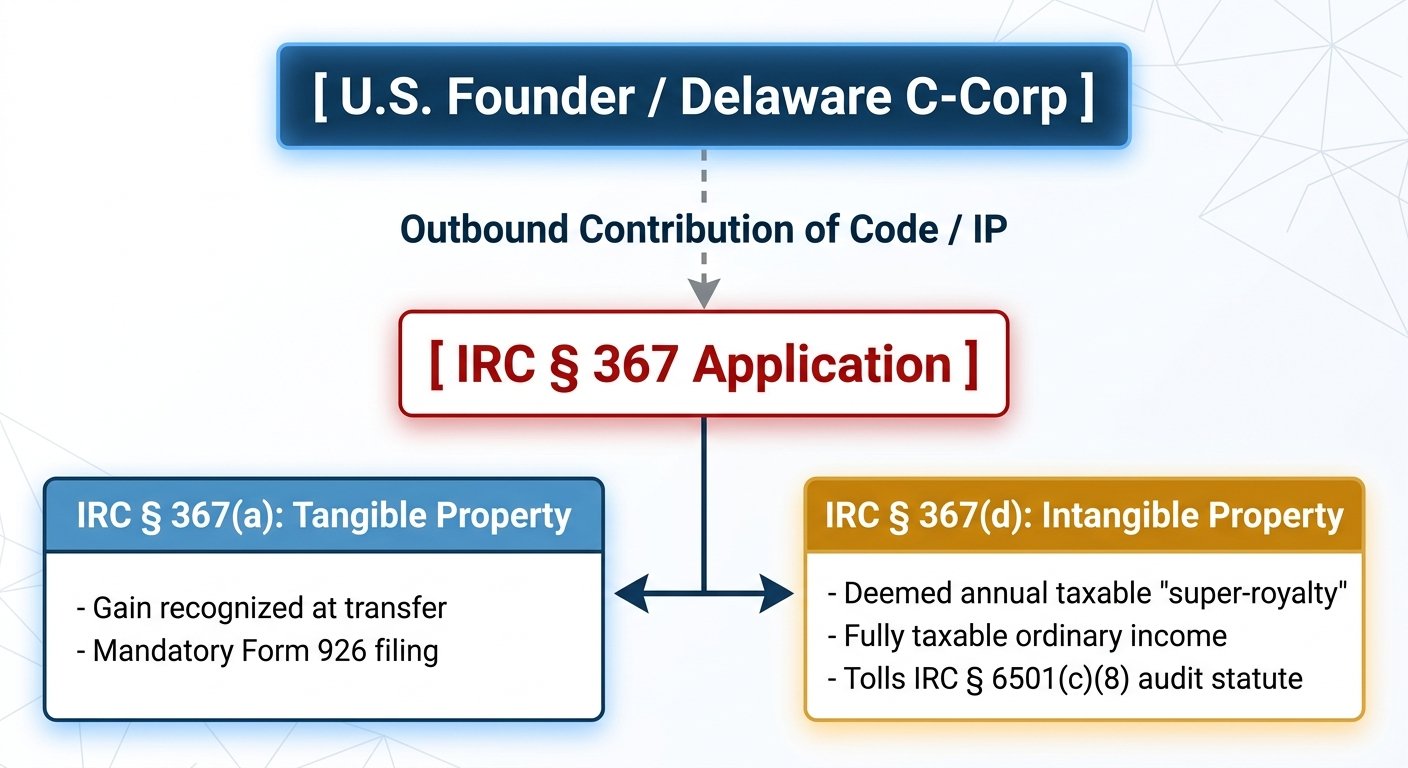
The Section 367(d) Deemed "Super-Royalty"
Under IRC § 367(d), contributing intellectual property (including source code, patents, domain assets, customer lists, and workforce-in-place) to a foreign corporation in a non-recognition transaction (such as a Section 351 share capital subscription) is treated as a taxable outbound sale.
The U.S. transferor is treated as receiving a continuous, contingent annual royalty over the useful life of the intangible asset. This phantom income is taxable as ordinary income and must be "commensurate with the income" generated by the intangible abroad.
Cross-Border IP Structuring Alternatives
To prevent unexpected Section 367(d) toll charges:
Arm's-Length IP Licensing: The U.S. parent or founder retains IP ownership domestically and licenses foreign commercialization rights to the foreign subsidiary under an OECD-compliant intercompany license agreement.
Qualified Cost Sharing Arrangements (CSAs): The foreign operating affiliate funds its proportionate share of ongoing R&D expenses under Treasury Regulation § 1.482-7, securing economic co-ownership of foreign IP rights before value is created.
Contemporaneous IRC § 6038B Reporting: Any property transferred outbound to a foreign corporation must be reported on Form 926. Failure to file triggers a penalty equal to 10% of the fair market value of the transferred property (capped at $100,000 unless the failure is intentional) and suspends the assessment statute of limitations indefinitely.
3. Anti-Deferral Realities: Controlled Foreign Corporations (CFCs)
When one or more U.S. citizens hold a significant stake in a foreign corporation, the company frequently qualifies as a Controlled Foreign Corporation (CFC) under IRC § 957. A CFC is any foreign corporation where U.S. shareholders (U.S. citizens or domestic entities holding 10% or more of voting power or stock value) collectively own more than 50% of the total combined voting power or value.
The Downward Attribution Trap
Following the Tax Cuts and Jobs Act (TCJA) repeal of IRC § 958(b)(4), stock owned by a foreign parent or foreign investor is attributed "downward" to its domestic subsidiaries or U.S. affiliates.
Practical Impact: If a foreign holding group owns a U.S. subsidiary and a foreign operating company, the foreign operating company can be converted into a CFC overnight by statutory attribution, subjecting minority U.S. citizen co-founders to complex CFC reporting and income inclusions, even though they hold zero direct voting control over the foreign company.
Subpart F Income vs. GILTI
Subpart F (IRC §§ 951–954): Subjects passive income (dividends, interest, rents, royalties) and foreign base company sales/services income to immediate U.S. tax at ordinary individual income rates, eliminating corporate deferral.
Global Intangible Low-Taxed Income (GILTI - IRC § 951A): Captures operational earnings exceeding a routine 10% return on tangible depreciable assets (Qualified Business Asset Investment, or QBAI). Active earnings are pulled into the U.S. owner's personal tax return annually.
Evaluating the IRC § 962 Corporate Tax Election
Individual U.S. shareholders face ordinary personal income tax rates on GILTI inclusions without the benefit of the Section 250 deduction (which provides domestic corporate shareholders an effective 10.5% rate) or indirect foreign tax credits (IRC § 960).
The Remedy: Filing an election under IRC § 962 allows an individual U.S. shareholder to be taxed on Subpart F and GILTI inclusions at corporate income tax rates (21%), while accessing the deemed-paid foreign tax credits under Section 960.
The Structural Catch: Section 962 is an accounting balancing act, not a silver bullet. Under IRC § 962(d), when the CFC subsequently distributes its actual retained earnings as cash dividends, those distributions are taxed a second time as dividend income, minus the tax already paid under the 962 inclusion. Detailed earnings and profits (E&P) basis tracking is essential to avoid double domestic taxation upon exit.
4. Multi-Layer Information Return Matrix
Information filing obligations apply even when an overseas company operates at a net loss or reinvests its operating capital entirely in regional operations.
IRS / Treasury Form | Statutory Filing Trigger | Responsible U.S. Party | Legal Exposure / Failure Penalties |
Form 5471 (Foreign Corporations) | Acquisition of ≥10% equity, holding a directorship when a U.S. person acquires 10%, or controlling a CFC. | Category 1–5 filers (shareholders, officers, directors). | $10,000 fine per form/year; continuation penalties up to $50,000; indefinite tolling of the three-year statute of limitations under IRC § 6501(c)(8). |
Form 8858 (Foreign Disregarded Entities / Branches) | Direct or indirect ownership of an FDE or foreign operational branch. | Direct tax owner or parent CFC. | $10,000 penalty per entity; loss of foreign tax credits. |
Form 8865 (Foreign Partnerships) | Controlling a foreign partnership (>50%) or contributing >$100,000 in assets within 12 months. | Category 1–4 partners. | $10,000 penalty, plus 10% of contributed property value (up to $100,000 unless willful). |
Form 8621 (PFIC) | Holding equity in a foreign company with ≥75% passive income or ≥50% passive assets. | Direct or indirect U.S. shareholders. | Confiscatory taxation under excess distribution rules; loss of capital gains rates; tolls assessment statute of limitations. |
5. Foreign Bank Accounts & Offshore Asset Disclosures
Corporate financial accounts maintained with foreign commercial banks trigger independent reporting obligations governed by the Bank Secrecy Act (Title 31) and the Internal Revenue Code (Title 26).
FinCEN Form 114 (FBAR) Signature Authority Rules
Under 31 C.F.R. § 1010.350, any U.S. citizen who holds signature or dispositive authority over a foreign financial account must report that account annually on FinCEN Form 114 if the aggregate balance across all foreign accounts exceeds $10,000 at any point during the calendar year.
The Executive Exposure: A U.S. citizen managing director, CFO, or authorized signatory who holds 0% equity in a foreign company must still file an FBAR disclosing corporate bank accounts under their operational control.
Penalties: Civil penalties for non-willful non-disclosure exceed $16,000 per violation (indexed annually for inflation). Willful violations trigger civil fines equal to the greater of $100,000 or 50% of the account balance, alongside criminal exposure.
IRS Form 8938 (FATCA) Coordination
Separately from the FBAR, direct owners of foreign stock and securities must disclose their holdings on IRS Form 8938, attached to Form 1040, subject to reporting thresholds ranging from $50,000 to $400,000 depending on marital status and tax residency.
6. U.S. Operational Nexus & Foreign-Country Interplay
Expanding operations abroad requires managing the friction points where foreign company law intersects with U.S. tax jurisdiction.
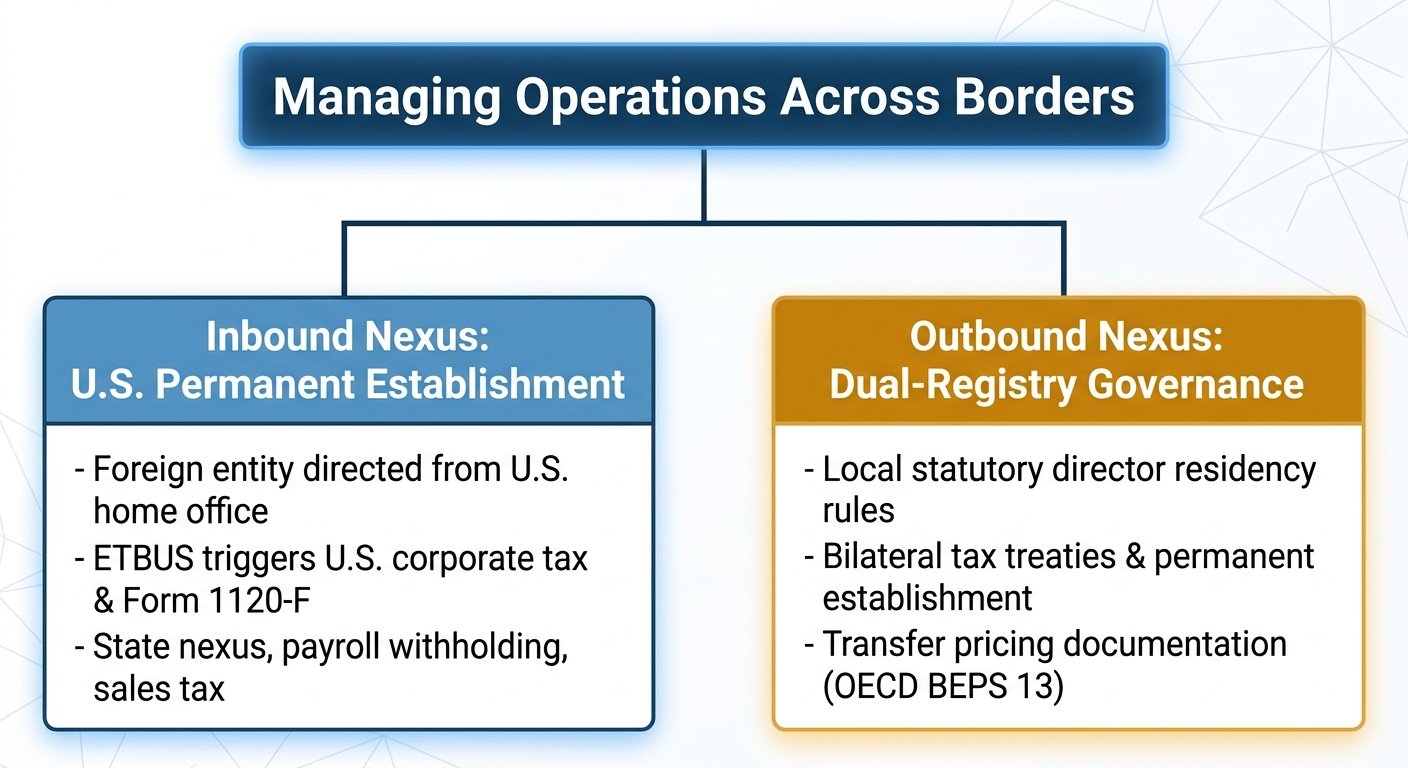
The Inbound U.S. Permanent Establishment Exposure
When an executive manages a foreign company's commercial operations from a home office within the United States, that activity can inadvertently create a U.S. Permanent Establishment (PE) or establish that the entity is Engaged in a Trade or Business within the United States (ETBUS).
The Tax Consequence: Revenue attributable to U.S.-based operational decisions becomes effectively connected income (ECI), subjecting the foreign entity to U.S. corporate income tax (21%), state corporate income tax, and potentially a 30% Branch Profits Tax under IRC § 884, requiring the foreign company to file a protective Form 1120-F.
Cross-Border Transparency & Corporate Registers
International compliance requires navigating local disclosure mandates alongside U.S. financial reporting:
Beneficial Ownership Transparency: While FinCEN's 2026 administrative rule updates permanently exempt domestic entities and U.S. persons from initial and ongoing BOI reporting, foreign reporting companies registered to do business in a U.S. state remain subject to FinCEN BOI filings.
Foreign Local Registers: Conversely, overseas jurisdictions enforce mandatory public disclosure. The UK Companies House Register of People with Significant Control (PSC), Singapore’s ACRA Register of Registrable Controllers (RORC), and regional African company registries impose local filing requirements that must align with IRS and FinCEN disclosures.
7. Strategic Action Checklist for Cross-Border Structuring
Classify Before Incorporation: Determine the optimal tax posture (CFC vs. FDE vs. Foreign Partnership) and execute Form 8832 within the 75-day statutory window to avoid deemed liquidations.
Execute Intercompany Agreements: Document cross-border IP licensing, technical support, and management services under arm's-length transfer pricing standards to insulate the company against IRC § 367(d) recharacterizations and OECD transfer pricing audits.
Formalize Cross-Border Board Protocols: Establish clear governance protocols detailing where executive decisions are reached and contracts executed, mitigating dual-tax residency or inadvertent U.S. Permanent Establishment exposure.
Coordinate Officer Signature Filings: Maintain an internal corporate log of all foreign financial accounts, tracking bank balances monthly to support FinCEN Form 114 (FBAR) and FATCA filings for equity holders and executive signatories.
Get Cross-Border Legal Intelligence
The Leading businesses and cross-border legal teams trust Briefly for real-time legal and regulatory intelligence whether expanding into or operating across 40+ countries
Access our full cross-border database: Subscribe to our intelligence platform for detailed jurisdiction guides, statutory filing trackers, and model intercompany agreements.
Finish Reading the Full Story and Expert Analysis.
Get the latest legal & regulatory intelligence in United States
Wansom is AI and can make mistakes.