
Oregon police officers lobby Ninth Circuit for immunity in wrongful conviction case
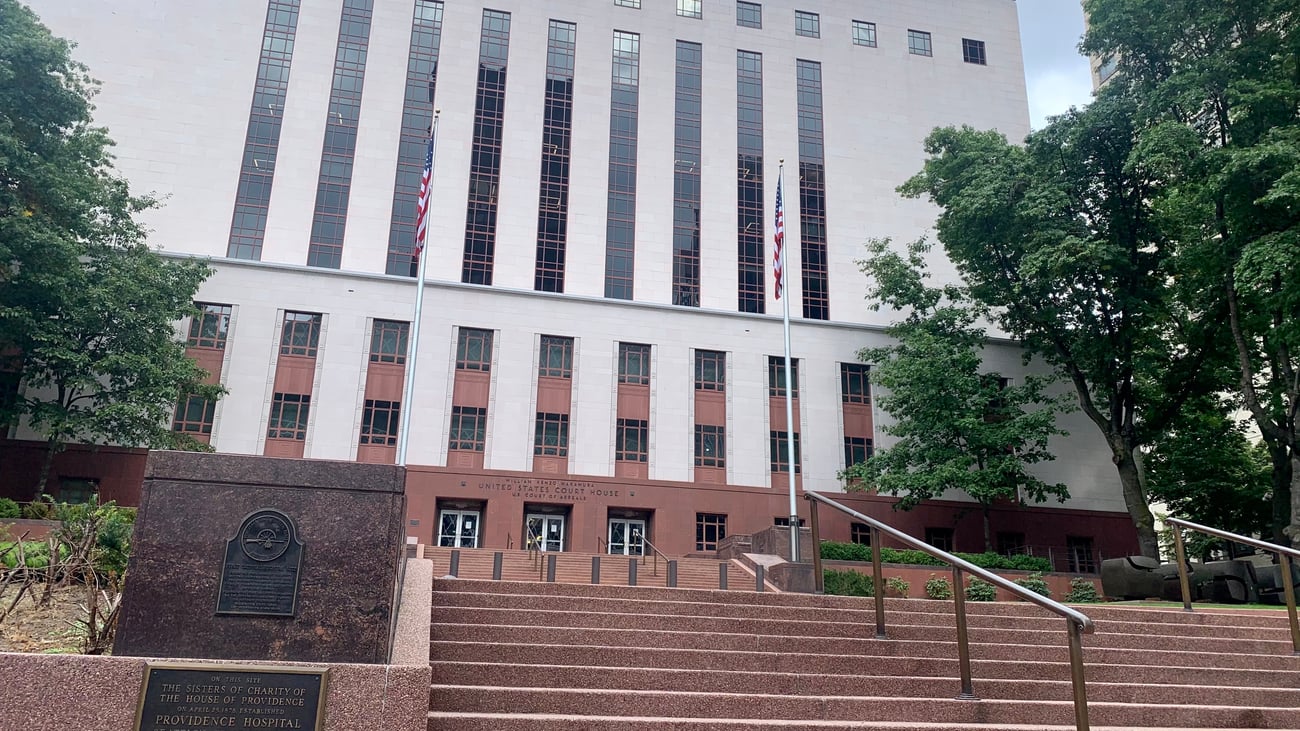
Nicholas McGuffin sued law enforcement after spending years in prison for a crime he did not commit. The U.S. Court of Appeals for the Ninth Circuit in Seattle. (Barbara Leonard/Courthouse News) SEATTLE (CN) — A Ninth Circuit panel will decide whether Oregon police officers accused of fabricating evidence to secure a manslaughter conviction in a murder cold case that was later overturned are entitled to qualified immunity. “The fact that on the actual evidence presented to the court, the inference that those statements were fabricated is completely contradicted by every piece of evidence in the record,” said Sarah Henderson, attorney representing the police, at a Ninth Circuit hearing Thursday. Fifteen-year-old Leah Freeman disappeared in June 2000 in Coquille, Oregon. Less than two months after her disappearance, Freeman’s decomposed remains were found down a steep river embankment around 9 miles from her hometown. The case went cold for nearly a decade until a Coos County jury found Nicholas McGuffin — Freeman’s boyfriend at the time of her disappearance — guilty of her death in 2011. In 2019, his conviction was overturned based on the finding that law enforcement had withheld key information, like unidentified male DNA evidence that the Oregon State Police crime lab had not reported. McGuffin received the state’s first-ever court-issued certificate of innocence last year. In 2020, McGuffin sued Oregon police in federal court, accusing individual officers of fabricating evidence to secure a conviction and depriving his daughter of time with her father while he was wrongfully imprisoned. The police officers moved for summary judgment, arguing they were entitled to qualified immunity, but a federal judge found there was enough evidence for a jury to find in McGuffin’s favor and denied the motion. Before the Ninth Circuit, the police officers argued there wasn’t enough evidence, but the Ninth Circuit panel was skeptical it could step in. The appeals court can’t review “garden variety of the he said, she said, varied facts” while the underlying case is proceeding, noted U.S. Circuit Judge Margaret McKeown, a Bill Clinton appointee. “We don’t have jurisdiction over sufficiency of the evidence,” said U.S. Circuit Judge Morgan Christen, a Barack Obama appointee. “ In general, our jurisdiction in this kind of an appeal is very thin. But I read your arguments much the way Judge McKeown reads them, where you’re really going to ask us to revisit the finding itself — We can’t do that.” The police officers argued there wasn’t enough evidence to tie all four to McGuffin’s claims, particularly that they had destroyed or fabricated evidence and the appellate panel appeared to agree, parsing out the details of what each police officer was accused of not disclosing. But McGuffin argued the police officers never made any specific citations to the lengthy record to support their arguments. “What the district court here is doing is providing examples of misconduct,” said David Owens, attorney representing McGuffin. “The district court does have a conclusion that a jury can find that each of the defendants who are now here on appeal participated in the violation of McGuffin’s rights, and in the context of this case and this type of an opinion, that’s sufficient.” McGuffin also argued the appeal should be dismissed because the police were attempting to use it as an avenue to challenge the facts of the case. “The way they’re framing those issues is actually disputing the facts,” Owens said. “Asking whether the trial court should have cited more things from this 10,000-page record about that specific fact issue is exactly why this court lacks jurisdiction.” As for McGuffin’s daughter’s claim that she had been deprived of familial association while her father was incarcerated, the police officers argued it should be dropped since the daughter was born in 2007 — years after the underlying investigation in which McGuffin a
How does this affect your business?
Get an AI analysis of this article grounded in your jurisdictions, practice areas, and any policy documents you've uploaded to Wansom.
Wansom is AI and can make mistakes.