
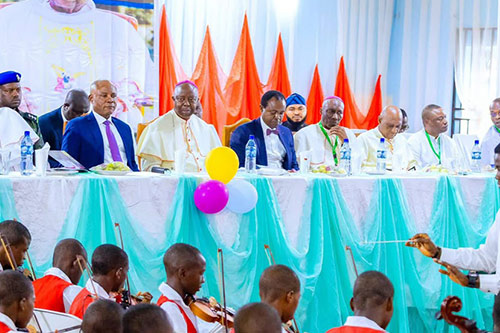
Onuoma SAN: Church Political Involvement Must Avoid Partisan Politics
Summary
- Ikechukwu Onuoma, SAN, urged the Catholic Church to actively promote good governance and defend human dignity.
- The Senior Advocate emphasized that the Church should confront injustice without becoming a tool for political parties.
- Onuoma, the Managing Partner of Obra Legal LP, stated the Church should not seek to dominate government.
- He maintained that the Church's responsibility is to speak truth to power while maintaining political neutrality.
A Legal Perspective on Church Engagement
Ikechukwu Onuoma, SAN, emphasized that the Church’s fundamental duty involves challenging authority and advocating for societal well-being, while carefully avoiding direct partisan alignment or attempts to control governmental functions.
Ikechukwu Onuoma, SAN, a distinguished Senior Advocate of Nigeria and the Managing Partner of Obra Legal LP, has articulated a clear stance on the appropriate role of the Catholic Church in national affairs. Onuoma SAN called upon the institution to maintain an active presence in fostering sound governance, upholding human dignity, and confronting societal injustices. His counsel underscores a nuanced approach to the Church's influence, advocating for its engagement without crossing into partisan politics.
Onuoma's statement emphasizes that while the Church has a vital responsibility to "speak truth to power," this mandate must be exercised without transforming the religious body into a political party itself. This perspective highlights a delicate balance, where the Church can champion ethical leadership and social welfare without becoming an instrument for specific political factions or seeking to dominate governmental structures. His insights contribute to the ongoing discourse surrounding Onuoma SAN Church political involvement.
Defining the Boundaries of Influence
The Senior Advocate's remarks delineate critical boundaries for religious institutions operating within the political landscape. He firmly maintained that the Catholic Church's involvement should not lead to it becoming a tool for political parties, nor should it aim to seize control of government functions. This distinction is crucial for preserving the Church's moral authority and its capacity to serve as an independent voice for the populace.
By stressing these limitations, Onuoma SAN provides a framework for how religious leaders can defend justice in Nigeria effectively. His view suggests that the Church's power lies in its moral persuasion and its ability to advocate for universal principles, rather than in direct political maneuvering. This approach allows the Catholic Church to continue its historical role in promoting good governance in Nigeria without compromising its spiritual mission.
The Imperative for Justice and Dignity
At the core of Onuoma's message is the unwavering responsibility of the Church to champion justice and human dignity. He urged the Catholic Church to actively promote good governance, a critical component for national development and stability. This involves advocating for transparency, accountability, and ethical leadership across all levels of government.
Furthermore, Onuoma SAN highlighted the Church's duty to defend human dignity, which encompasses protecting fundamental rights and ensuring equitable treatment for all citizens. Confronting injustice, whether social, economic, or political, remains a paramount obligation. This comprehensive engagement, as outlined by Ikechukwu Onuoma SAN, ensures that the Church remains a relevant and impactful force for positive change in society.
Significance for Nigerian Society
The opinion offered by a Senior Advocate of Nigeria like Ikechukwu Onuoma carries significant weight, providing a legal professional's perspective on the complex interplay between religious institutions and the state. His call is not to be interpreted as introducing new legal obligations or precedents, but rather as an informed viewpoint on the ethical and practical considerations for religious bodies in a democratic society. It underscores the ongoing relevance of the Church role in Nigerian politics.
This perspective is particularly pertinent in a nation where religious leaders often play a substantial role in public discourse. Onuoma's articulation of the Church's responsibility—to speak truth to power without becoming partisan—serves as a guiding principle for how religious organizations can contribute constructively to national progress and uphold their spiritual integrity simultaneously. It reinforces the idea that religious institutions can be powerful advocates for societal good without directly entering the political fray.
Practical Implications
This article presents a Senior Advocate's opinion on the role of religious institutions in governance and justice. It does not introduce a new legal obligation, precedent, or compliance requirement for lawyers or their clients, but rather offers a perspective on societal engagement from a legal professional.
Source
How does this affect you?
Get an AI analysis of this article grounded in your jurisdictions, practice areas, and any policy documents you've uploaded to Wansom.
Finish Reading the Full Story and the Expert Analysis.
Wansom is AI and can make mistakes.