
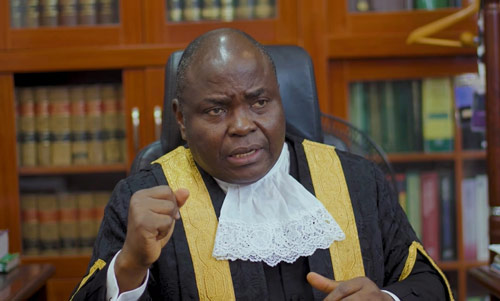
Okutepa SAN: NJC Role in Imo Chief Judge Appointment Constitutional
Summary
- Jibrin Okutepa, SAN, has publicly criticized the Imo State Attorney-General.
- The criticism concerns the Attorney-General's objection to the National Judicial Council's role in appointing Imo State's Chief Judge.
- Okutepa described the objection as misconceived and inconsistent with Nigeria's constitutional framework for judicial appointments.
- He firmly stated that the arbitrary exclusion of the most senior judge lacks legal basis.
- Okutepa's position supports the National Judicial Council's intervention in the matter.
What Happened
Central to Okutepa's argument is the principle that the "whimsical exclusion of the most senior judge has no support in law."
Prominent Senior Advocate of Nigeria, Jibrin Okutepa, recently voiced strong disapproval regarding the position taken by the Imo State Attorney-General. This critique specifically targets the Attorney-General's objection to the National Judicial Council's (NJC) involvement in the process of appointing a substantive Chief Judge for Imo State. Okutepa, a respected legal figure, characterized the Attorney-General's stance as both "misconceived" and fundamentally at odds with the established constitutional framework that governs judicial appointments across Nigeria.
The dispute centers on the critical role of the NJC in ensuring due process and adherence to legal principles when filling such a high-ranking judicial office. Okutepa's intervention highlights a significant disagreement over the scope of authority and the proper procedure for judicial selection within the state, particularly concerning the Imo Chief Judge. His public statement underscores the importance of maintaining the integrity of the judicial appointment system against perceived arbitrary interference.
Legal Context
Jibrin Okutepa, SAN, firmly articulated his legal rationale for supporting the National Judicial Council's position. He contended that the Imo State Attorney-General's objection lacks any foundation in law, describing it as inconsistent with the constitutional framework governing judicial appointments in Nigeria. Okutepa's analysis emphasizes that the process for selecting a Chief Judge is not left to arbitrary discretion but is instead guided by clear constitutional provisions designed to uphold the independence and integrity of the judiciary.
Central to Okutepa's argument is the principle that the "whimsical exclusion of the most senior judge has no support in law." This assertion directly addresses concerns about potential bypasses of qualified candidates based on seniority, reinforcing the idea that merit and established protocols, rather than personal preferences, should dictate judicial selections. His backing of the NJC in this matter serves to strengthen the council's constitutional mandate to oversee and ensure fairness in judicial appointments, including those for the Imo Chief Judge. Lawyers advising on judicial appointments or constitutional law in Nigeria would find Okutepa's stance a significant reinforcement of the constitutional framework.
Why It Matters
The public intervention by Jibrin Okutepa, SAN, carries substantial weight, particularly for the future of judicial appointments in Nigeria. By unequivocally supporting the National Judicial Council and challenging the Imo State Attorney-General's objection, Okutepa reinforces the constitutional authority of the NJC to intervene in state-level judicial selection processes. This stance is crucial for maintaining uniformity and adherence to established legal norms across the federation, preventing states from unilaterally deviating from recognized procedures.
Okutepa's emphasis on preventing the "senior judge exclusion Imo" without legal justification sends a clear message about the importance of seniority and due process in judicial career progression. His strong advocacy for the constitutional framework governing judicial appointments in Nigeria could influence how similar disputes are handled in the future, potentially deterring attempts to circumvent established protocols. This case, involving the Imo Chief Judge, therefore becomes a significant point of reference for upholding the independence and structural integrity of the Nigerian judiciary.
Practical Implications
Lawyers advising on judicial appointments or constitutional law in Nigeria should note the NJC's firm stance against arbitrary exclusion of senior judges, reinforcing the constitutional framework for such appointments and potentially influencing future judicial selection processes and challenges.
Source
How does this affect you?
Get an AI analysis of this article grounded in your jurisdictions, practice areas, and any policy documents you've uploaded to Wansom.
Wansom is AI and can make mistakes.