
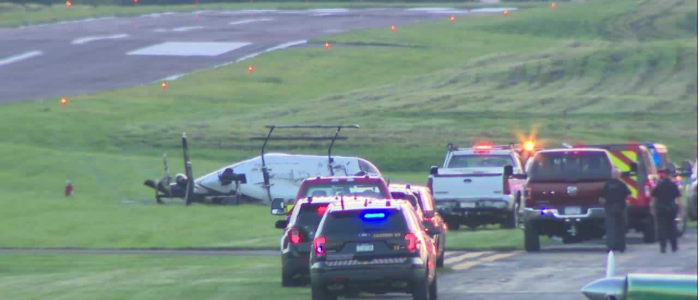
NTSB Reveals New Details in Fatal Carlisle Airport Plane and Helicopter Crash
Midair Collision Prompts Federal Aviation Safety Probe
Federal safety officials are piecing together the timeline of a violent midair collision that took place at Carlisle Regional Airport, roughly 20 miles west of Harrisburg, Pennsylvania.
The incident occurred around 6:50 p.m. as a Pennsylvania State Police Bell 407 helicopter was conducting a low-altitude hover training exercise over a grassy strip near the runway. Simultaneously, a fixed-wing Cessna 150 was executing an approach toward the runway. Preliminary video evidence gathered by NTSB investigators reveals that the Cessna approached from behind the hovering helicopter before making a sharp, unexpected right-hand turn, causing the two aircraft to collide.
The force of the impact severed the main rotor blades and tail assembly of the state police helicopter, sending the fuselage onto its side on the airfield. The Cessna shattered upon impact, scattering debris across the runway environment.
Emergency crews responding to the scene pronounced the pilot of the Cessna, 57-year-old Dr. Paul Sokoloski of Hershey, dead at the site. Dr. Sokoloski was a respected physician at Penn State Health and a veteran of the Pennsylvania Air National Guard.
Heroic Escape and Emergency Response
The two Pennsylvania State Troopers aboard the downed Bell 407 helicopter suffered injuries but survived the impact. Authorities identified the crew as Corporal Bryce Corman and Trooper Jason Mills.
Following the collision, the troopers were briefly trapped inside the overturned cockpit. Demonstrating remarkable composure under pressure, Corporal Corman managed to kick out a broken window pane and extract Trooper Mills from the wreckage. Both men were immediately rushed to the Penn State Health Milton S. Hershey Medical Center.
State officials confirmed that both troopers were treated for minor to moderate injuries and placed in stable condition. Pennsylvania Governor Josh Shapiro visited the injured officers shortly after the incident, expressing gratitude for their survival while calling the outcome a miracle given the destruction at the crash site.
Investigative Focus: Radio Frequencies and Sightlines
Because Carlisle Regional Airport is a non-towered facility, air traffic control does not actively monitor or direct aircraft movements on the ground or in the local pattern. Instead, pilots operating in the vicinity are required to use a Common Traffic Advisory Frequency (CTAF) to broadcast their intentions, altitude, and position.
NTSB lead investigators have outlined two key areas of focus for the ongoing probe:
Audio and Radio Communications: Analysts are retrieving and reviewing all CTAF radio logs to determine whether either aircraft made position calls prior to the collision, and if so, whether those broadcasts were received or acknowledged.
Video Trajectory Analysis: Federal agents are utilizing ground surveillance camera footage alongside radar data to reconstruct the exact flight paths and cockpit sightlines of both aircraft leading up to the point of impact.
Why This Investigation Matters
The collision at Carlisle Regional Airport brings renewed national attention to procedural safety at un-towered general aviation facilities across the United States. Flight training exercises—such as helicopter hover maneuvers—frequently occur alongside standard fixed-wing takeoff and landing patterns at non-towered fields.
The NTSB's final findings could lead to updated safety recommendations regarding operational segregation between rotary-wing training areas and fixed-wing landing corridors at uncontrolled airports nationwide.
Federal investigators noted that an official preliminary report will be issued within two to three weeks, while a comprehensive final report detailing the probable cause of the accident will take between 12 and 24 months to complete.
Citations
- 1.Pennsylvania State Police Press Conference: Official statements delivered by Lt. Col. George Bivens (Acting Commissioner of the Pennsylvania State Police) detailing the flight path, pilot identities, CTAF radio frequency usage, and the rescue of Corporal Bryce Corman and Trooper Jason Mills.
- 2.Penn State Health & Hershey Medical Center Briefings: Statements regarding the status of injured state troopers provided by Dr. Ashley Ludwig (Trauma Medical Director) and identification of Dr. Paul Sokoloski.
Finish Reading the Full Story and Expert Analysis.
Get the latest legal & regulatory intelligence in United States
Wansom is AI and can make mistakes.