
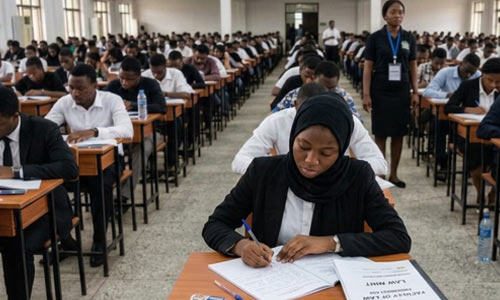
Nigerian Law School: Clarifies Hijab Dress Code, Bans Abaya Bubu
Summary
- The Muslim Students’ Society of Nigeria at the Bwari Campus announced the resolution of concerns from female Muslim candidates.
- Concerns included the wearing of hijabs, prescribed clothing, and security screening procedures during the 2026 Bar Final Examinations.
- The Nigerian Law School clarified that abayas and bubu-style clothing are not permitted for candidates.
- It was also stipulated that all female candidates must be screened by female staff.
- These rules are crucial for candidates to avoid issues during the Bar Final Examinations.
Resolution of Dress Code Concerns
The Nigerian Law School explicitly stated that certain garments, namely abayas and bubu-style clothing, are not permitted for candidates.
The Muslim Students’ Society of Nigeria (MSSN) at the Nigerian Law School’s Bwari Campus in Abuja recently announced the successful resolution of various concerns that had been raised by female Muslim candidates. These issues primarily revolved around appropriate attire, specifically the wearing of hijabs, and the general prescribed clothing guidelines for the Bar Final Examinations.
Further concerns addressed included the security screening procedures for candidates. These discussions and subsequent clarifications were particularly pertinent as they occurred during the initial phase of the 2026 Bar Final Examinations, highlighting the immediate relevance for aspiring legal professionals.
Clarified Dress Code and Screening Rules
In a significant clarification regarding the Nigerian Law School hijab dress code, the institution explicitly stated that certain garments, namely abayas and bubu-style clothing, are not permitted for candidates. This directive provides clear boundaries for what constitutes acceptable attire during the rigorous Bar Final Examinations, ensuring uniformity and adherence to established Nigerian Law School Bar exam rules.
Beyond clothing, the updated guidelines also addressed security protocols. To ensure comfort and cultural sensitivity, it was stipulated that all female candidates undergoing security checks must be screened exclusively by female staff members. This measure aims to streamline the screening process while respecting the candidates' privacy and religious considerations, forming a crucial part of the overall Bar Final Examinations dress code and procedural rules.
Importance for Aspiring Lawyers
These specific clarifications from the Nigerian Law School are vital for all candidates preparing for the Bar Final Examinations. Understanding and adhering to the updated Nigerian Law School hijab dress code, including the Abaya Bubu style clothing ban, is paramount to avoid any potential disruptions or disqualifications during the examination process.
Aspiring lawyers and legal educators across Nigeria should take note of these detailed Bar Final Examinations dress code regulations. Compliance with these rules, particularly concerning attire and screening, is crucial for candidates to navigate the examination period smoothly and without incident, ensuring their focus remains on demonstrating their legal knowledge and skills.
Practical Implications
Aspiring lawyers and legal educators in Nigeria should be aware of the specific dress code clarifications issued by the Nigerian Law School for Bar Final Examinations, particularly regarding acceptable attire like hijabs and the prohibition of abayas and bubu-style clothing. Compliance with these rules is crucial for candidates to avoid issues during screening and examination.
Source
How does this affect you?
Get an AI analysis of this article grounded in your jurisdictions, practice areas, and any policy documents you've uploaded to Wansom.
Finish Reading the Full Story and the Expert Analysis.
Get the latest legal & regulatory intelligence in Nigeria
Wansom is AI and can make mistakes.