
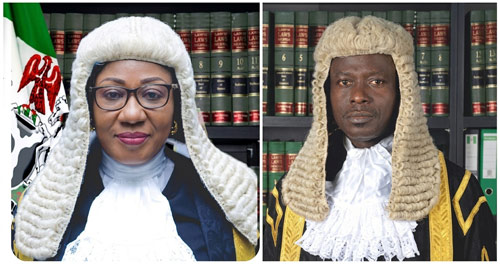
NICN Justices to Discuss Employees’ Compensation Act, Workplace Liability
Hon. Justice Olufunke Anuwe and Hon. Justice Olukayode Arowosegbe, two Justices of the National Industrial Court of Nigeria (NICN), are scheduled to lead discussions on the judicial interpretation of the Employees’ Compensation Act, 2010, employer liability, and compensation awards at the 2026 Legal Stakeholders’ Engagement in Abuja.
This upcoming event signifies a proactive engagement by senior judicial officers from Nigeria's specialized labour court to address critical aspects of workplace injury compensation. The focus on judicial interpretation, employer liability, employees' entitlements, and the enforcement of compensation awards under the Employees’ Compensation Act, 2010 (ECA) indicates an ongoing effort to clarify and streamline the application of this crucial legislation. The fact that two NICN Justices are leading these discussions underscores the court's commitment to ensuring a consistent and effective approach to these matters, which are central to industrial relations and social welfare in Nigeria. The outcome of this specific engagement is not yet reported, as it is a future event focused on discussion and clarification rather than a specific ruling.
For practitioners, this initiative is highly significant as it offers invaluable insights into the NICN's evolving perspectives on the ECA. Clarity on judicial interpretation directly impacts how cases are litigated, how employers assess and manage risk, and how employees understand their rights. Discussions led by sitting judges often foreshadow areas where the court seeks greater consistency, or where there might be emerging legal challenges or ambiguities in the current application of the law. This engagement could lead to more predictable outcomes in compensation claims, influencing settlement strategies and litigation approaches for both employers and employees.
The Employees’ Compensation Act, 2010, is the primary legislation governing compensation for employees who suffer occupational diseases or sustain injuries arising out of or in the course of employment in Nigeria. It replaced the Workmen's Compensation Act, Cap. W6, LFN 2004, aiming to provide a more comprehensive and humane framework for employee welfare. The National Industrial Court of Nigeria (NICN) holds exclusive jurisdiction over labour and industrial relations matters, including disputes arising from the ECA, as established by Section 254C of the 1999 Constitution (as amended). The NICN's decisions are binding and form part of the jurisprudence guiding workplace compensation. The National Social Insurance Trust Fund (NSITF) is typically responsible for administering the ECA, collecting contributions, and paying compensation. The key parties involved are Hon. Justice Olufunke Anuwe and Hon. Justice Olukayode Arowosegbe, both Justices of the National Industrial Court of Nigeria (NICN), and the event is the 2026 Legal Stakeholders’ Engagement, organised by the National Social [Insurance Trust Fund, likely, based on the context of ECA administration].
Attorneys representing employers should closely monitor any outcomes or summaries from this 2026 engagement, as they may provide critical guidance on compliance, risk management, and defence strategies concerning workplace injuries and employer liability under the ECA. Similarly, lawyers representing employees will gain valuable insights into the court's approach to entitlements and enforcement, which can inform their advocacy. Businesses should review their internal policies and insurance coverage in light of any emerging interpretations or emphasis from the NICN, ensuring robust compliance with the ECA and proactive measures to mitigate workplace risks. This event underscores the dynamic nature of labour law in Nigeria and the NICN's pivotal role in shaping its application.
How does this affect you?
Get an AI analysis of this article grounded in your jurisdictions, practice areas, and any policy documents you've uploaded to Wansom.
Finish Reading the Full Story and the Expert Analysis.
Wansom is AI and can make mistakes.