
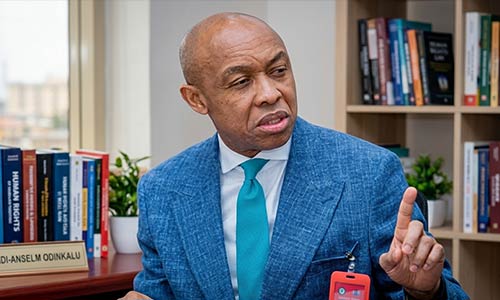
NJC: Hyeladzira Nganjiwa Judicial Bazaar Raises Ethics Concerns
Summary
- Chidi Anselm Odinkalu's commentary highlights a shift in focus for Nigerian election legitimacy.
- Traditionally, scrutiny centered on post-election petition tribunals, but for 2027, the focus is expected to be on judges' actions before votes are cast.
- A recent incident involved a judge in Abuja nullifying an entire slate of candidates.
- The commentary, titled "Hyeladzira Nganjiwa: When The NJC Allows A Judicial Bazaar," frames concerns about judicial ethics and oversight by the Nigerian Judicial Council.
- This shift emphasizes the growing importance of pre-election judicial decisions in shaping electoral outcomes and integrity.
Evolving Electoral Scrutiny
For the upcoming 2027 electoral cycle, a more critical examination of judicial actions *before* the casting of ballots will be paramount.
Recent commentary by Chidi Anselm Odinkalu has drawn attention to the evolving landscape of electoral legitimacy in Nigeria, particularly concerning the role of the judiciary. The analysis, titled "Hyeladzira Nganjiwa: When The NJC Allows A Judicial Bazaar," points to a significant shift in where scrutiny of election integrity should be directed. Traditionally, concerns about the fairness and validity of Nigerian elections have predominantly centered on the proceedings of election petition tribunals, which adjudicate disputes after votes have been cast and results declared.
However, Odinkalu's perspective suggests that for the upcoming 2027 electoral cycle, a more critical examination of judicial actions *before* the casting of ballots will be paramount. This reorientation of focus is underscored by recent events, including a notable instance where a judge in Abuja issued a ruling that effectively nullified an entire slate of candidates. Such pre-election judicial interventions, the commentary implies, have the potential to profoundly shape the electoral playing field even before citizens have the opportunity to vote.
Judicial Ethics and Integrity
The shift in focus from post-election tribunals to pre-election judicial decisions highlights a growing concern about judicial ethics in Nigeria's election processes. The commentary implicitly questions the oversight mechanisms, particularly those involving the Nigerian Judicial Council (NJC), in preventing what it terms a "judicial bazaar"—a phrase suggesting a marketplace where judicial outcomes might be influenced or traded. This perspective suggests that the integrity of the electoral process is increasingly vulnerable to decisions made by judges long before election day.
The implications for judicial integrity in Nigeria elections are substantial. When judges make rulings that can disqualify candidates or entire party slates before the election, it can undermine public confidence in the impartiality of the judiciary and the fairness of the democratic process itself. This scenario presents a challenge to the established norms of electoral dispute resolution, which typically anticipate judicial intervention primarily after the election has taken place.
Implications for 2027 Elections
As Nigeria looks towards the 2027 elections, the insights offered by Chidi Anselm Odinkalu underscore a critical need for heightened vigilance regarding judicial conduct. The traditional emphasis on the outcomes of election petition tribunals, while still important, may no longer capture the full scope of challenges to electoral legitimacy. Instead, the actions of judges in the period leading up to the vote are posited as a key determinant of the perceived fairness and credibility of future elections.
This evolving dynamic means that all stakeholders, including lawyers advising on electoral matters and those involved in election petition tribunals, must be acutely aware of the increased scrutiny on judicial decisions made at the pre-election stage. The potential for a single judicial ruling to alter the entire political landscape before any votes are cast necessitates a robust framework for judicial accountability and transparency to safeguard the democratic process.
Practical Implications
Lawyers advising on electoral matters or involved in election petition tribunals in Nigeria should be acutely aware of the heightened scrutiny on judicial conduct and integrity, particularly concerning pre-election judicial decisions. This article highlights potential challenges to the legitimacy of judicial processes, which could impact case strategy, client advice, and the perceived fairness of electoral outcomes.
Source
How does this affect you?
Get an AI analysis of this article grounded in your jurisdictions, practice areas, and any policy documents you've uploaded to Wansom.
Finish Reading the Full Story and the Expert Analysis.
Get the latest legal & regulatory intelligence in Nigeria
Wansom is AI and can make mistakes.