
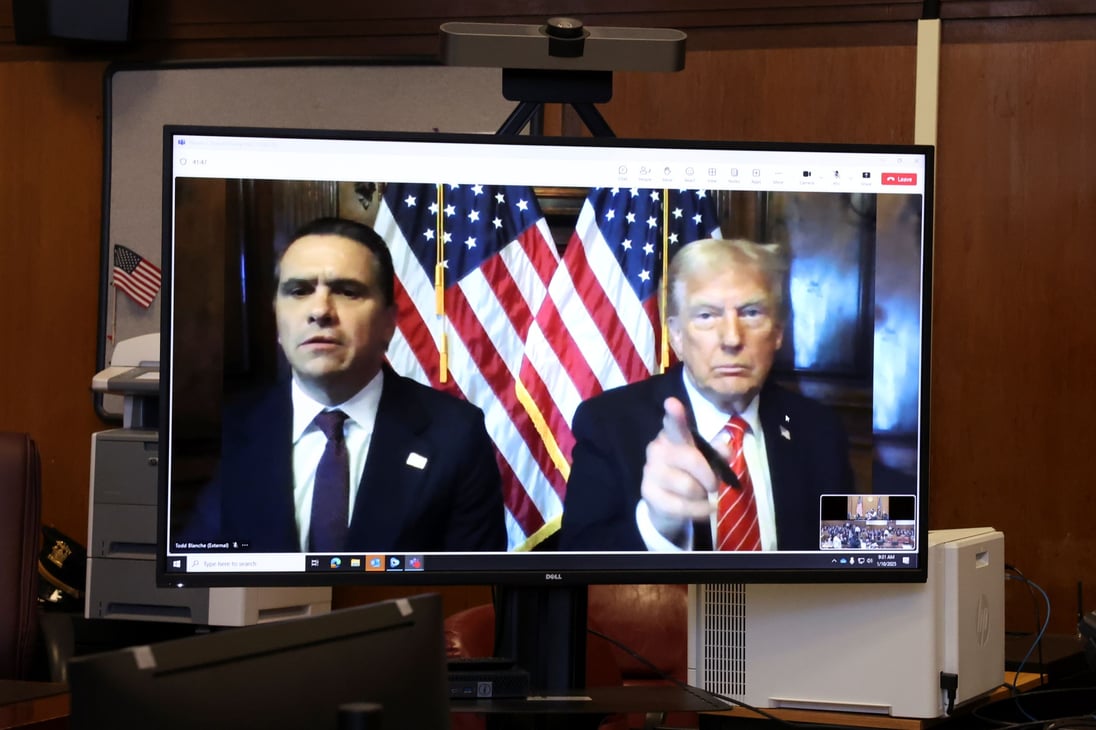
New York Appellate Division Hears Trump Hush Money Appeal
Summary
- Donald Trump's legal team argued before a New York appellate court to overturn his 2024 conviction for falsifying business records.
- Attorney Robert Giuffra claimed the case was flawed and should be dismissed based on presidential immunity and federal preemption.
- The defense specifically argued that the Manhattan District Attorney unlawfully used federal election law to elevate a misdemeanor to a felony.
- Prosecutors countered that the falsified records were used to commit other crimes, including FECA violations, and that immunity claims regarding tweets were minor.
- The appellate court did not issue an immediate decision on the New York Trump hush money appeal.
Appellate Challenge to Trump's Conviction
Justice Webber further probed the defense's argument regarding the tweets, asking how such communications could be considered presidential acts that would 'enrich the lives of American citizens.'
Former President Donald Trump's legal team recently presented arguments before a New York appellate court, seeking to overturn his 2024 conviction on 34 counts of falsifying business records. Despite receiving a sentence of unconditional discharge, Mr. Trump has initiated several efforts to reverse the guilty verdict. The latest attempt unfolded at the mid-level state appeals court, the New York Appellate Division, First Department, where a panel of five judges scrutinized the defense's assertions.
Attorney Robert Giuffra, representing Mr. Trump, contended that the landmark criminal case was plagued by fundamental flaws. He argued that the conviction should be dismissed based on claims of presidential immunity and federal preemption, more than two years after the trial concluded. Mr. Giuffra, from Sullivan & Cromwell, specifically challenged Manhattan District Attorney Alvin Bragg's alleged unlawful use of the Federal Election Campaign Act of 1971 (FECA) to elevate what he described as a time-barred business records misdemeanor into a felony.
Federal Preemption and State Authority
A central point of contention in the appeal revolved around the application of federal election law in a state criminal proceeding. Mr. Giuffra expressed concern that allowing one of the nation's 2,300 local district attorneys to prosecute a presidential candidate for alleged FECA violations represented an overreach of authority. Justice Troy Webber, a member of the appellate panel, appeared to question the extent to which FECA was central to the prosecution's case, as asserted by Mr. Giuffra.
The conviction stemmed from payments Mr. Trump made to his then-personal lawyer, Michael Cohen, which were reimbursements for hush money paid to adult film star Stormy Daniels. These payments were illicitly disguised as standard legal fees. Justice Webber observed that these particular payments were not directly linked to the election but rather served as a means for Mr. Trump to avoid negative publicity. Executive Assistant District Attorney Steven Wu countered for the prosecution, explaining that the charges were elevated to felonies because the falsified records were part of a broader scheme to commit other crimes, including violations of FECA. However, Mr. Wu maintained that this did not warrant dismissing the entire case on grounds of federal preemption.
Presidential Immunity and Official Acts
The defense also asserted that certain evidence used by prosecutors should have been suppressed due to presidential immunity. Specifically, Mr. Giuffra cited a series of tweets related to the hush money payments, which the defense characterized as official presidential communications. Mr. Wu, however, dismissed the significance of these posts, describing them as
Practical Implications
This appellate review of the Trump hush money conviction tests the boundaries of presidential immunity and federal preemption in state criminal proceedings. Lawyers should monitor the court's decision for potential precedents regarding the scope of these defenses, particularly for high-profile individuals or cases with federal implications, as it could influence future litigation strategies or compliance risk assessments.
Source
Source: Original reporting via CN
How does this affect you?
Get an AI analysis of this article grounded in your jurisdictions, practice areas, and any policy documents you've uploaded to Wansom.
Wansom is AI and can make mistakes.