
New Study: Universe Making Fewer Stars, Not Running Out of Gas
What Happened
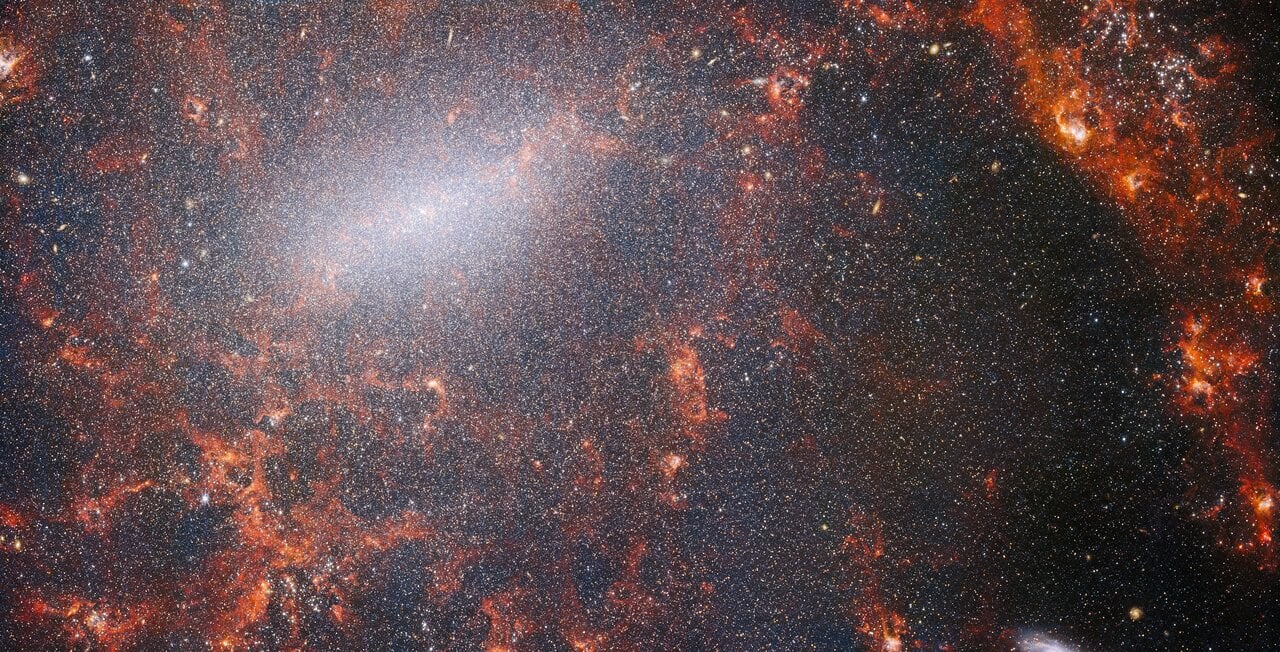
Star formation has plunged, but the universe still has plenty of neutral hydrogen. When viewed in the near-infrared spectrum of light, young stars ionizing hydrogen in the galaxy NGC 5068 create a fiery red glow. (ESA/Webb, NASA & CSA, J. Lee and the PHANGS-JWST Team) (CN) — The universe is making far fewer stars than it did billions of years ago, but it doesn’t appear to be running out of one of their key ingredients. Researchers found that the amount of neutral atomic hydrogen, a major reservoir of gas in galaxies, has changed surprisingly little over the past 4.5 billion years even as star formation dropped sharply. About 4.5 billion years ago, stars were forming at roughly 2.5 times today’s rate, while the density of neutral atomic hydrogen was only about 1.4 times higher, according to findings published Tuesday in Nature Astronomy. Scientists have thought the decline in star formation could be explained by galaxies gradually using up the gas needed to make new stars. But the new findings suggest it isn’t that simple. Instead, researchers suggest the problem may have more to do with what happens to that gas before it can form stars. Stars form primarily in dense clouds of molecular gas. Neutral atomic hydrogen, known as HI, acts as an intermediate reservoir between the larger supply of gas in the universe and the molecular gas that ultimately feeds star formation. If declining star formation was simply the result of galaxies running low on cold gas, researchers would expect the amount of HI to have fallen sharply alongside the star formation rate. But that isn’t what they found. Researchers combined observations from a Chinese telescope called FAST with data from Arizona’s Dark Energy Spectroscopic Instrument, or DESI, to analyze about 2.5 million galaxies across nearly one-third of the sky. Because neutral hydrogen signals from distant galaxies are often too faint to detect individually, the team stacked signals from many galaxies together. That allowed researchers to track changes in the gas over the past 4.5 billion years. The results showed a much smaller decline in HI than in star formation, shifting attention toward another question: If plenty of neutral atomic hydrogen remains, why is less of it ending up in new stars? Researchers suggest the answer could lie in changes to the way gas moves through galaxies and is converted into molecular hydrogen. As the supply of gas from the cosmic web weakens and gas becomes less dense, HI may be converted into molecular gas less efficiently. That could allow the universe to maintain a relatively stable supply of HI while the molecular gas that directly feeds star formation gradually declines. The findings do not settle exactly why the universe has become less efficient at making stars. But they indicate that simply running low on HI isn’t enough to explain the decline. Instead, the research points toward understanding why the hydrogen that remains is becoming less likely to make it to the molecular stage needed to form new stars. Our weekly newsletter Closing Arguments offers the latest about ongoing trials, major litigation and rulings in courthouses around the U.S. and the world, while the monthly Under the Lights dishes the legal dirt from Hollywood, sports, Big Tech and the arts.
Source
How does this affect you?
Get an AI analysis of this article grounded in your jurisdictions, practice areas, and any policy documents you've uploaded to Wansom.
Finish Reading the Full Story and the Expert Analysis.
Wansom is AI and can make mistakes.