
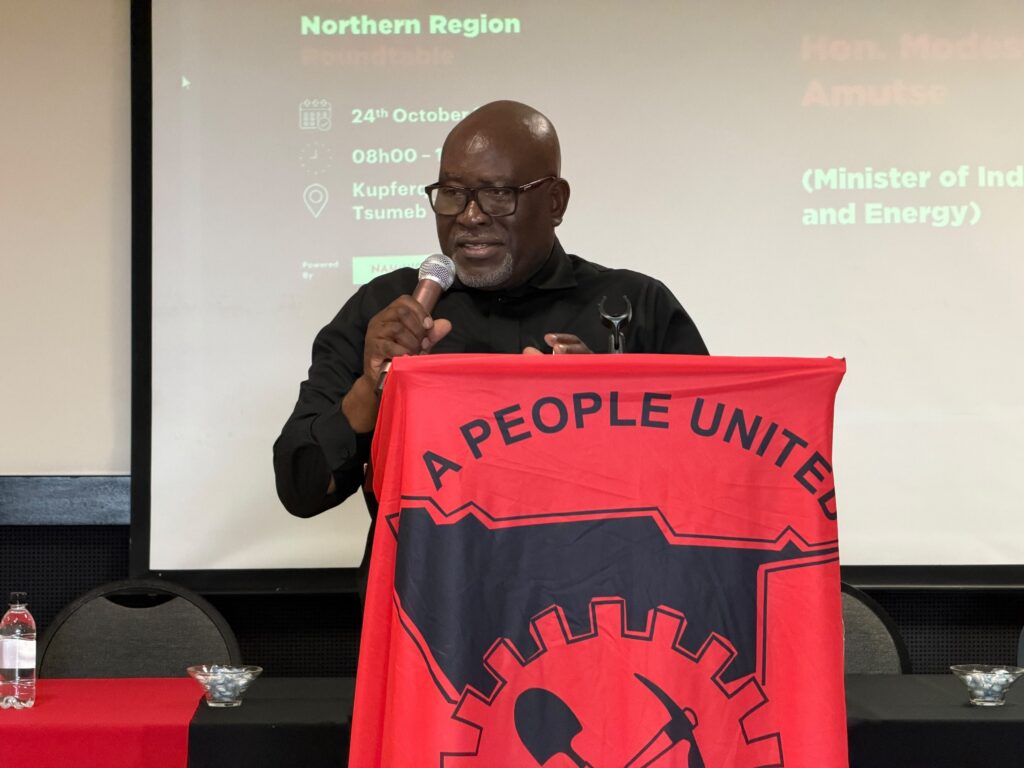
Minister Amutse: Namibia Mining Short-Term Contracts Under Scrutiny
Summary
- Minister Modestus Amutse expressed concerns over the repeated use of short-term employment contracts in Namibia's mining sector.
- His remarks specifically targeted mining operations that hold long-term licenses.
- The Minister stated that this practice warrants scrutiny when credible evidence supports it.
- These comments were made during the Mineworkers Union of Namibia Northern Regional roundtable in Tsumeb.
- The statement signals potential future regulatory attention on labor stability in long-term mining operations.
Ministerial Scrutiny on Namibia Mining Employment
Ultimately, Minister Amutse's intervention foreshadows a period of potential regulatory adjustment or intensified enforcement within the Namibian mining industry.
Modestus Amutse, serving as the Minister of Industries, Mines and Energy, recently voiced significant apprehension regarding the prevalent application of short-term employment contracts within Namibia mining enterprises. His comments, delivered at the Mineworkers Union of Namibia (MUN) Northern Regional roundtable held in Tsumeb on a recent Saturday, underscore a growing governmental focus on labor practices in the nation's vital extractive sector. The Minister's address highlighted a specific area of concern that could reshape future industry standards.
Implications for Labor Practices and Stability
The core of Minister Amutse's critique centered on the repeated use of these temporary agreements in mining operations that are themselves conducted under long-term licenses. He articulated that such a practice warrants thorough investigation and scrutiny, particularly in instances where verifiable, credible evidence of its misuse or widespread application can be presented. This distinction is crucial, signaling that the government's interest is not in all short-term contracts, but specifically those used repeatedly in inherently long-term ventures, impacting short-term employment mining Namibia.
Minister Amutse's public statements carry substantial weight, signaling a potential shift in how Namibia mining labor practices are viewed and regulated. The reliance on short-term contracts for roles within operations designed for decades raises fundamental questions about job security, worker welfare, and the overall stability of the workforce. This approach can create an environment of uncertainty for employees, potentially hindering skill development and long-term commitment to the industry.
For companies engaged in long-term mining operations employment, the Minister's remarks serve as a clear indicator of heightened governmental interest. The practice of continuously renewing short-term employment contracts for positions that are integral to sustained operations could come under increased official review. This scrutiny aims to ensure that employment conditions align with the long-term nature of the mining projects themselves, promoting more stable and equitable labor arrangements across the sector.
Anticipated Regulatory Focus
The Minister's explicit call for scrutiny, contingent on the existence of "credible evidence," suggests a data-driven approach to potential future interventions. This framework implies that the Ministry of Industries, Mines and Energy is not merely expressing an opinion but is laying the groundwork for a more robust examination of current contracting methodologies. Mining companies should interpret this as a directive to review their existing short-term employment mining Namibia strategies, especially those pertaining to long-term mining operations employment.
Ultimately, Minister Amutse's intervention foreshadows a period of potential regulatory adjustment or intensified enforcement within the Namibian mining industry. His concerns about short-term employment contracts in long-term mining operations underscore a governmental desire to foster greater labor stability and fairness. This development could prompt companies to re-evaluate their human resources policies, moving towards more permanent or long-term employment contracts where appropriate, to pre-empt future regulatory actions and align with evolving national labor expectations.
Practical Implications
Namibian mining companies should review their use of short-term employment contracts, particularly in long-term operations, as Minister Amutse's public concerns signal potential future regulatory scrutiny or policy shifts regarding labor stability in the sector.
Source
How does this affect you?
Get an AI analysis of this article grounded in your jurisdictions, practice areas, and any policy documents you've uploaded to Wansom.
Finish Reading the Full Story and the Expert Analysis.
Get the latest legal & regulatory intelligence in Namibia
Wansom is AI and can make mistakes.