
Museveni Says Unnamed Kenyan Senator Exposed Middlemen Costing Uganda Up to $35 a Tonne on Fuel Imports
What Museveni Actually Said, and What's Independently Confirmed
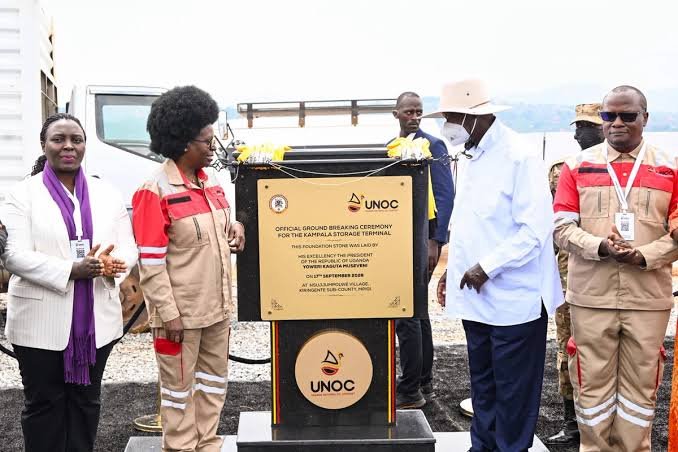
Speaking at the groundbreaking of Uganda's new Kampala Storage Terminal in Mpigi District on Thursday, 17 September 2026, President Yoweri Museveni said an unnamed Kenyan senator had alerted him that Uganda was procuring petroleum products through middlemen based in Kenya, rather than dealing directly with bulk suppliers. Museveni did not name the senator, nor did he specify when the senator raised the issue with him — both details absent from every outlet we reviewed, making "the mysterious Kenyan senator" itself a minor secondary story in Kenyan press coverage of this event.
Museveni's account, delivered in his characteristic direct style, placed blame squarely on Ugandan officials: "When we took over Government in 1986, we entrusted administration to technocrats. However, it took a Kenyan Senator to alert me that Uganda was buying petroleum products through middlemen in Kenya." He went further in some reporting, saying he had personally raised the issue at the time with then-Energy Minister Eng. Irene Muloni, quoting himself as telling her "This is a disaster, how can this be?" — and alleging she "did nothing." This is a specific, attributed allegation against a named former official, reported as Museveni's own quoted remarks; we have not found Muloni's response and note this as one-sided political commentary from the president, not an independently established fact about her conduct. Museveni characterized the earlier failure to act as explainable only by "either ignorance or corruption."
The Pricing Figures
According to figures Museveni and Uganda's Permanent Secretary for Energy, Irene Batebe, presented at the ceremony, the premiums Uganda was paying per metric tonne fell as follows under the current UNOC-Vitol arrangement compared with the prior middlemen-based one:
Fuel Type | Previous Premium (per metric tonne) | Current Premium (per metric tonne) | Reduction |
|---|---|---|---|
Diesel | $118 | $83 | $35 (~30%) |
Petrol | $97.50 | $61.50 | $36 (~37%) |
Aviation fuel | $114.25 | $79.25 | $35 (~31%) |
These figures were presented by the Ugandan government at its own event and have not been independently verified by outside audit or a neutral third party in available reporting. They should be treated as the Ugandan government's own account of its cost savings, not an independently confirmed figure, a distinction worth preserving given the political charge of the underlying allegation against Kenyan intermediaries.
The Broader Procurement Shift, Which We Traced Independently
The move away from Kenyan intermediaries is corroborated independently of Museveni's speech: in 2024, Uganda moved to reduce its reliance on Kenyan oil marketing companies, seeking to let UNOC import fuel directly through Kenyan territory. This initially triggered a licensing and infrastructure-access dispute with Kenya. Kenya and Uganda subsequently reached a bilateral agreement allowing UNOC to import petroleum products through Kenya, using the Port of Mombasa and the Kenya Pipeline network — meaning Uganda's shift was to direct importing via Kenyan infrastructure, not a bypass of Kenya altogether. UNOC's current supply partner for this direct arrangement is Vitol (Vitol Bahrain, specifically, per financing details on the new terminal project).
One claim we found in a single outlet, and are explicitly excluding from this article, deserves a note: a widely circulated account described a specific vessel — "the MT Maritime Lira" — allegedly docking at Mombasa Port on 3 July 2024 as the symbolic first direct UNOC-Vitol shipment. We could not corroborate this specific claim, including the vessel's name and date, in any other source, and the outlet carrying it used markedly sensationalized framing elsewhere in its coverage ("cartel-like," "explosive geopolitical storm," "multi-million-dollar exploitation"). We treat this specific claim as unverified and have not relied on it.
The New Terminal, Separately
The Kampala Storage Terminal (KST), being built at Namuwabula Estate in Mpigi District (roughly 26km west of Kampala), is a separate but related development: a 320-million-litre petroleum storage facility, to be built in two phases — an initial 225-million-litre capacity, expanding to the full 320 million litres in a second phase tied to progress on Uganda's planned 60,000-barrel-per-day refinery in Hoima. UNOC Chairman Mathias Katamba put the project's cost at $350 million, funded under a financing agreement Vitol Bahrain signed in December 2025. The EPC (engineering, procurement, and construction) contract takes effect 18 September 2026, with detailed engineering targeted for completion by March 2027 and commissioning expected within 24 months of the contract's effective date — around September 2028. Energy and Mineral Development Minister Monica Musenero described the facility as central to Uganda's energy security, intended to protect against supply disruptions and market shocks; Uganda's current monthly petroleum consumption is roughly 240 million litres, meaning even the full 320-million-litre capacity would cover only slightly more than a month of national demand.
Compliance Implications / What This Means for Regional Energy and Trade Businesses
Who must act, and what specifically changes: No new regulatory obligation results from this announcement. For Kenyan oil marketing companies that previously served as intermediaries in Uganda-bound fuel supply, the practical business implication is that this channel has already contracted, per Uganda's own account, and there's no indication of a policy reversal.
Operational and market exposure: For traders and logistics companies operating along the Mombasa-Kampala petroleum corridor, Uganda's continued reliance on the Port of Mombasa and Kenya Pipeline network — even under the direct UNOC-Vitol arrangement — means Kenyan infrastructure remains commercially essential to Uganda's fuel supply chain regardless of who the contracting parties are. The new Mpigi terminal, once operational around 2028, will materially increase Uganda's strategic storage buffer, which is relevant for any business modeling regional fuel-supply resilience or disruption risk.
Realistic timeline: The procurement shift described by Museveni is already in effect. The terminal project has a defined public timeline: construction from 18 September 2026, detailed engineering complete by March 2027, commissioning around September 2028.
What remains uncertain or pending: The identity of the Kenyan senator Museveni credited was not disclosed and remains unconfirmed. The precise timing of when the alert was raised, and when the procurement switch actually took effect, was not specified. The pricing figures presented are the Ugandan government's own account, not independently audited. Any response from former Energy Minister Irene Muloni to Museveni's specific allegation was not found in available reporting.
Frequently Asked Questions
Who is the Kenyan senator Museveni credited? Unknown. Museveni did not name the senator in his remarks, and no outlet we reviewed has identified them — several Kenyan publications have specifically noted this as an open question.
Did Uganda stop using the Port of Mombasa and Kenya Pipeline after cutting out the middlemen? No. Uganda still imports through Kenya's Port of Mombasa and Kenya Pipeline network under the current UNOC-Vitol arrangement — what changed was who Uganda contracts with for the fuel itself, not the physical logistics route.
Are the cost-savings figures Museveni cited independently verified? Not based on available reporting. They were presented by the Ugandan government (Museveni and Permanent Secretary Irene Batebe) at a public event, and we found no independent audit or third-party verification of the $35–36 per-tonne premium reductions cited.
Is the new Mpigi terminal related to the middlemen issue Museveni described? They're related but distinct. The middlemen issue concerns who Uganda buys fuel from; the Mpigi terminal is about how much fuel Uganda can store domestically. Museveni discussed both at the same event because both relate to Uganda's broader push for energy security and cost control, but the terminal's $350 million financing and construction timeline are a separate project from the procurement shift.
Is Kenya's G-to-G petroleum framework the same arrangement Museveni was criticizing? No, and this is worth distinguishing clearly. Kenya's G-to-G framework, introduced in 2023, governs how Kenya itself sources fuel from Gulf state government suppliers. It is not the Kenyan-middlemen arrangement Museveni described Uganda using — those were private Kenyan intermediary companies, a different arrangement entirely.
When will the full 320-million-litre terminal capacity be available? The terminal opens in phases: an initial 225 million litres, expanding to the full 320 million litres in a second phase linked to progress on Uganda's planned Hoima refinery. Commissioning of at least the initial phase is targeted within 24 months of the 18 September 2026 contract effective date.
Citations
- 1.Original reporting: Citizen Digital, "Museveni: Kenyan senator revealed middlemen in G-to-G oil deal, prompting Uganda's withdrawal".
- 2.Museveni's fuller quoted remarks, including the allegation against former Energy Minister Irene Muloni: Watchdog Uganda, "Museveni breaks ground on 320-million-litre Kampala fuel storage terminal"; PML Daily (same terminal financing and timeline detail).
- 3.The "mysterious senator" framing, confirming no identity was disclosed: Radio47, "Who is the mysterious Kenyan senator Museveni says exposed Uganda's fuel middlemen?".
- 4.Terminal specifications, financing ($350m, Vitol Bahrain, December 2025 agreement), EPC contract date, and construction timeline: PML Daily; UG Standard; UG Bulletin, "Museveni breaks ground for 320 million litre Kampala fuel storage terminal" (source of the detailed engineering/commissioning timeline); Pulse Uganda (source of Uganda's ~240 million litre monthly consumption figure).
- 5.Uganda's 2024 UNOC direct-import push and the resulting Kenya-Uganda infrastructure access agreement: corroborated across the original Citizen Digital piece and People Daily's account.
- 6.Excluded as unreliable: Uzalendo News, "How Kenya's Oil Middlemen Milked Uganda," which claims a specific vessel ("MT Maritime Lira") docked at Mombasa Port on 3 July 2024 as the first direct UNOC-Vitol shipment. This specific claim was not corroborated by any other source we reviewed, and the outlet's surrounding language ("cartel-like," "explosive geopolitical storm") reads as sensationalized rather than sourced reporting. We have not used this claim.
Finish Reading the Full Story and Expert Analysis.
Get the latest legal & regulatory intelligence in Kenya
Wansom is AI and can make mistakes.