
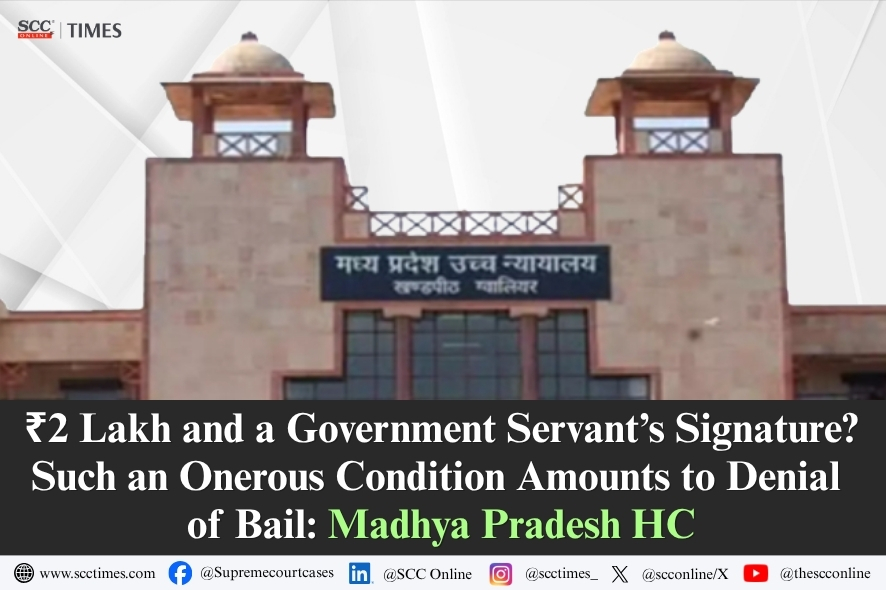
Madhya Pradesh HC: Onerous Bail Condition Amounts to Denial
Summary
- The Madhya Pradesh High Court held that an onerous condition attached to release on bail amounts to denial of bail.
- The court's decision came in response to a petition filed by individuals granted bail with an additional requirement for a government servant's signature.
- This ruling sets a precedent for challenging excessive conditions attached to release on bail in India.
What Happened
The MP HC held that the onerous condition attached to release on bail amounts to denial of bail, which is done in exceptional circumstances and not as a matter of course.
In a significant ruling, the Madhya Pradesh High Court (MP HC) has held that imposing an onerous condition on bail amounts to denial of bail. The court's decision came in response to a petition filed by several individuals who were granted bail with the condition that they furnish bail bonds and sureties, as well as obtain a government servant's signature. This additional requirement was deemed excessive by the court.
Legal Context
The MP HC's ruling is significant in light of existing case law on bail conditions in India. While courts have consistently emphasized that bail conditions should be reasonable and not unduly burdensome, this decision sets a precedent for challenging onerous conditions attached to release on bail. The court's reasoning was based on the principle that exceptional circumstances justify denial of bail, but not as a matter of course. This distinction is crucial in determining whether a condition amounts to denial of bail.
Why It Matters
The MP HC's decision has far-reaching implications for lawyers and their clients seeking bail in similar cases. The ruling establishes that onerous conditions attached to release on bail can be challenged as amounting to denial of bail. This precedent may impact the way lawyers argue bail applications, with a greater emphasis on demonstrating that such conditions are unreasonable and unjustified. As a result, lawyers should carefully review bail conditions and consider arguing that excessive requirements amount to denial of bail.
Practical Implications
Lawyers should watch for this precedent, which may impact their clients' bail applications in similar cases, and consider arguing that onerous conditions attached to release on bail amount to denial of bail.
Source
Source: Original reporting via SCC Times
How does this affect your business?
Get an AI analysis of this article grounded in your jurisdictions, practice areas, and any policy documents you've uploaded to Wansom.
Wansom is AI and can make mistakes.