
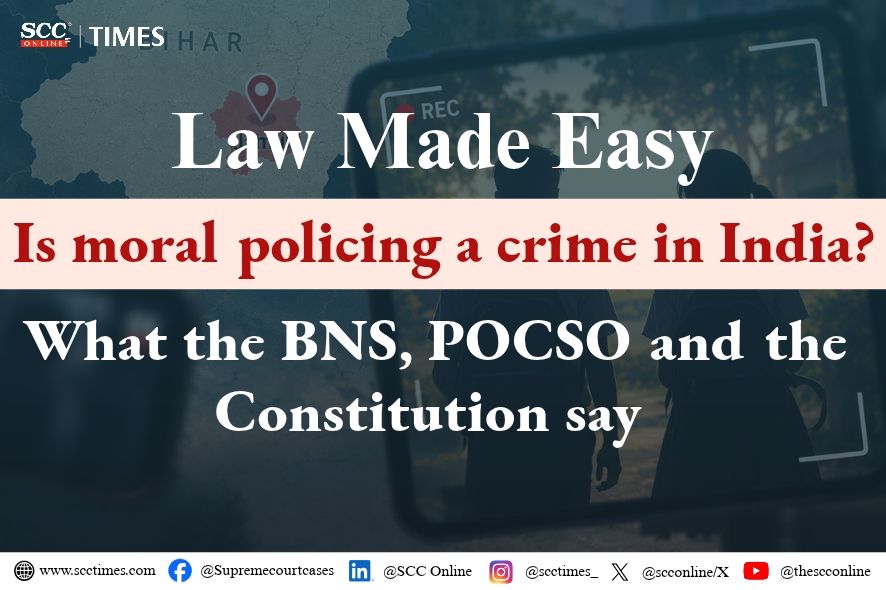
India: Moral Policing Not a Specific Crime Under BNS, POCSO Punishes Related Acts
Summary
- The term 'moral policing' is not a specific criminal offense defined in Indian law, including the Bharatiya Nyaya Sanhita (BNS).
- However, the underlying conduct associated with moral policing, such as wrongful restraint, assault, and sexual harassment, is punishable under BNS and the POCSO Act, 2012.
- A September 2026 incident in Jamui, Bihar, involving minor students, led to police action under POCSO and BNS, demonstrating the criminality of such acts.
- India's Constitution, specifically Article 21, protects an adult's choice of partner and individual liberty, making interference by private groups unlawful.
- Legal complaints should detail specific criminal acts rather than using the non-statutory term 'moral policing' to ensure effective prosecution and uphold constitutional rights.
Incident Highlights Legal Gaps
For legal practitioners advising clients who have been subjected to such incidents, it is crucial to focus on the specific criminal acts committed rather than the non-statutory term 'moral policing.'
In September 2026, a widely circulated video from Jamui, Bihar, depicted a troubling encounter involving two minor students. The footage reportedly showed a group of men intercepting and harassing the Class 10 students as they returned from coaching classes. This incident, which quickly gained traction on social media, brought the contentious issue of 'moral policing' back into public discourse.
Reports indicated that the male student was subjected to an assault, while the female student experienced sexual harassment during the confrontation. The recording and subsequent dissemination of this event led to significant public outcry. Authorities responded by registering a case under the Protection of Children from Sexual Offences Act, 2012 (POCSO), alongside relevant provisions of the Bharatiya Nyaya Sanhita, 2023 (BNS). A Special Investigation Team was promptly established, leading to the arrest of individuals implicated in the incident.
Defining 'Moral Policing' in Indian Law
Despite the common use of the term, 'moral policing' itself does not constitute a specific criminal offense under Indian law. Neither the recently enacted Bharatiya Nyaya Sanhita (BNS) nor any other central legislation includes a statutory definition for this concept. This absence means that individuals cannot be charged directly with 'moral policing India BNS POCSO' as a standalone crime.
However, this lack of a specific label does not render the underlying actions lawful. The phrase generally describes instances where individuals or groups attempt to impose their personal or communal standards of morality and acceptable behavior on others. Such attempts often manifest through various forms of interference, including intrusive questioning, public humiliation, verbal threats, surveillance, physical violence, forced separation, or even sexual harassment.
Applicable Statutes and Constitutional Safeguards
While 'moral policing' is not a crime, the conduct associated with it is unequivocally punishable under existing legal frameworks. Depending on the specific facts of an incident, actions such as wrongful restraint, wrongful confinement, criminal intimidation, assault, and sexual harassment can be prosecuted under the Bharatiya Nyaya Sanhita, 2023. When the targeted individual is a minor, the stringent provisions of the Protection of Children from Sexual Offences Act, 2012 (POCSO) become applicable, with strict rules prohibiting the disclosure of the child's identity.
Beyond specific criminal statutes, the Indian Constitution offers fundamental protections. Article 21, which guarantees the right to life and personal liberty, safeguards an adult's fundamental right to choose their partner and make personal decisions without unwarranted interference. This constitutional protection underscores that social disagreement or perceived moral transgressions do not grant any individual or group the authority to infringe upon another's freedom or safety. The legal inquiry must always prioritize the actions of the perpetrators rather than the circumstances or relationships of those targeted.
Strategic Legal Counsel for Victims
For legal practitioners advising clients who have been subjected to such incidents, it is crucial to focus on the specific criminal acts committed rather than the non-statutory term 'moral policing.' Complaints should meticulously detail the precise conduct, such as physical assault, wrongful restraint, or sexual harassment, aligning them with the relevant sections of the Bharatiya Nyaya Sanhita (BNS) or the POCSO Act, where applicable. This approach ensures that the legal process addresses the actual offenses and provides a clear path for prosecution.
Lawyers should also emphasize the robust constitutional protection of individual liberty and choice, particularly under Article 21. By framing complaints around concrete criminal violations and fundamental rights, legal professionals can effectively navigate these complex situations, ensuring accountability for perpetrators and upholding the rule of law against attempts to enforce extra-legal moral codes. The legal system is designed to address criminal acts, irrespective of any 'moral' justification offered by the perpetrators.
Practical Implications
Lawyers must advise clients targeted by 'moral policing' to frame complaints based on specific criminal acts like wrongful restraint, assault, or sexual harassment under the Bharatiya Nyaya Sanhita (BNS) and POCSO Act, rather than the non-statutory term 'moral policing.' They should also emphasize the constitutional protection of individual liberty and choice under Article 21.
Source
How does this affect you?
Get an AI analysis of this article grounded in your jurisdictions, practice areas, and any policy documents you've uploaded to Wansom.
Wansom is AI and can make mistakes.