
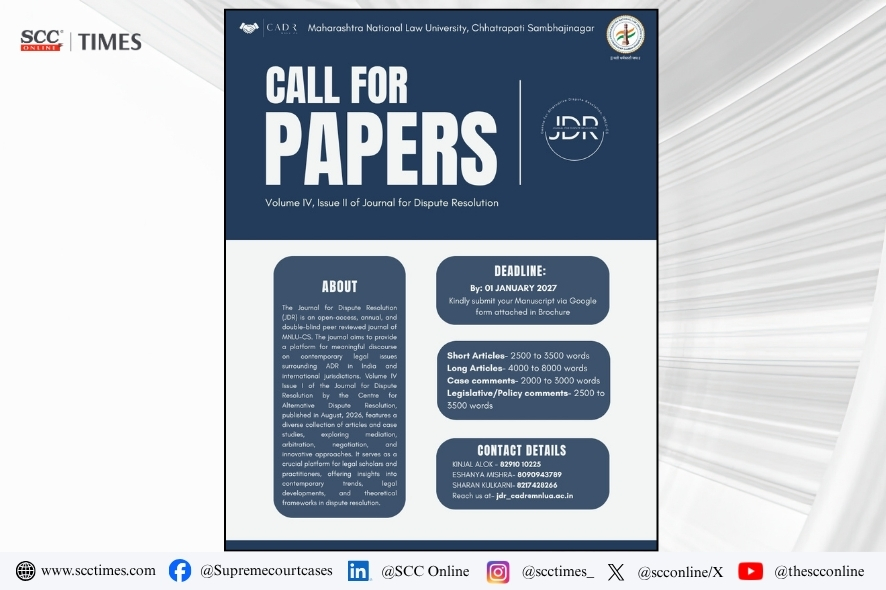
MNLU-CS Journal: Dispute Resolution Call for Papers for Volume IV Issue II
Summary
- The MNLU-CS Journal has issued a call for papers for its upcoming Volume IV Issue II.
- Submissions are invited on the theme "Pluralism in Dispute Resolution: Bridging Individual Rights, Community Interests, and Corporate Governance."
- The theme encourages scholarship on individual rights, community interests, and corporate governance within dispute resolution.
- This initiative aims to enrich academic discourse and contribute to legal scholarship in the field of conflict resolution.
Call for Scholarly Contributions
The central theme for Volume IV Issue II is articulated as "Pluralism in Dispute Resolution: Bridging Individual Rights, Community Interests, and Corporate Governance."
The MNLU-CS Journal, a prominent academic publication, has formally announced a call for papers for its upcoming Volume IV Issue II. This initiative invites legal scholars, practitioners, and researchers to submit original works that delve into a highly pertinent and complex area of contemporary law: dispute resolution. The journal seeks to gather diverse perspectives and rigorous analysis on the designated theme, aiming to enrich the academic discourse surrounding conflict resolution mechanisms.
This specific call for papers from the MNLU-CS Journal Dispute Resolution focuses on a comprehensive theme designed to explore the multifaceted nature of conflict. Submissions are expected to contribute significantly to the understanding of how various interests and rights intersect within the realm of dispute resolution. The journal's commitment to fostering in-depth scholarship is evident in the broad scope of the chosen topic, encouraging a wide array of research methodologies and analytical approaches.
Exploring Pluralism in Dispute Resolution
The central theme for Volume IV Issue II is articulated as "Pluralism in Dispute Resolution: Bridging Individual Rights, Community Interests, and Corporate Governance." This expansive topic signals a desire for scholarship that examines the diverse methodologies and perspectives involved in resolving conflicts across different societal layers. The concept of pluralism in dispute resolution acknowledges the existence of multiple approaches, stakeholders, and legal frameworks that must be considered when addressing disagreements, moving beyond singular solutions to embrace a spectrum of effective resolutions.
By specifically highlighting individual rights dispute resolution scholarship, the call encourages authors to investigate how fundamental entitlements and personal liberties are protected, negotiated, or potentially challenged within various conflict resolution processes. Furthermore, the inclusion of community interests prompts an examination of collective concerns, societal well-being, and the role of alternative dispute resolution mechanisms in addressing disputes that impact broader groups. The emphasis on corporate governance dispute resolution papers indicates a particular interest in the mechanisms for resolving conflicts within organizational structures, encompassing issues such as shareholder disputes, board disagreements, and regulatory compliance challenges. This holistic approach aims to foster a deeper understanding of how these distinct yet interconnected domains—individual, communal, and corporate—can be effectively reconciled through innovative dispute resolution scholarship.
Significance for Legal Scholarship
The MNLU-CS Journal's call for papers for its Volume IV Issue II represents a significant opportunity for the academic community to contribute to a critical area of legal study. As an India legal journal call for papers, it plays a vital role in shaping the national and international discourse on dispute resolution, a field that is constantly evolving in response to societal, economic, and technological changes. The journal serves as a platform for disseminating cutting-edge research and fostering intellectual exchange among legal professionals and academics.
Such academic initiatives are crucial for advancing legal theory and practice, providing insights that can inform policy-making, judicial processes, and the development of more effective conflict resolution strategies. The interdisciplinary nature of the theme, bridging individual rights, community interests, and corporate governance, underscores the complex challenges faced in modern legal systems and the necessity for comprehensive, nuanced solutions. The contributions received will undoubtedly enrich the body of knowledge surrounding dispute resolution, offering valuable perspectives on how to navigate the intricate balance between diverse rights and interests.
Source
Source: Original reporting via SCC Times
How does this affect you?
Get an AI analysis of this article grounded in your jurisdictions, practice areas, and any policy documents you've uploaded to Wansom.
Finish Reading the Full Story and the Expert Analysis.
Get the latest legal & regulatory intelligence in India
Wansom is AI and can make mistakes.