
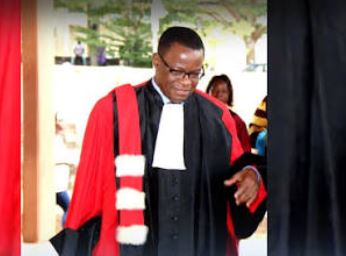
Maurice Kamto: Denounces 'Blanchiment Juridique Afrique' by Scholars
Summary
- Maurice Kamto, a Cameroonian academic and politician, critiques "legal laundering" in African nations.
- He argues that traditional military coups have been replaced by "constitutional coups" orchestrated by legal scholars.
- Kamto's thesis of "blanchiment juridique" describes leaders using constitutionalists to legitimize violations of fundamental law.
- A key step in this process is the suppression of presidential term limits, initially established in the 1990s.
- His critique is directed at academics who, despite their expertise, contribute to undermining democratic principles.
A Scholar's Indictment of Power Manipulation
The objective is to present a violation as legally sound, thereby legitimizing an otherwise illegitimate extension of power.
Maurice Kamto, a prominent figure in Cameroonian politics and a distinguished academic, has issued a scathing critique of what he terms "legal laundering" in African nations. Speaking as a seasoned professor and former Dean of the Faculty of Legal and Political Sciences at the University of Yaoundé II, Maurice Kamto, a prominent political opposition figure who recently resigned as National President of the Cameroon Renaissance Movement (MRC) on September 8, 2026, directed his sharp observations towards his academic peers across cities like Yaoundé, Dakar, and Abidjan. His perspective, rooted in an intimate understanding of constitutional mechanisms, lends significant weight to his pronouncements.
Kamto's central argument, articulated in his reflections dated September 28, 2026, posits a fundamental transformation in the nature of power seizures across Francophone Africa. He contends that the traditional military coup, characterized by soldiers taking over radio stations, has largely been supplanted. Instead, a more insidious form of power grab, which he labels the "constitutional coup," has become prevalent, often orchestrated by legal scholars.
The Rise of Constitutional Coups
This shift, according to Kamto, means that the uniform of the military has been replaced by the judicial robe, signifying a move from overt force to legalistic manipulation. He asserts that over the past four decades, African nations have experienced a greater number of these `coups d'État constitutionnels Afrique` than conventional military takeovers. This evolution underscores a sophisticated method of maintaining power, where the appearance of legality is paramount.
Kamto's thesis of `blanchiment juridique Afrique` describes a process where unscrupulous leaders no longer resort to armed force to violate fundamental laws. Instead, they seek out respected constitutional law experts to provide a veneer of scientific and legal justification for actions that, in essence, undermine democratic principles. The objective is to present a violation as legally sound, thereby legitimizing an otherwise illegitimate extension of power. This highlights a critical challenge for `droit constitutionnel Afrique`.
The Anatomy of Legal Laundering
The former Dean meticulously outlines a three-part "recipe" for manufacturing an extended presidential term, a process he has observed firsthand. The initial and crucial step involves the abolition of presidential term limits, a democratic safeguard that was widely adopted during the wave of democratic enthusiasm in the 1990s. This move effectively removes a key barrier to perpetual rule, setting the stage for further constitutional maneuvering.
By dismantling these `limitation mandats présidentiels Afrique`, leaders create the legal space necessary to pursue additional terms without appearing to overtly defy the constitution. This strategic manipulation of foundational legal texts is central to the concept of `blanchiment juridique dictatures`, where the very instruments designed to protect democracy are co-opted to subvert it. The process transforms what would traditionally be considered an illegal power grab into a seemingly legitimate constitutional amendment.
An Insider's Warning to Academia
Kamto's critique is particularly potent because it comes from an individual deeply embedded within the academic and legal structures he is scrutinizing. His statement, "They went to seek light, sometimes even abroad, only to come back and plunge their countries into darkness," is a direct and forceful challenge to `Maurice Kamto universitaires dictatures`. It underscores his belief that some academics, despite their advanced education and expertise, have become complicit in the erosion of democratic governance.
This insider perspective from `Maurice Kamto Cameroun` reveals the intricate ways in which legal expertise can be exploited to serve authoritarian agendas, rather than uphold constitutional integrity. His analysis offers a critical framework for understanding how `blanchiment juridique` operates, transforming what might appear as legitimate legal reforms into tools for perpetuating undemocratic rule.
Practical Implications
This analysis by Maurice Kamto provides a critical framework for constitutional lawyers and political risk analysts to identify and challenge instances of 'legal laundering' that undermine democratic principles and term limits in African states. Lawyers should scrutinize constitutional amendments and judicial rulings for signs of such manipulation, which can impact governance stability and legal certainty for clients.
Source
How does this affect you?
Get an AI analysis of this article grounded in your jurisdictions, practice areas, and any policy documents you've uploaded to Wansom.
Finish Reading the Full Story and the Expert Analysis.
Get the latest legal & regulatory intelligence in Cameroon
Wansom is AI and can make mistakes.