
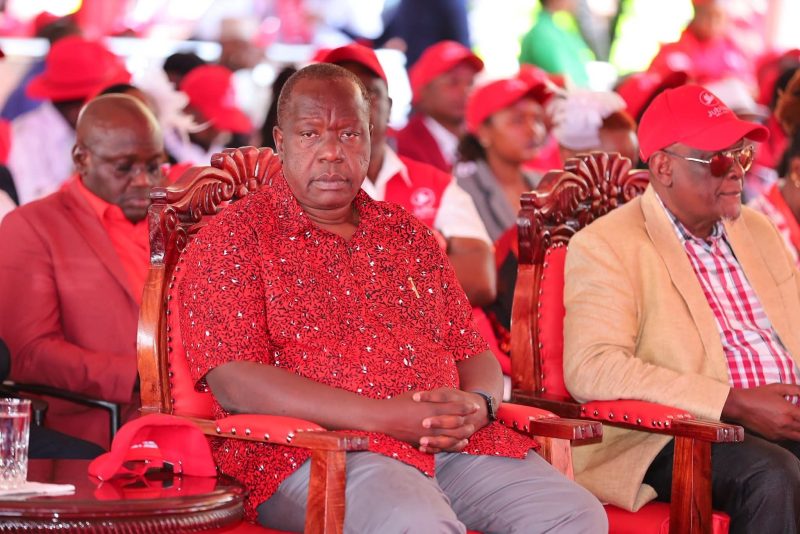
Matiang'i: Demands Kenya G-to-G Oil Deal Disclosure
Summary
- Fred Matiang'i has demanded the full publication of Kenya's Government-to-Government (G-to-G) oil importation agreement and scrutiny of intermediaries.
- This call for transparency follows Ugandan President Yoweri Museveni's remarks about costly intermediaries in the regional petroleum supply chain.
- Matiang'i also advocates for the National Oil Corporation of Kenya (NOCK) to resume its proper role in securing petroleum supplies and market stability.
- Kenya's Energy Cabinet Secretary Opiyo Wandayi defends the G-to-G framework, stating it was established in 2023 to address a 2022 US dollar shortage and stabilize foreign exchange reserves.
- The arrangement involves three international oil companies and six vetted local Oil Marketing Companies for managing supply logistics.
Heightened Scrutiny on Kenya's G-to-G Oil Deal
The ongoing debate has intensified calls for greater transparency in public procurement, particularly concerning significant national resources like petroleum imports.
Jubilee Party Deputy Leader Fred Matiang'i has recently called for the complete disclosure of Kenya's Government-to-Government (G-to-G) oil importation agreement. This demand for greater transparency follows public remarks by Ugandan President Yoweri Museveni concerning the involvement of intermediaries within the regional petroleum supply chain, which has intensified the focus on the Matiang'i Kenya G-to-G oil deal disclosure.
Matiang'i specifically urged that the entire G-to-G agreement be released for public viewing and that the activities of any intermediary firms involved be thoroughly examined. He underscored the critical need for transparency in managing Kenya's petroleum imports, asserting that the controversy surrounding the current arrangement necessitates full public access to information. His stance highlights a broader call for Fred Matiang'i G-to-G oil transparency, particularly when public funds are at stake.
Furthermore, Matiang'i advocated for the National Oil Corporation of Kenya (NOCK) to reclaim its intended role in securing petroleum supplies and fostering stability within the local fuel market. He emphasized that secrecy is unacceptable when public money is involved, stating that Kenyans are entitled to understand who benefited from the arrangement, at what cost, and for what reasons. This push for the Kenya G-to-G agreement publication aims to shed light on the entire Kenya petroleum supply chain scrutiny.
The Framework's Genesis and Operational Structure
The Kenyan government, through Energy Cabinet Secretary Opiyo Wandayi, has defended the G-to-G arrangement, explaining its establishment in 2023. According to Wandayi, the framework was a strategic response to a severe shortage of US dollars in 2022, which posed a significant threat to the nation's foreign exchange reserves. He maintained that the initiative successfully secured essential petroleum supplies while simultaneously alleviating pressure on Kenya's foreign exchange position, forming the core of the Opiyo Wandayi G-to-G defense.
The G-to-G agreement was brokered between Kenya and three prominent international oil companies: Aramco Trading Fujairah FZE, Abu Dhabi National Oil Company (ADNOC) Global Trading Ltd, and Emirates National Oil Company (Singapore) Private Limited (ENOC). These international partners, in turn, appointed licensed Oil Marketing Companies (OMCs) to manage local supply logistics. Following a vetting process, six specific OMCs were onboarded: Gulf Energy Limited, Galana Energies Limited, Oryx Energies Limited, One Petroleum Limited, Asharami Synergy Limited, and BE Energy Limited.
Wandayi consistently asserts that this structured arrangement played a crucial role in preserving Kenya's foreign exchange reserves and contributed significantly to the stability of the Kenya shilling-US dollar exchange rate. This perspective contrasts with the calls for greater transparency, particularly regarding the specific terms and financial implications of the deal.
Divergent Views and Broader Implications
The debate gained significant traction following Ugandan President Yoweri Museveni's September 17 remarks, where he revealed that Uganda had previously procured petroleum products through intermediaries in Kenya, despite the existence of a G-to-G framework. Museveni questioned the continuation of what he described as a costly procurement arrangement, prompting Uganda to shift towards direct sourcing of bulk petroleum products. He also noted that the late former Kenyan legislator, Cyrus Jirongo, had alerted him to the presence of Uganda Museveni Kenya oil intermediaries in the regional G-to-G oil arrangement as early as 2019.
While Museveni has raised concerns about the use of intermediaries, the Kenyan government's position, as articulated by Wandayi, is that the G-to-G framework was primarily designed to address foreign exchange pressures and ensure stable fuel supplies. This divergence of views has placed renewed attention on how Kenya’s G-to-G petroleum arrangement was structured, the mechanisms for handling local supply logistics, and the precise roles played by both NOCK and the licensed oil marketing companies.
The ongoing debate has intensified calls for greater transparency in public procurement, particularly concerning significant national resources like petroleum imports. Matiang'i's insistence on the public scrutiny of these agreements and related arrangements underscores a growing demand for accountability in government-to-government deals and the operations of the energy sector.
Practical Implications
This development signals increased scrutiny on government-to-government procurement deals and the role of intermediaries in Kenya's energy sector. Compliance officers should review their due diligence processes for public contracts, particularly those involving state-owned entities or significant public funds, to mitigate risks associated with transparency and potential conflicts of interest.
Source
How does this affect you?
Get an AI analysis of this article grounded in your jurisdictions, practice areas, and any policy documents you've uploaded to Wansom.
Finish Reading the Full Story and the Expert Analysis.
Get the latest legal & regulatory intelligence in Kenya
Wansom is AI and can make mistakes.