
MASAE Dément Faux Appel Projets Agricoles: Alerte Fraude 130 Milliards FCFA
Summary
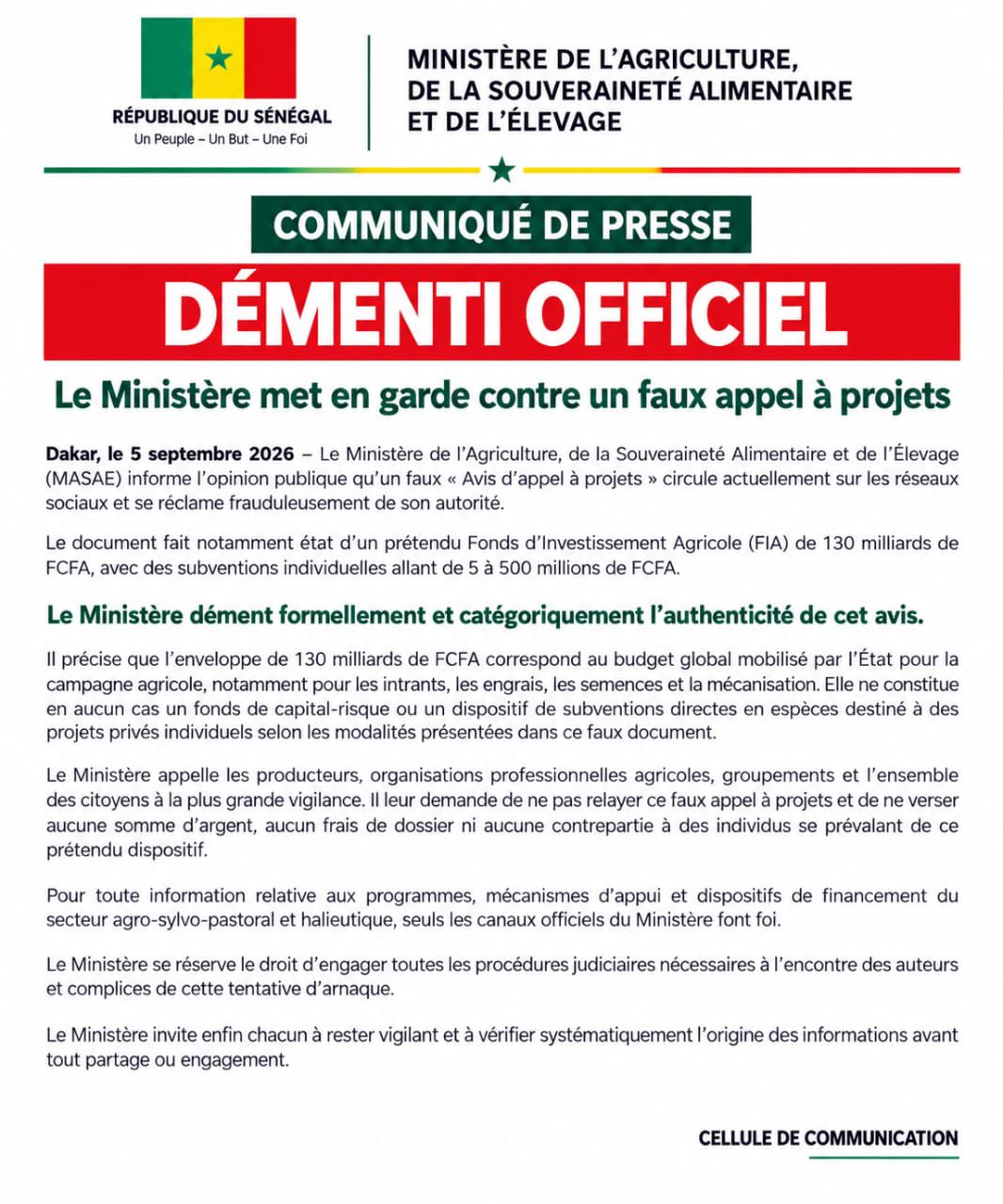
- The Ministry of Agriculture, Food Sovereignty and Livestock (MASAE) formally denied a fake 'Call for Projects Notice' circulating on social media on September 5, 2026.
- The fraudulent document falsely advertised an Agricultural Investment Fund (FIA) of 130 billion FCFA with individual subsidies, claiming affiliation with MASAE.
- MASAE clarified that the 130 billion FCFA is the actual state budget for the agricultural campaign, intended for inputs, seeds, fertilizers, and mechanization, not direct cash subsidies.
- The ministry urged the public to be vigilant, not to relay the fake call, and to avoid paying any fees to individuals promoting the scam.
- MASAE stated it reserves the right to pursue legal action against those responsible for the attempted fraud and directed the public to agriculture.gouv.sn for official information.
MASAE Issues Urgent Warning Against Agricultural Funding Scam
The MASAE dément faux appel projets agricoles is a clear signal that due diligence is paramount.
The Ministry of Agriculture, Food Sovereignty and Livestock (MASAE) in Senegal has formally disavowed a fraudulent 'Call for Projects Notice' circulating widely on social media platforms. On September 5, 2026, the ministry issued a communiqué to unequivocally deny the authenticity of this document, which falsely claims affiliation with MASAE and promotes a supposed Agricultural Investment Fund (FIA) valued at 130 billion FCFA.
The deceptive notice promises individual subsidies ranging from 5 million to 500 million FCFA, enticing producers and agricultural organizations with direct cash injections. This widespread arnaque fonds agricole Sénégal has prompted MASAE to alert the public, emphasizing that the document is entirely fabricated and does not represent any legitimate government initiative. The ministry's swift action aims to prevent potential victims from falling prey to this sophisticated fraud MASAE subventions.
MASAE has urged producers, professional agricultural organizations, various groups, and all citizens to exercise extreme vigilance. The ministry specifically warned against relaying the fake call for projects and, crucially, advised against making any payments—whether application fees, processing charges, or any other form of compensation—to individuals purporting to represent this bogus scheme. This proactive stance highlights the government's commitment to protecting its agricultural sector from exploitation.
Clarifying the True Purpose of State Agricultural Funds
The 130 billion FCFA mentioned in the fraudulent document corresponds to a genuine financial commitment by the Senegalese State, but its purpose is entirely different from what the fake FIA 130 milliards FCFA suggests. MASAE clarified that this substantial sum represents the total budget allocated for the agricultural campaign, earmarked for essential resources such as inputs, fertilizers, seeds, and mechanization efforts across the nation. It is designed to support the broader agricultural infrastructure and productivity.
Crucially, this budget is not intended for direct cash subsidies to individual private projects, as the deceptive notice implies. The ministry underscored that the government's financial support for the agro-sylvo-pastoral and fishing sectors is channeled through specific programs and mechanisms, which are communicated exclusively via official channels. The distinction between the actual state budget and the misrepresented 'fund' is vital for understanding the nature of the fraud.
Official Channels and Legal Consequences
To combat the spread of misinformation and protect stakeholders, MASAE has reiterated that only its official communication channels are authoritative for information regarding financing programs and support mechanisms within the agricultural, livestock, and fishing sectors. The ministry explicitly directed the public to its official website, agriculture.gouv.sn, as the sole reliable source for such details, reinforcing the message of vigilance appel projets MASAE.
Furthermore, the Ministère Agriculture Souveraineté Alimentaire Élevage has declared its intention to pursue legal action against all individuals identified as authors or accomplices in this attempted scam. This firm stance underscores the seriousness with which the government views such fraudulent activities, aiming to deter future attempts and hold perpetrators accountable. The ministry advises everyone to systematically verify the origin of any information related to government funding opportunities before sharing it or making any financial commitments.
Implications for Agricultural Stakeholders and Legal Advisors
This incident serves as a critical reminder for all participants in Senegal's agricultural sector, from small-scale producers to large organizations and potential investors, about the pervasive threat of financial fraud. The sophisticated nature of this particular scam, leveraging a real budget figure to lend credibility to a false scheme, highlights the need for heightened scrutiny of all funding solicitations. The MASAE dément faux appel projets agricoles is a clear signal that due diligence is paramount.
For legal professionals, this situation emphasizes the importance of advising agricultural clients and investors in Senegal to exercise extreme vigilance regarding funding opportunities. It is crucial to verify all calls for projects directly through official MASAE channels to avoid falling victim to this specific fraud. Compliance officers should also be aware of the ministry's intent to pursue legal action against perpetrators, underscoring the necessity of robust due diligence in identifying and engaging with legitimate government programs and initiatives.
Practical Implications
Lawyers should advise agricultural clients and investors in Senegal to exercise extreme vigilance regarding funding opportunities, verifying all calls for projects directly through official MASAE channels to avoid this specific fraud. Compliance officers should be aware of the ministry's intent to pursue legal action against perpetrators of such scams, highlighting the importance of due diligence in identifying legitimate government programs.
Source
Source: Original reporting via {source}
How does this affect you?
Get an AI analysis of this article grounded in your jurisdictions, practice areas, and any policy documents you've uploaded to Wansom.
Finish Reading the Full Story and the Expert Analysis.
Wansom is AI and can make mistakes.