
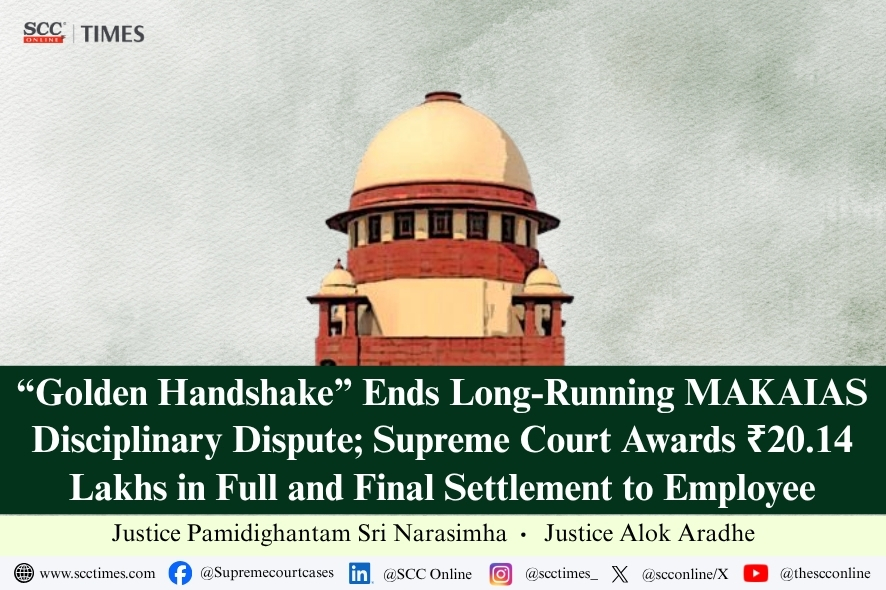
Makaias Supreme Court Settlement: ₹20.14 Lakhs Awarded in Disciplinary Dispute
Summary
- The Supreme Court awarded ₹20.14 Lakhs to an Administrative-cum-Finance Officer at MAKAIAS in full and final settlement.
- The employee had challenged his compulsory retirement, alleging bias in the disciplinary proceedings.
- The ruling sets a precedent for resolving long-running disciplinary disputes with 'golden handshake' settlements.
- This decision has significant implications for Indian employment law settlements and may influence future negotiations.
What Happened
The Supreme Court's award of ₹20.14 Lakhs in full and final settlement to the employee marks a significant development in the realm of Indian employment law settlements.
A long-running disciplinary dispute at MAKAIAS has finally come to an end with the Supreme Court awarding a significant settlement to the affected employee. The Administrative-cum-Finance Officer had challenged his compulsory retirement, alleging that the disciplinary proceedings were marred by bias on the part of the Director who served as the disciplinary authority. This move marked a critical juncture in the dispute, which had been ongoing for an extended period. The Supreme Court's decision brings closure to the employee and sets a precedent for resolving similar disputes in the future.
Relevant Legal/Regulatory Context
The case highlights the importance of ensuring fairness and impartiality in disciplinary proceedings, particularly when it comes to compulsory retirement. The Supreme Court's ruling underscores the need for institutions to adhere to due process and avoid any semblance of bias or arbitrariness. This is especially crucial in cases involving employee grievances, where the stakes are high and the consequences can be severe. In this context, the court's decision serves as a reminder of the importance of upholding the principles of natural justice.
Why It Matters
The Supreme Court's award of ₹20.14 Lakhs in full and final settlement to the employee marks a significant development in the realm of Indian employment law settlements. This precedent has far-reaching implications for lawyers and compliance officers, who will need to take note of this ruling when advising clients on negotiating similar settlements in the future. The 'golden handshake' approach, as seen in this case, may become an increasingly popular means of resolving long-running disciplinary disputes, providing a more efficient and cost-effective solution for all parties involved.
Practical Implications
Lawyers and compliance officers should note this precedent for resolving long-running disciplinary disputes with a 'golden handshake' settlement, which may be used to advise clients on negotiating similar settlements in the future.
Source
Source: Original reporting via SCC Times
How does this affect your business?
Get an AI analysis of this article grounded in your jurisdictions, practice areas, and any policy documents you've uploaded to Wansom.
Wansom is AI and can make mistakes.