
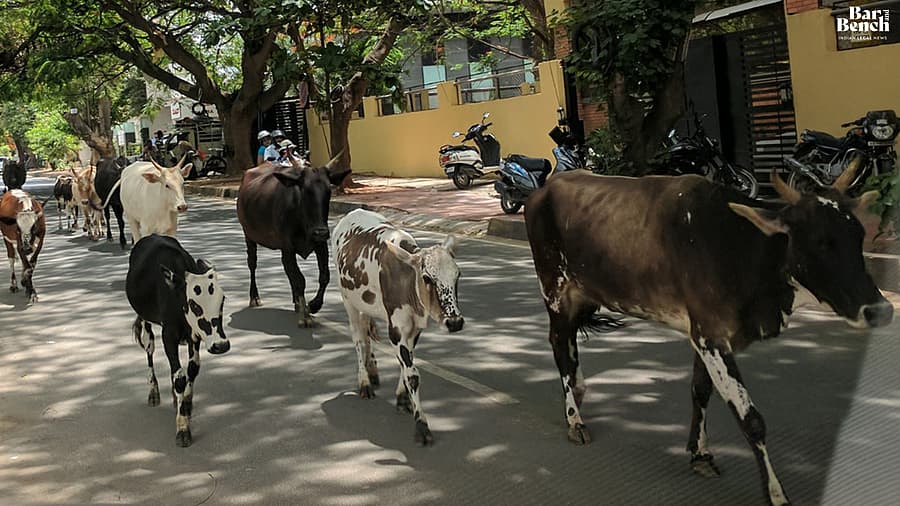
Madras High Court: Mandates Stray Cattle Seizure Across Tamil Nadu
Summary
- The Madras High Court ordered a state-wide crackdown to seize stray cattle found on public roads across Tamil Nadu.
- Local authorities are directed to seize animals and initiate criminal prosecution against repeat offenders who allow their livestock to roam freely.
- The court, in Kamesh v. Municipal Commissioner, asserted that cattle owners have no right to endanger public safety by allowing animals on roads.
- The ruling stemmed from a public interest litigation by M. Kamesh, detailing how stray cattle cause traffic obstructions, accidents, and endanger pedestrians.
- The State informed the court that existing legislation, including the Tamil Nadu Animals and Birds in Urban Areas (Control and Regulation) Act, 1997, supports these enforcement actions.
State-Wide Crackdown Ordered
Public roads are meant for the safe movement of people and vehicles. No cattle owner has the right to let livestock wander onto public streets, endangering human lives and disrupting traffic.
The Madras High Court has mandated a comprehensive, state-wide crackdown targeting stray cattle found on public roads throughout Tamil Nadu. This significant directive, stemming from the case of Kamesh v. Municipal Commissioner, instructs local authorities to seize any livestock obstructing traffic or pedestrian movement. The ruling further stipulates that repeat offenders, those who consistently permit their animals to roam freely in public areas, will face criminal prosecution. This decisive action underscores a heightened focus on public safety and order across the state.
A Division Bench, comprising Chief Justice Sushrut Arvind Dharmadhikari and Justice G Arul Murugan, unequivocally stated that livestock owners bear no right to compromise public safety by allowing their animals to wander onto roadways. The court emphasized that public thoroughfares are designated for the secure passage of individuals and vehicles. It firmly asserted that no cattle owner possesses the authority to permit livestock to stray onto public streets, as such actions inherently endanger human lives and disrupt the flow of traffic. This clear pronouncement sets a strong precedent for the Tamil Nadu cattle roads order.
Public Safety Concerns Drive Ruling
The Madras High Court's decision was directly influenced by pressing public safety concerns, explicitly highlighted by the court's observation that "Public roads are meant for the safe movement of people and vehicles. No cattle owner has the right to let livestock wander onto public streets, endangering human lives and disrupting traffic." This statement encapsulates the core principle guiding the court's directive. The judges underscored the inherent danger posed by uncontrolled animals on infrastructure designed for human transit, making the Madras High Court public safety a paramount consideration.
The court's order aims to mitigate the risks associated with stray livestock, which have been documented to cause accidents and endanger both pedestrians and motorists. The potential for criminal prosecution for repeat offenders serves as a stern warning, reinforcing the judiciary's commitment to ensuring that public spaces remain safe and accessible for their intended use. This ruling establishes a clear legal expectation for livestock owners regarding their responsibility to manage their animals effectively.
Origins of the Litigation
This far-reaching judgment originated from a public interest litigation (PIL) initiated by advocate M. Kamesh. His petition specifically sought judicial intervention to control the pervasive issue of stray cattle on public roads within the Thiruverkadu Municipality, an area situated near Chennai. Kamesh presented compelling arguments detailing how stray livestock frequently created traffic obstructions, directly leading to accidents and posing significant risks to both those on foot and in vehicles.
The petitioner provided specific examples of the dangers, including instances where two-wheeler riders would slip on cow dung, and collisions occurred due to cattle resting on poorly illuminated roads during nighttime hours. Furthermore, Kamesh cited complaints of animals attacking pedestrians and causing damage to merchandise in local vegetable shops, illustrating the multifaceted nature of the stray livestock public nuisance. These detailed accounts of public hazard ultimately prompted the court's comprehensive response, leading to the Madras High Court stray cattle seizure order.
Legal Framework for Enforcement
The State government, in its submissions to the Madras High Court, confirmed the existence of established legal provisions to address the issue of stray animals in public spaces. It highlighted relevant legislation, including the Tamil Nadu Animals and Birds in Urban Areas (Control and Regulation) Act, 1997. This existing legal framework provides the statutory basis for the enforcement actions now mandated by the court, reinforcing the legitimacy and enforceability of the state-wide crackdown.
The court's order, therefore, leverages and strengthens the application of these pre-existing laws, ensuring that local authorities have both the mandate and the legal backing to proceed with the seizure of animals and the prosecution of owners. This integration of the court's directive with existing statutes provides a robust mechanism for addressing the persistent problem of stray cattle on public roads, aligning with the broader Tamil Nadu cattle roads order.
Practical Implications
Lawyers advising clients who own livestock in Tamil Nadu should inform them of the increased enforcement risk and potential for criminal prosecution if their animals are found on public roads, following this state-wide crackdown order by the Madras High Court. This ruling also provides a strong precedent for public nuisance claims related to stray animals.
Source
How does this affect you?
Get an AI analysis of this article grounded in your jurisdictions, practice areas, and any policy documents you've uploaded to Wansom.
Finish Reading the Full Story and the Expert Analysis.
Get the latest legal & regulatory intelligence in India
Wansom is AI and can make mistakes.