
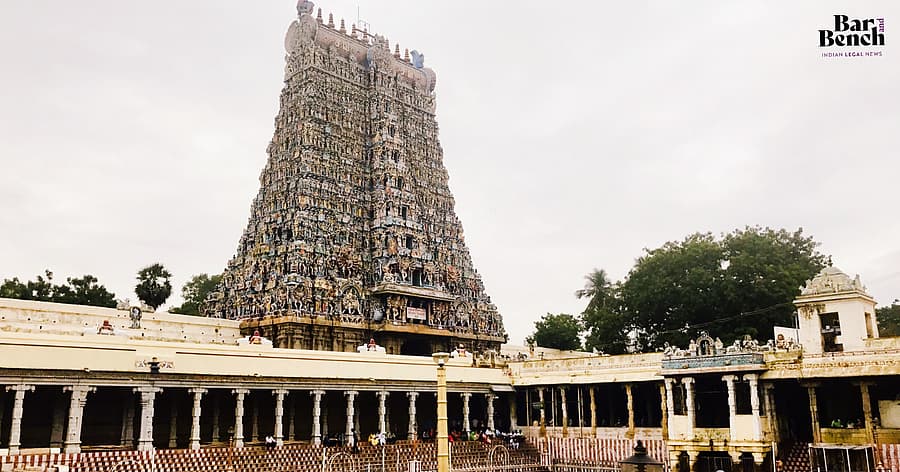
Madras High Court: Non-Hindus Must Declare Faith for Agamic Temple Entry
Summary
- The Madras High Court ruled that non-Hindus cannot enter Agamic temples in Tamil Nadu without affirming belief in the presiding deity.
- Entry also requires non-Hindus to agree to follow the temple's established customs and practices.
- This undertaking must be provided in a format prescribed by the specific temple institution.
- The ruling, from the case Thangam Venkatesh Vs State of TN, applies exclusively to Agamic temples.
- The court distinguished Agamic temples from more inclusive sites like those for Lord Ayyappa or Shirdi Sai Baba.
What Happened
A Division Bench, comprising Justices GR Swaminathan and P Murugan, ruled that individuals not belonging to the Hindu faith may not enter these specific temples unless they formally declare their belief in the presiding deity and commit to observing the established customs and practices of the institution.
The Madras High Court recently delivered a significant judgment concerning access to Agamic temples in Tamil Nadu, stipulating new conditions for non-Hindus. A Division Bench, comprising Justices GR Swaminathan and P Murugan, ruled that individuals not belonging to the Hindu faith may not enter these specific temples unless they formally declare their belief in the presiding deity and commit to observing the established customs and practices of the institution. This decision, issued on October 23 in the case of Thangam Venkatesh Vs State of TN, provides clear guidance on temple entry protocols.
The court's directive extends beyond mere entry into the sanctum, clarifying that even access to the broader temple premises is restricted for non-Hindus who display their own religious symbols or who do not express reverence for the deity. To gain entry, any non-Hindu must provide an undertaking, the specific format of which is to be determined by the individual temple management. This requirement underscores the court's emphasis on the spiritual sanctity and traditional observances within Agamic religious spaces.
Legal Context and Distinctions
This ruling by the Madras High Court religious institutions specifically addresses Agamic temples, which are defined as Hindu temples whose architectural design, ritualistic practices, and forms of worship strictly adhere to the principles outlined in the Agamas, ancient Hindu scriptures. The judgment meticulously distinguishes these traditional temples from other places of worship that historically welcome a broader spectrum of devotees, irrespective of their religious background. This distinction is crucial for understanding the scope of the new Agamic temple entry rules India.
For instance, the court drew a contrast with institutions dedicated to Lord Ayyappa and Shirdi Sai Baba. It noted that Lord Ayyappa commands a following that transcends religious boundaries, and Shirdi Sai Baba is similarly revered across diverse faiths. The court explicitly stated that its judgment on non-Hindu entry is exclusively applicable to Agamic temples, thereby not imposing the same conditions on religious sites that have traditionally embraced a more inclusive approach to worship and pilgrimage. This clarification helps delineate the specific application of the Tamil Nadu temple access law in this context.
Why It Matters
The judgment from the Madras High Court on non-Hindu Agamic temple entry carries considerable weight for religious trusts, temple management committees, and individuals navigating religious freedom in India. The Justice GR Swaminathan temple judgment provides a definitive legal framework, affirming the right of Agamic temples to maintain their distinct religious identity and practices by requiring a formal undertaking of belief from non-Hindu visitors. This impacts how temple authorities formulate and enforce their entry policies, particularly in Tamil Nadu.
This ruling clarifies that while religious freedom is a fundamental right, it does not automatically grant unrestricted access to all religious institutions, especially those with specific scriptural mandates like Agamic temples. The October 23 judgment reinforces the idea that the sanctity and traditional customs of these temples can be protected through specific entry requirements. For lawyers advising on these matters, the decision in Thangam Venkatesh Vs State of TN serves as a critical precedent for managing access to traditional Hindu places of worship, ensuring that policy formulation and any future legal challenges related to temple access are informed by this judicial interpretation.
Practical Implications
Lawyers advising religious trusts, temple management committees, or individuals on religious freedom in India should note this Madras High Court ruling. It clarifies that Agamic temples can require non-Hindus to provide an undertaking of belief in the deity and adherence to customs for entry, impacting policy formulation and legal challenges related to temple access.
Source
How does this affect you?
Get an AI analysis of this article grounded in your jurisdictions, practice areas, and any policy documents you've uploaded to Wansom.
Finish Reading the Full Story and the Expert Analysis.
Wansom is AI and can make mistakes.