
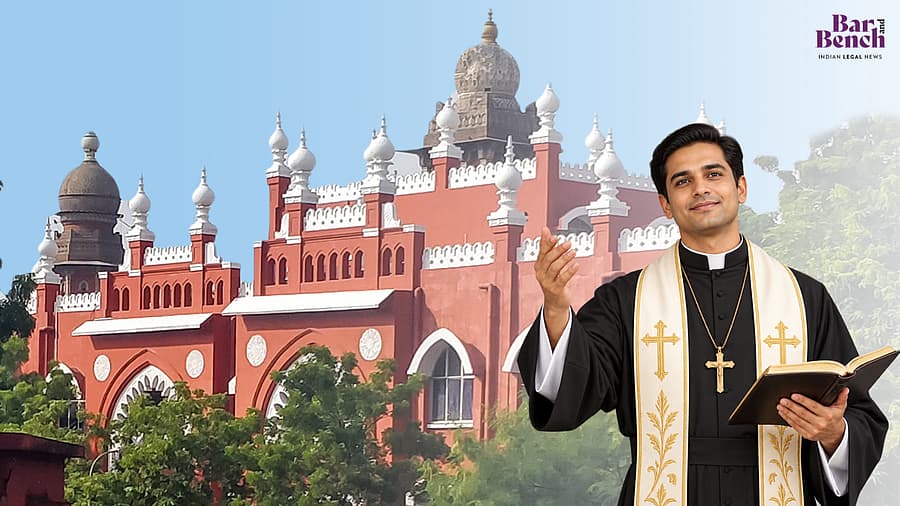
Madras High Court: ABVM vs Deiva Nayagan Rules Priest Property Belongs to Order
Summary
- The Madras High Court ruled that properties acquired by Catholic priests after taking religious vows belong to their religious society, not their legal heirs.
- The decision was made by Justices N Anand Venkatesh and KK Ramakrishnan in the case of ABVM vs Deiva Nayagan, overturning a district court order concerning ₹56 lakh in fixed deposits.
- The court emphasized that property ownership is determined by religious obligations and the institutional character of acquisition, not solely by individual title documents.
- The ruling clarified that while 'civil death' implies renunciation of worldly interests, it does not strip a priest of legal personhood or all civil rights.
- This judgment provides critical clarity for religious order property rights in India and impacts succession planning for priests.
Court Clarifies Property Ownership for Catholic Priests
The Madras High Court has issued a significant ruling clarifying that assets acquired by Catholic priests after they have joined a religious order and taken their vows belong to the religious society, not to their individual legal heirs.
The Madras High Court has issued a significant ruling clarifying that assets acquired by Catholic priests after they have joined a religious order and taken their vows belong to the religious society, not to their individual legal heirs. This decision, delivered by a Division Bench comprising Justices N Anand Venkatesh and KK Ramakrishnan in the case of ABVM vs Deiva Nayagan Madras High Court, overturns a prior district court order that had granted succession rights to the relatives of a deceased priest over fixed deposits valued at ₹56 lakh.
The High Court's judgment specifically addressed appeals filed by a Catholic religious society, which contended that the property in question was institutionally owned. The court's determination establishes a precedent for how property ownership is to be assessed when a priest, having renounced worldly ties, acquires assets during their service within a religious order. This ruling directly impacts priest inheritance legal heirs India, providing clarity on the disposition of such assets.
Legal Basis for the Ruling
The Madras High Court emphasized that the ownership of properties obtained during a priest's religious service must be evaluated based on the specific obligations undertaken by the priest and the institutional nature of the acquisition. The court stated that the mere fact that title documents might be in an individual priest's name does not automatically confer personal ownership, especially when viewed against the backdrop of their religious commitment. This principle is central to understanding religious order property rights India.
The court further elaborated on the concept of 'civil death' in the context of a person entering a religious order. This doctrine signifies an individual's renunciation of worldly relationships and interests upon taking religious vows. However, the Bench was careful to clarify that this 'civil death concept property law' does not imply that a priest ceases to exist as a legal person or forfeits all civil rights. Instead, it primarily pertains to the renunciation of personal worldly possessions and familial claims, particularly concerning property acquired post-vows.
Implications for Religious Societies and Succession
This judgment by Justices N Anand Venkatesh and KK Ramakrishnan provides crucial guidance for Catholic religious societies and individual priests across India regarding property ownership and succession planning. By affirming that property acquired after joining an order belongs to the society, the ruling helps prevent disputes between religious institutions and the legal heirs of deceased priests. It reinforces the institutional character of assets obtained by individuals who have committed to a life of religious service.
The decision in ABVM vs Deiva Nayagan Madras High Court underscores the unique legal position of religious professionals and their assets. It ensures that the intent behind a priest's renunciation of worldly possessions is respected in the eyes of the law, thereby safeguarding the assets of religious orders and streamlining the process of managing Madras High Court Catholic priest property. This clarity is vital for the long-term financial stability and operational continuity of religious institutions.
Practical Implications
Lawyers advising Catholic religious societies or individual priests in India must be aware of this Madras High Court precedent, which clarifies that property acquired by a priest after taking religious vows belongs to the society, not their legal heirs. This ruling is critical for estate planning, succession disputes, and advising on the legal implications of renouncing worldly interests upon entering a religious order.
Source
How does this affect you?
Get an AI analysis of this article grounded in your jurisdictions, practice areas, and any policy documents you've uploaded to Wansom.
Finish Reading the Full Story and the Expert Analysis.
Get the latest legal & regulatory intelligence in India
Wansom is AI and can make mistakes.