
Madagascar: Décret 2026-2432 Enelec Réquisition in Toamasina
Summary
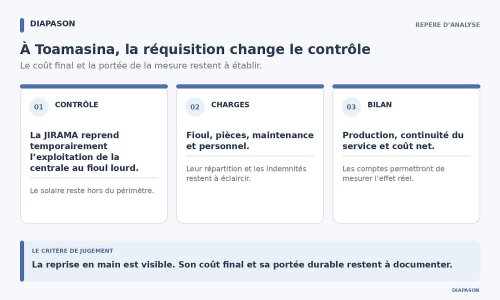
- The Malagasy government has temporarily requisitioned Enelec's heavy fuel oil power plant in Toamasina via Décret n° 2026-2432 du 3 novembre.
- State utility JIRAMA has assumed operational control of the plant and its staff, with the requisition capped at 24 months and Enelec's solar assets excluded.
- The intervention, authorized by the Code de l'électricité, aims to address persistent power outages and Enelec's alleged operational deficiencies.
- Significant financial ambiguities persist regarding who will cover costs for fuel, salaries, maintenance, existing debts, and potential compensation for the requisitioned assets.
- This action highlights the state's willingness to invoke emergency powers to ensure energy supply amidst Madagascar's ongoing power crisis and JIRAMA's substantial debt.
State Intervention at Enelec
The critical lack of public information regarding specific financial arrangements, compensation amounts, or payment responsibilities for fuel, maintenance, and outstanding debts creates significant uncertainty for all parties involved.
The Malagasy government has initiated a temporary operational takeover of Enelec's heavy fuel oil power plant located in Toamasina, along with all necessary operational assets. This action was formalized by Décret n° 2026-2432 du 3 novembre, which places the facility under requisition. Under this decree, the state utility JIRAMA assumes direct operational control of the plant, though Enelec's solar energy assets are specifically excluded from this measure. Reports indicate that Enelec's contract with JIRAMA has been terminated.
This intervention, characterized as a temporary measure, is capped at a maximum duration of twenty-four months. A critical aspect of the Décret 2026-2432 Enelec réquisition Madagascar is its lack of clarity regarding financial responsibilities. The decree does not explicitly define who will bear the costs for essential operational expenses such as fuel, employee salaries, ongoing maintenance, existing debts, or any potential compensation due to Enelec as a result of the requisition. This ambiguity creates immediate financial uncertainty for all parties involved in the JIRAMA Enelec takeover in Toamasina.
Madagascar's Persistent Power Challenges
This state intervention unfolds against a backdrop of severe and ongoing electricity supply issues across Madagascar. In Antananarivo, a brief respite from power cuts was observed in late September 2025, preceding the presidential inauguration on October 17. This temporary improvement was attributed to a reduction in demand coinciding with a slowdown in economic activities, coupled with the commissioning of two new combustion turbines on September 23. However, this relief was both costly, with the turbines incurring approximately 300 million Ariary for just five hours of operation, and short-lived.
By November 5, load shedding had returned to the capital. JIRAMA explained that only one of the four units at the Andekaleka power station was functional during peak demand, producing a mere 24 megawatts, significantly below its announced capacity of 120 megawatts. The continuity of power supply across the nation is demonstrably dependent on fluctuating demand, the operational status of existing infrastructure, and the availability of water resources. In Toamasina, the situation was exacerbated by Cyclone Gezani in early 2026, which severely damaged the power grid. By March, only 62 out of 138 fokontany had electricity restored, while the Enelec plant itself was operating at a mere 30% capacity. Persistent night-time outages continued into October, despite Enelec's announcement of deploying ten mobile units intended to add 1.8 megawatts to the local grid. These events underscore the systemic challenges facing the Madagascar energy sector state control efforts.
Further escalating tensions, in July, the President of the Republic of Madagascar (PRRM) issued Enelec a one-week ultimatum to restore power production in several cities and publicly challenged the terms of its contract with JIRAMA. The PRRM asserted the existence of a clause guaranteeing Enelec 65% of its payment regardless of actual production, a claim reportedly corroborated by a JIRAMA source, though the contract itself remains inaccessible. While this specific example pertained to Antsiranana, not Toamasina, and Enelec cited technical problems, the confrontation highlighted the political dimensions underlying the eventual requisition.
Legal Basis and Unresolved Financial Questions
The legal foundation for this significant intervention is rooted in the Code de l'électricité, which empowers the state to take emergency measures to ensure the continuity of essential services in instances of supplier deficiency. The Décret n° 2026-2432 du 3 novembre stipulates that the requisition will conclude once the circumstances justifying it are resolved, with a definitive end date no later than twenty-four months from its notification. Furthermore, the decree authorizes JIRAMA to directly procure necessary maintenance parts for the plant. Enelec's existing personnel are to remain in their roles, operating under JIRAMA's direction, with JIRAMA reportedly contributing to their salaries.
It is crucial to understand that this Enelec power plant requisition legal action constitutes a transfer of operational control, not a transfer of ownership of the company or its assets. The Code de l'électricité explicitly recognizes the title holder's ownership rights over installations for the duration of their title. It also provides for compensation in cases of early contract withdrawal that are not a result of the title holder's breach of contract. For the requisitioned assets themselves, any compensation amount is to be determined by an independent evaluation commission. These compensation frameworks are distinct from potential payments related to salaries or the reported termination of Enelec's contract. The critical lack of public information regarding specific financial arrangements, compensation amounts, or payment responsibilities for fuel, maintenance, and outstanding debts creates significant uncertainty for all parties involved.
Broader Implications for Energy Security
The Décret 2026-2432 Enelec réquisition Madagascar underscores the Malagasy state's readiness to invoke emergency powers to safeguard its energy supply, particularly in the face of persistent outages and perceived deficiencies from private operators. This action, while not a permanent nationalization, represents a significant assertion of state control over a private energy asset and necessitates JIRAMA assuming certain operational expenditures. The ultimate financial outcome of this temporary takeover will heavily depend on how costs for fuel, repairs, staff salaries, existing debts, and any eventual indemnities are allocated and managed.
This event also brings into sharp focus the precarious state of Madagascar's energy sector. In 2022, only an estimated 36% of the population had access to electricity. The economic viability of power generation is severely challenged by a stark imbalance between production costs, which can reach as high as 2,946 Ariary per kilowatt-hour in some plants, and an average tariff of just 372 Ariary. This disparity contributes significantly to the financial woes of JIRAMA, whose debt has already surpassed $625 million. The Enelec takeover, therefore, is not merely an isolated incident but a symptom of deeper structural issues within the nation's energy landscape, setting a precedent for how the state might address future energy supply crises.
Practical Implications
This requisition highlights the Malagasy state's willingness to invoke emergency powers under the Code de l'électricité to ensure energy supply. Lawyers advising energy companies in Madagascar should review their contracts for state intervention clauses and potential compensation disputes arising from such temporary operational takeovers, especially regarding unclear payment responsibilities for fuel, salaries, and maintenance.
Source
Source: Original reporting via Diapason
How does this affect you?
Get an AI analysis of this article grounded in your jurisdictions, practice areas, and any policy documents you've uploaded to Wansom.
Finish Reading the Full Story and the Expert Analysis.
Get the latest legal & regulatory intelligence in Madagascar
Wansom is AI and can make mistakes.