
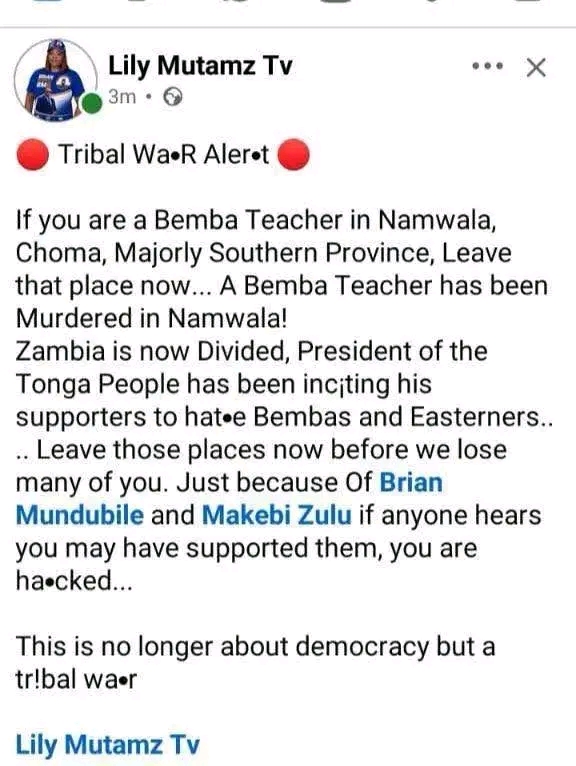
Lillian Mutambo: Zambia Takes Legal Action Over Incitement
Summary
- Lillian Mutambo's recent statements have been widely criticized as dangerous tribal incitement and the promotion of tribal hegemony, with legal proceedings initiated against her for related online statements.
- These remarks are seen as a direct threat to Zambia's national unity and are not considered ordinary political debate.
- Critics are demanding legal action against Mutambo, emphasizing that her statements must be addressed, and legal proceedings have already begun.
- The 1948 Genocide Convention, which remains in force, recognizes "direct and public incitement to commit [...]" as a serious offense, providing an international legal context for the calls for action.
Allegations of Tribal Incitement in Zambia
The ongoing discussion surrounding Lillian Mutambo's incitement and the legal actions initiated against her in Zambia highlight the critical importance placed on maintaining a unified and peaceful society.
Lillian Mutambo has recently become the subject of significant public concern following a series of pronouncements that have drawn sharp criticism. Her statements are being widely characterized as having crossed a critical boundary, moving beyond acceptable political discourse into the realm of dangerous tribal incitement. These remarks are further described as actively promoting tribal hegemony, suggesting an intent to elevate one tribal group above others within the nation. The gravity of these utterances has prompted immediate and forceful calls for decisive action, and legal proceedings have been initiated against her for related online statements.
The prevailing view among critics is that Mutambo's rhetoric poses a direct and serious threat to the fundamental unity of Zambia. Unlike the typical exchanges and debates that characterize ordinary political engagement, these specific statements are deemed to be of a far more perilous nature. They are not considered mere political opinions but rather expressions that could actively sow discord and division among the populace. This distinction underscores the urgent demand for a response that acknowledges the profound potential for harm these statements carry for the nation's social cohesion and stability.
International Legal Framework for Incitement
The serious nature of the allegations against Lillian Mutambo is further underscored by established international legal precedents concerning incitement. A cornerstone of international law, the 1948 Genocide Convention, explicitly addresses and condemns certain forms of public speech. This crucial international treaty, which remains in force today, recognizes "direct and public incitement to commit [...]" as a grave offense, highlighting the global consensus on the dangers posed by rhetoric that encourages severe group-based harm. The Convention's provisions serve as a powerful reminder of the legal responsibilities individuals hold regarding their public utterances, particularly when those statements could be interpreted as promoting division or hostility.
In the context of Zambia, the principles enshrined within the 1948 Genocide Convention provide a significant legal backdrop to the current controversy. The characterization of Lillian Mutambo's statements as "dangerous tribal incitement" directly resonates with the type of conduct that international instruments aim to prevent. This connection suggests that the ongoing legal actions in Zambia against Mutambo for her alleged incitement and related online statements align with broader international standards designed to safeguard populations from the destructive consequences of divisive rhetoric. The emphasis on "incitement" within the Convention reinforces the argument that such speech should not be dismissed as ordinary political commentary but rather treated with the seriousness it warrants under both national and international law.
Calls for Legal Action and National Stability
The strong condemnation of Lillian Mutambo's statements has culminated in widespread demands for concrete legal action, with legal proceedings already initiated against her for related online statements. Proponents of this view argue that such intervention is not merely punitive but essential for safeguarding Zambia's delicate national unity. Allowing rhetoric that promotes tribal hegemony and dangerous incitement to go unaddressed, they contend, would signal a dangerous tolerance for divisive speech, potentially eroding the foundational principles upon which the nation is built. The call for action reflects a collective desire to reinforce the boundaries of acceptable public discourse and to protect the country from internal fragmentation.
The implications of failing to act against statements deemed to be tribal incitement extend far beyond the immediate controversy, posing a significant challenge to Zambia's long-term stability. If such pronouncements are treated as ordinary political debate, it risks normalizing divisive narratives and potentially fostering an environment where tribal tensions could escalate. Therefore, the insistence that these statements "must be acted upon" underscores a deep concern for the preservation of national cohesion and the prevention of any actions that could destabilize the country. The ongoing discussion surrounding Lillian Mutambo's incitement and the legal actions initiated against her in Zambia highlight the critical importance placed on maintaining a unified and peaceful society.
Source
How does this affect you?
Get an AI analysis of this article grounded in your jurisdictions, practice areas, and any policy documents you've uploaded to Wansom.
Finish Reading the Full Story and the Expert Analysis.
Wansom is AI and can make mistakes.