
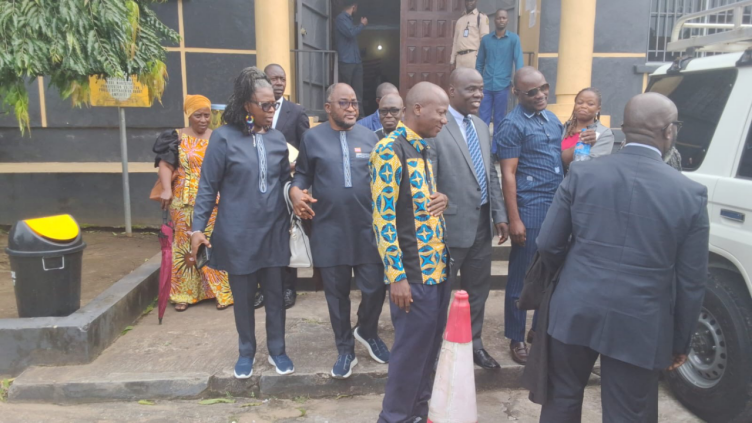
Liberia: Saudi Rice Trial Final Arguments Scheduled
Summary
- The Liberia Saudi rice trial is set for final arguments before a jury on Friday, October 9, 2026, at Criminal Court "C" in Monrovia.
- The case involves the alleged misappropriation of 25,054 bags of Saudi-donated rice, valued at approximately US$425,918.
- Defendant Dee-Maxwell Saah Kemayah, former Foreign Affairs Minister, denies the allegations, stating his role was limited to facilitating the donation.
- The evidentiary phase has concluded, with both prosecution and defense now preparing their legal arguments for the jury.
- The trial's outcome is expected to set precedents for public accountability and the handling of international aid in Liberia.
Trial Nears Conclusion
The outcome of this Liberia Saudi rice trial holds significant weight for public accountability and governance within the nation.
The high-profile Liberia Saudi rice trial is poised to enter its decisive phase, with final arguments scheduled before a jury at Criminal Court "C" in Monrovia on Friday, October 9, 2026, at 8:00 a.m. This critical juncture follows the recent conclusion of the evidentiary portion of the proceedings, which saw the prosecution present its final rebuttal witnesses on Wednesday. The court has now directed both the prosecution and defense to prepare their respective post-trial memoranda, detailing the legal precedents and citations they intend to rely upon to support their cases.
This significant public corruption trial centers on allegations surrounding the handling and distribution of a substantial humanitarian donation: 29,412 bags of 25-kilogram rice provided by the Kingdom of Saudi Arabia to Liberia. The transition from witness testimonies and exhibits to legal and factual arguments marks a pivotal moment, as both sides will now present their interpretations of the evidence to the jury, aiming to sway their verdict in a case that has drawn considerable public attention.
Allegations and Contested Evidence
At the heart of the Dee-Maxwell Saah Kemayah trial are claims by the State that a considerable portion of the Saudi-donated rice was unlawfully diverted. The prosecution's indictment specifically targets 25,054 bags of rice, after accounting for quantities deemed legitimately supplied, placing the alleged value of the disputed commodity at approximately US$425,918. The State has meticulously traced the movement of the donation from its initial receipt into government storage through various institutions and intended beneficiaries.
However, the defense has consistently challenged the State's accounting and the evidentiary foundation for the quantities presented during the proceedings. A central point of contention has been the transfer of rice from the National Disaster Management Agency (NDMA) to warehouses managed by the General Services Agency (GSA). Former Internal Affairs Minister Varney A. Sirleaf, who also chaired the NDMA Board, provided testimony asserting that this transfer was an institutional decision, explicitly rejecting any suggestion that former Foreign Affairs Minister Dee-Maxwell Saah Kemayah had personally directed him to move the rice. Additionally, former Director-General of the General Services Agency (GSA) Mary T. Broh offered evidence regarding the involvement of various government agencies in the commodity's movement and distribution.
Defendant's Stance and Evidentiary Closure
Former Foreign Affairs Minister Dee-Maxwell Saah Kemayah, a key defendant in the Liberia public corruption trial, has steadfastly denied the charges against him. Testifying in his own defense, Kemayah maintained that he did not misappropriate any of the Saudi-donated rice, clarifying that his involvement was solely in facilitating the donation between the two nations. His testimony directly challenged the prosecution's characterization of the rice's movement, particularly questioning the roles of the government institutions responsible for its reception, storage, and eventual distribution.
The defense's core argument posits that administrative decisions concerning the rice, even if subject to scrutiny, should not automatically be construed as evidence of criminal conduct. With the evidentiary phase now formally closed following the prosecution's final rebuttal on Wednesday, neither side is expected to introduce further witnesses. Instead, the focus for the upcoming Criminal Court C Liberia closing arguments will be on how each party interprets the extensive body of evidence presented, with the prosecution aiming to establish the alleged offenses and link defendants to wrongdoing, while the defense seeks to dismantle those conclusions.
Broader Implications for Accountability
The outcome of this Liberia Saudi rice trial holds significant weight for public accountability and governance within the nation. As a high-profile case involving alleged misappropriation of international aid, the jury's verdict and any subsequent legal processes could establish crucial precedents regarding the standards of evidence required in such complex cases and the level of responsibility expected from public officials.
This trial underscores the challenges inherent in managing large-scale humanitarian donations and the intense scrutiny that accompanies allegations of corruption in their distribution. The proceedings have highlighted the intricate interplay between various government agencies and the potential for conflicting accounts regarding the movement of vital resources. The final judgment will be keenly observed by legal professionals and compliance officers, as it may influence future approaches to prosecuting public officials and safeguarding international assistance in Liberia.
Practical Implications
Lawyers and compliance officers in Liberia should closely monitor the outcome of this high-profile public corruption trial, as the jury's verdict and any subsequent appeals could establish significant precedents regarding accountability for public officials and the evidentiary standards required in cases involving the alleged misappropriation of international aid.
Source
How does this affect you?
Get an AI analysis of this article grounded in your jurisdictions, practice areas, and any policy documents you've uploaded to Wansom.
Finish Reading the Full Story and the Expert Analysis.
Get the latest legal & regulatory intelligence in Liberia
Wansom is AI and can make mistakes.