
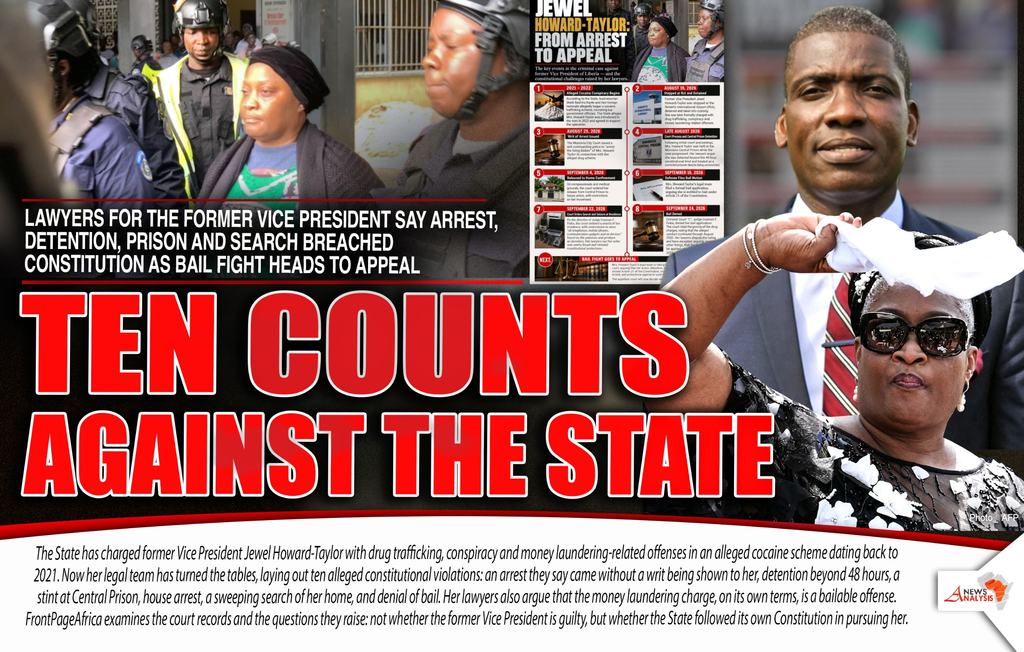
Liberia: Lawyers for the former Vice President Say Arrest, Detention, Prison and Search Breached Constitution as Bail Fight Heads to Appeal
Summary
- Liberia's former Vice President, Jewel Howard-Taylor, was arrested on August 25, 2026, and is currently under house arrest with bail denied.
- She faces charges under the Controlled Drugs and Substances Act of 2023, New Penal Law, and AML-CFT Act of 2021, related to an alleged international cocaine trafficking conspiracy.
- Her legal team argues ten constitutional breaches, primarily citing a violation of Article 21's 48-hour rule for charging and presenting an accused before a court.
- The defense claims Ms. Howard-Taylor was held beyond the 48-hour limit without proper judicial process, among other procedural irregularities.
- The ongoing appeal is critical for establishing precedents regarding constitutional due process, particularly the 48-hour rule, in Liberian criminal proceedings.
High-Profile Arrest and Constitutional Challenge
If the defense's timeline regarding Ms. Howard-Taylor's detention beyond this 48-hour window is substantiated, it would represent a clear and straightforward constitutional breach, as this rule is not subject to discretion.
A significant criminal proceeding against Jewel Howard-Taylor, Liberia's former Vice President, commenced with a writ of arrest issued by the Monrovia City Court on August 19, 2026. This action initiated one of the most high-profile cases involving a former senior official in recent Liberian history. Currently, approximately one month following her arrest, Ms. Howard-Taylor remains under house arrest, with her application for bail having been denied. Authorities have also confiscated her mobile phones and computers as part of the ongoing investigation.
Her legal team has launched a robust challenge, asserting that nearly every step taken by the state against their client has violated the Liberian Constitution. In a formal declaration, her lawyers enumerate ten distinct instances where they contend Ms. Howard-Taylor's liberty was curtailed or restricted without due regard for the constitutional safeguards enshrined in Article 21 of the 1986 Constitution. While the state's allegations against her are yet to be substantiated, the defense's claims of constitutional breaches will also undergo judicial scrutiny as the case progresses, particularly through the Jewel Howard-Taylor bail denial appeal Liberia.
State's Allegations of Drug Trafficking Conspiracy
The writ of arrest outlines the government's case, detailing a complex international drug trafficking scheme. According to the state, businessman Sheik Bashiru Kante facilitated the entry of two foreign nationals, Taras Zadereiko (also known as Tony) and Mihovil Vrovac (also known as Michael), into Liberia in 2021. These individuals are alleged to have conspired to import and export cocaine, using Liberia as a transit point for shipments destined for Europe.
The prosecution further claims that the conspirators sought to enlist high-ranking government officials to protect their illicit operations. In 2022, Kante reportedly introduced the two foreign nationals to Ms. Howard-Taylor, who was then serving as Vice President. The writ alleges that early in 2022, she met with these men at her Sophie residence in Congo Town. Subsequently, she was purportedly invited to Dubai to meet Nikola Ivancic, a Croatian national whom the government identifies as a drug kingpin and the cartel's ringleader. Prosecutors contend that a meeting took place in Dubai where the use of Liberia as a cocaine transit hub was discussed, and Ms. Howard-Taylor allegedly agreed to this arrangement. She is accused of receiving US$45,000 from Ivancic in Dubai for shopping, later requesting and receiving an additional US$75,000 from the cartel via Kante, and subsequently obtaining a further US$15,000. These actions have led to charges under the Controlled Drugs and Substances Act of 2023, the New Penal Law, and the AML-CFT Act of 2021, including importation and exportation of controlled drugs, illicit trafficking, criminal conspiracy, criminal facilitation, and criminal solicitation.
Defense's Constitutional Grievances
The legal team for Ms. Howard-Taylor has chosen not to address the merits of the state's allegations at this stage, instead focusing on procedural irregularities and constitutional violations. Their formal statement outlines ten specific grievances, central to which is the alleged violation of Liberia Article 21 constitutional rights. Key among these is the assertion that Ms. Howard-Taylor was incarcerated beyond the constitutionally mandated 48-hour period without being formally charged and presented before a competent court, constituting a significant Howard-Taylor 48-hour rule violation.
Other points of contention include her arrest without the presentation of a writ, the absence of a demonstrated completed investigation to justify her initial deprivation of liberty, and the lack of an indictment at the relevant stage. The defense also challenges her incarceration at the Monrovia Central Prison while unconvicted, arguing that her treatment was inconsistent with the distinction between an accused and a convicted prisoner. Further grievances encompass the imposition of house arrest with substantial movement restrictions, continued pretrial deprivation of liberty, and the denial of bail despite the passage of several years since the alleged conduct. The lawyers emphasize that an accusation does not equate to a conviction, underscoring the importance of due process.
Significance of the Appeal
The ongoing Jewel Howard-Taylor bail denial appeal Liberia is poised to become a landmark case, particularly concerning the strict adherence to constitutional due process in Liberian criminal proceedings. The defense's focus on Article 21 of the 1986 Constitution, which unequivocally mandates that anyone arrested must be formally charged and presented before a court within 48 hours, highlights a critical aspect of fundamental rights. If the defense's timeline regarding Ms. Howard-Taylor's detention beyond this 48-hour window is substantiated, it would represent a clear and straightforward constitutional breach, as this rule is not subject to discretion.
This Liberia criminal procedure appeal carries significant weight for future high-profile cases, especially those involving Liberia former VP detention or other senior officials. The outcome could establish a vital precedent for challenging state actions related to arrest, detention, and bail, reinforcing the constitutional limits on governmental authority even in serious criminal investigations. The legal team acknowledges the state's right to investigate alleged criminal conduct but insists that such authority must be exercised strictly within constitutional boundaries, making this appeal a crucial test of judicial oversight and constitutional protection.
Practical Implications
This case highlights the critical importance of strict adherence to constitutional due process, particularly Article 21's 48-hour rule, in Liberian criminal proceedings. Lawyers should monitor the appeal's outcome as it could set a significant precedent for challenging state actions related to arrest, detention, and bail in high-profile cases.
Source
How does this affect you?
Get an AI analysis of this article grounded in your jurisdictions, practice areas, and any policy documents you've uploaded to Wansom.
Finish Reading the Full Story and the Expert Analysis.
Get the latest legal & regulatory intelligence in Liberia
Wansom is AI and can make mistakes.