
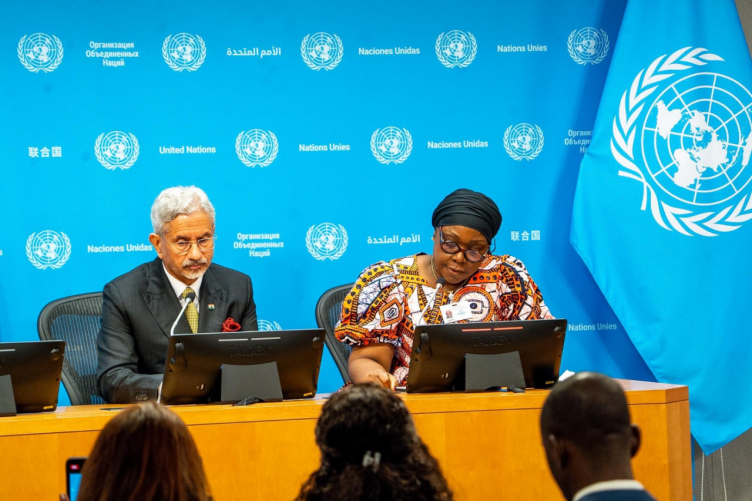
Liberia, India: Launch Maritime Security Pact for Seafarer Safety
Summary
- Liberia and India launched the Group of Friends on Safety and Security of Shipping and Seafarers (GoF on S4) at the UN General Assembly.
- The pact unites Liberia, which runs the world's largest shipping registry, with India, a major supplier of global seafarers.
- The alliance addresses escalating maritime dangers, including attacks on commercial vessels and the severe hardships faced by nearly two million seafarers.
- Its core objectives are to enhance shipping safety, bolster maritime transport security, and provide comprehensive protection for seafarers.
- India has also proposed a Seafarers Emergency Support Network and co-hosted a UN meeting focused on seafarer protection.
A New Maritime Alliance Takes Shape
This unique collaboration seeks to formalize an existing, albeit often unacknowledged, interdependence between the two nations, whose stakes in global shipping are immense yet distinct.
A significant diplomatic partnership, the Group of Friends on Safety and Security of Shipping and Seafarers (GoF on S4), was recently inaugurated on the sidelines of the 81st session of the United Nations General Assembly in New York. This initiative, launched by Liberia's Foreign Minister Sara Beysolow Nyanti and India's External Affairs Minister Dr. S. Jaishankar, brings together two nations with profoundly different yet complementary roles in the global maritime sector.
Liberia maintains the world's largest shipping registry by gross tonnage, a remarkable achievement for the West African nation. Concurrently, India stands as one of the foremost suppliers of the seafarers who crew these vessels. This unique collaboration seeks to formalize an existing, albeit often unacknowledged, interdependence between the two nations, whose stakes in global shipping are immense yet distinct. Minister Nyanti hailed the launch as a landmark diplomatic and maritime achievement, underscoring that over 80 percent of the world's goods are transported by sea, making the oceans the backbone of the global economy.
Escalating Threats on the High Seas
The formation of the GoF on S4 comes at a critical juncture, as maritime routes have become increasingly perilous. Minister Jaishankar highlighted recent attacks on commercial ships in vital waterways such as the Gulf, the Red Sea, and the Black Sea, noting that these incidents have tragically claimed innocent lives, including those of Indian seafarers. He unequivocally stated that attacks on civilian shipping, which disrupt trade and endanger human lives, are unacceptable.
For Liberia, these threats are not abstract; several Liberian-flagged vessels have been targeted in Red Sea attacks in recent years, inadvertently placing the nation's flag in the midst of conflicts in which it has no direct involvement. Beyond direct attacks, Jaishankar also drew attention to the less visible but equally severe hardships faced by nearly two million seafarers worldwide. These include prolonged confinement aboard ships, delays in crew changes and repatriation, extended separation from families, and the significant psychological toll these conditions impose, all of which necessitate stronger international protection.
Pillars of Protection and Global Cooperation
Minister Nyanti outlined the three foundational pillars upon which the GoF on S4 is built: ensuring the safety of shipping, enhancing the security of maritime transport, and robustly protecting seafarers. Regarding safety, the group will focus on upholding strict technical standards, ensuring vessel compliance, and promoting environmental stewardship. For security, the emphasis will be on safeguarding commercial sea lanes from threats such as piracy, armed attacks, regional instability, and emerging asymmetric challenges.
On the crucial aspect of seafarer protection, the group aims to address issues like crew abandonment, advocate for fair labor standards, facilitate rapid medical assistance, and ensure the safety of crews navigating through conflict zones. Nyanti also clarified that the GoF on S4 is designed to be action-oriented and to complement, rather than duplicate, the vital work already being undertaken by established international bodies such as the International Maritime Organization (IMO) and the International Labour Organization (ILO).
India's Proactive Role in Seafarer Welfare
India has demonstrated a proactive stance in advocating for seafarer welfare and maritime security, bringing its own initiatives to the global stage. Minister Jaishankar recalled India's proposal at a recent BRICS Summit for a Seafarers Emergency Support Network. This proposed network aims to establish a crucial link between maritime authorities and embassies to effectively manage distress alerts, provide medical assistance, facilitate family communications, and coordinate evacuations for seafarers in need.
Further underscoring its commitment, India, in collaboration with Greece and the Philippines, co-hosted a United Nations Arria Formula meeting in November 2025. This meeting was specifically dedicated to discussing and advancing the protection of seafarers, highlighting India's consistent efforts to champion the rights and safety of the global maritime workforce.
Source
Source: Original reporting via {source}
How does this affect you?
Get an AI analysis of this article grounded in your jurisdictions, practice areas, and any policy documents you've uploaded to Wansom.
Finish Reading the Full Story and the Expert Analysis.
Get the latest legal & regulatory intelligence in Liberia
Wansom is AI and can make mistakes.