
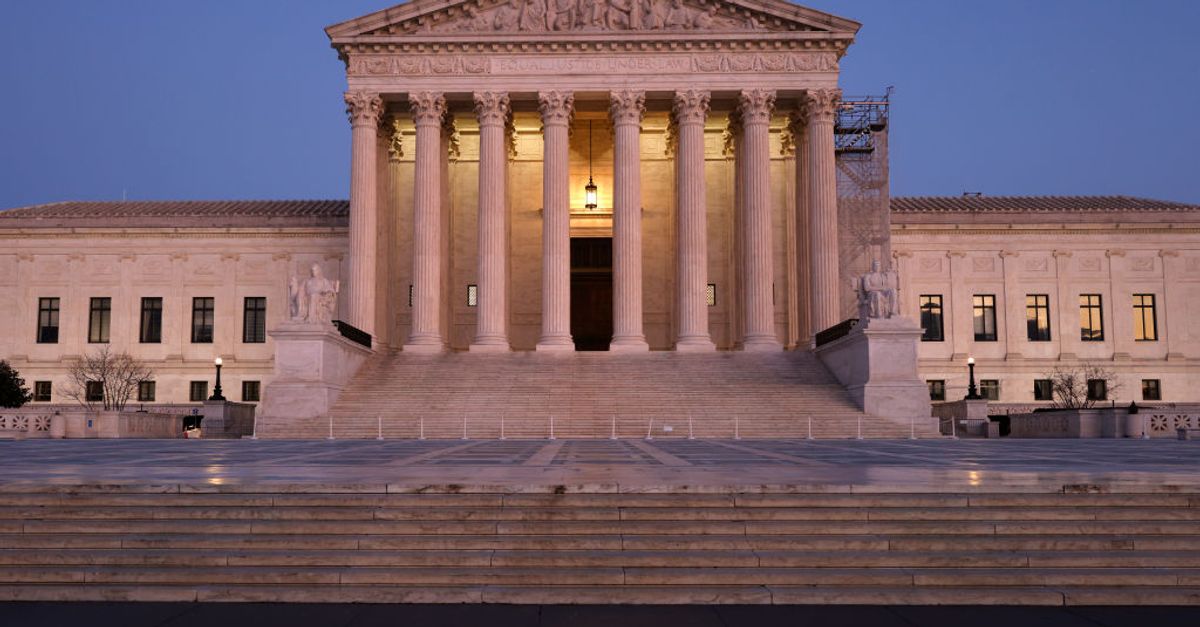
Supreme Court: Federal Lawmaking Separation of Powers Overly Simplified
Summary
- The Supreme Court's reliance on an abstract "separation of powers" concept is critiqued for oversimplifying federal lawmaking.
- The Constitution lacks a specific "separation of powers" clause, instead relying on distinct provisions to enforce power separation.
- Justices, including Sonia Sotomayor, Amy Coney Barrett, and Chief Justice John Roberts (in Learning Resources v. Trump), frequently refer to Congress as unilaterally making law.
- The Court is urged to abandon this practice and refer to specific constitutional provisions to better respect the multi-branch lawmaking process.
- This shift would provide greater specificity to the separation-of-powers provisions governing federal lawmaking.
Reassessing Federal Lawmaking Dynamics
To truly honor the Constitution's design, the Supreme Court is advised to discontinue its consistent practice of portraying Congress as if it possesses the sole capacity to enact laws.
A critical examination of the Supreme Court's approach to federal lawmaking reveals a recurring tendency to conceptualize the legislative process in an overly simplistic manner. This perspective often attributes unilateral lawmaking authority to Congress, a practice that, according to recent analysis, warrants reconsideration for better alignment with the Constitution's intricate design. This critique builds upon an earlier argument that challenged the Court's reliance on an abstract notion of "separation of powers," advocating instead for a more precise engagement with the specific constitutional provisions that underpin such principles.
The Constitution, notably, does not contain an explicit "separation of powers" clause. Rather, it meticulously outlines a series of distinct provisions that collectively enforce the division of governmental authority. To genuinely uphold the constitutional framework, the Supreme Court is urged to move beyond generalized references and instead ground its decisions in these specific textual mandates. This shift in judicial discourse is particularly pertinent when discussing the creation of federal statutes, aiming to foster a more accurate representation of the multi-branch process involved.
Judicial Language and Constitutional Specificity
The phenomenon of judicial opinions referring to Congress as the sole actor in lawmaking is widespread, appearing in pronouncements from justices across the interpretive spectrum. For instance, in 2025, Justice Sonia Sotomayor, writing for a unanimous Court, stated that "Congress enacted ERISA to ‘protect . . . the interests of participants in employee benefit plans and their beneficiaries.’" Justice Sonia Sotomayor continues to serve as an Associate Justice of the U.S. Supreme Court. In the same year, Justice Amy Coney Barrett asserted that "Congress did not intend for courts to consider" certain factors, further illustrating this common judicial phrasing. Justice Amy Coney Barrett also continues to serve as an Associate Justice of the U.S. Supreme Court.
More recently, Chief Justice John Roberts, in the case of Learning Resources v. Trump, noted that "[t]he Government points to no statute in which Con," highlighting how judicial language often frames legislative action as singularly congressional. Chief Justice John Roberts remains the Chief Justice of the United States Supreme Court. The case Learning Resources v. Trump was a real Supreme Court case decided in 2026, which held that the International Emergency Economic Powers Act (IEEPA) does not authorize the President to unilaterally set tariffs. The Chief Justice's quoted statement is accurate from the opinion. These examples underscore a pattern where the Supreme Court's rhetoric can inadvertently obscure the complex, multi-branch nature of federal lawmaking. The ongoing SCOTUS multi-branch lawmaking critique suggests that a more nuanced articulation is necessary to reflect the Constitution's actual mechanics, where lawmaking is a shared responsibility, not a unilateral act.
Upholding Constitutional Separation of Powers
To truly honor the Constitution's design, the Supreme Court is advised to discontinue its consistent practice of portraying Congress as if it possesses the sole capacity to enact laws. This adjustment in judicial interpretation would bring a heightened level of specificity to the separation of powers provisions directly related to the federal lawmaking process. By focusing on the explicit constitutional text rather than an abstract concept, the Court can reinforce a more accurate understanding of how laws are genuinely made in the United States.
This refined approach to Constitutional separation of powers interpretation is crucial for ensuring that judicial review legislative power is exercised with a deep respect for the distributed authorities outlined in the nation's founding document. Abandoning the notion of unilateral congressional lawmaking challenge in judicial language would not only align the Court's rhetoric more closely with constitutional reality but also provide a clearer framework for future legal arguments and statutory interpretations, as explored in SCOTUSblog constitutional law analysis. SCOTUSblog remains an active and relevant source for Supreme Court analysis.
Practical Implications
This analysis provides critical insight into the Supreme Court's evolving interpretation of separation of powers in federal lawmaking, which can inform constitutional arguments, statutory interpretation, and challenges to legislative or executive actions by highlighting the Court's underlying theoretical approach.
Source
How does this affect you?
Get an AI analysis of this article grounded in your jurisdictions, practice areas, and any policy documents you've uploaded to Wansom.
Finish Reading the Full Story and the Expert Analysis.
Get the latest legal & regulatory intelligence in United States
Wansom is AI and can make mistakes.