
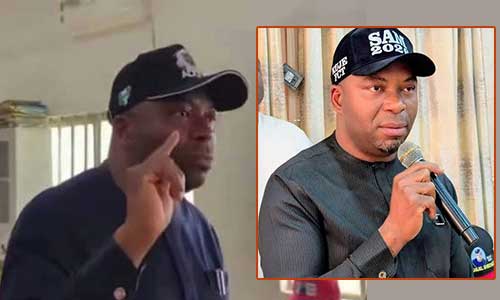
Kuje Chairman Backtracks APC Threat: No Forced Party Support
Summary
- Kuje Area Council Chairman, Danjuma Shekwolo, retracted his directive for residents to support the All Progressives Congress or leave the council.
- His initial statement had drawn widespread criticism for infringing on political freedoms.
- Shekwolo clarified on Wednesday that he lacks the authority to deny citizens fundamental rights based on their political affiliation.
- This retraction affirms that public officials cannot disenfranchise residents or coerce their political choices.
Initial Controversy and Subsequent Retraction
This incident provides a clear example of the legal limits of public officials' power regarding citizens' fundamental rights and freedom from political coercion.
The Chairman of Kuje Area Council, Danjuma Shekwolo, located within Nigeria's Federal Capital Territory (FCT), recently reversed a contentious directive he had previously issued to local residents. Shekwolo had controversially declared that individuals residing in the Kuje Area Council were obligated to either lend their support to the All Progressives Congress (APC) political party or face the consequence of having to depart the council. This initial statement sparked considerable public outcry and widespread criticism, drawing significant attention to the boundaries of political authority at the local government level.
In response to the mounting public pressure, Mr. Shekwolo issued a clarification on Wednesday, effectively retracting his earlier pronouncement. His reversal acknowledged the fundamental principle that he lacks the legal standing or authority to compel residents' political affiliations or to deny them their basic rights based on such choices. This public backtracking by the Kuje Chairman on his APC threat underscores the swift and necessary response to perceived overreach by public officials.
Legal Limits and Official Acknowledgment
Mr. Shekwolo's subsequent clarification explicitly stated his recognition that he possesses no right to disenfranchise any resident of the Kuje Area Council. This admission directly addresses the core legal issue raised by his initial declaration, which implicitly threatened to curtail the political rights of citizens. His retraction highlighted that public officials, even those in leadership positions like the Kuje Chairman, operate under strict legal constraints, particularly when it comes to citizens' fundamental freedoms. The notion that residents must either offer APC support or leave the FCT area council was legally untenable from its inception.
The chairman's acknowledgment that he lacks the power to deny citizens their fundamental rights on account of political affiliation serves as a crucial reaffirmation of constitutional protections. This incident provides a clear example of the legal limits of public officials' power regarding citizens' fundamental rights and freedom from political coercion. Lawyers can cite this public retraction as an acknowledgment that such threats are legally indefensible, informing advice to clients facing similar unlawful directives. It underscores that political rights, including the freedom to associate or not associate with any political party, are sacrosanct and cannot be arbitrarily revoked by local government leaders.
Implications for Political Rights and Governance
The swift and widespread criticism that preceded Danjuma Shekwolo's Kuje retraction highlights the vigilance of the public and civil society in safeguarding democratic principles. Such incidents, where a public official attempts to impose political allegiance, often provoke strong reactions because they challenge the very essence of free political participation. The chairman's initial statement, suggesting residents support APC or leave FCT, directly impinged upon the freedom of association and expression, which are cornerstones of Nigeria's democratic framework.
This episode serves as an important reminder of the accountability expected from elected officials and the legal framework that protects citizens from arbitrary directives. The Kuje Chairman's acknowledgment that he cannot disenfranchise residents based on their political choices reinforces the principle that governance must respect individual liberties. It underscores the importance of upholding Nigeria's fundamental rights political landscape, ensuring that all citizens, regardless of their political leanings, can reside and participate in their communities without fear of reprisal or expulsion. The incident ultimately reaffirms the inviolability of individual political rights within the Kuje Area Council and beyond.
Practical Implications
This incident reaffirms the legal limits of public officials' power regarding citizens' fundamental rights and freedom from political coercion. Lawyers can cite this public retraction as an acknowledgment that such threats are legally indefensible, informing advice to clients facing similar unlawful directives.
Source
How does this affect you?
Get an AI analysis of this article grounded in your jurisdictions, practice areas, and any policy documents you've uploaded to Wansom.
Wansom is AI and can make mistakes.