
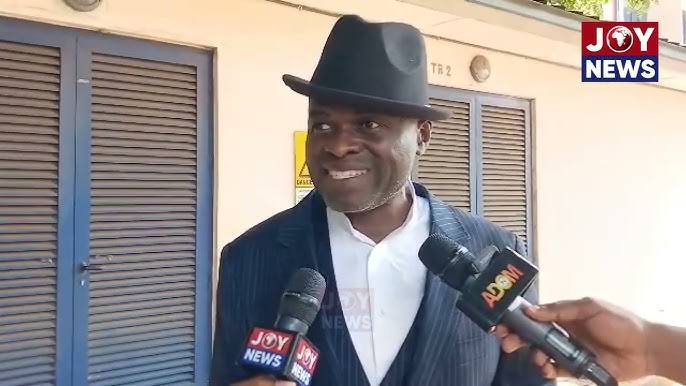
Martin Kpebu: Urges Ghana Political Insults Dialogue To End Vitriol
Summary
- Private legal practitioner Martin Kpebu has called for a national dialogue to address Ghana's escalating culture of political insults.
- Kpebu argues that arrests and prosecutions alone are insufficient to resolve this deep-seated problem.
- He highlighted the "Ghana Jollof" TikTok controversy as an example of a broader issue in political discourse.
- Kpebu noted that the "culture of vitriol" is getting out of hand and affects political actors across the entire spectrum.
The Call for National Dialogue
Kpebu firmly asserts that relying solely on arrests and legal prosecutions will not provide a lasting solution to this pervasive societal challenge.
Private legal practitioner Martin Kpebu has issued a compelling appeal for a nationwide dialogue aimed at confronting Ghana's escalating culture of political insults. Kpebu firmly asserts that relying solely on arrests and legal prosecutions will not provide a lasting solution to this pervasive societal challenge, arguing that such measures address symptoms rather than the underlying causes. His remarks, made during an appearance on Joy FM’s popular program, Top Story, underscore a conviction that a more collaborative and inclusive approach is essential to foster a healthier and more respectful political environment across the nation.
Kpebu's intervention highlights a critical juncture in Ghanaian public life, where the tenor of political discourse has become a significant concern for many citizens. He posits that while legal mechanisms certainly have their place in maintaining order, they are ultimately insufficient to address the deep-seated roots and widespread nature of the problem of vitriolic language. Instead, he advocates for a collective societal effort, involving various stakeholders, to understand and mitigate the complex factors contributing to the current climate of hostility and disrespect in public conversations.
Unpacking the "Culture of Vitriol"
The impetus for Kpebu's urgent call was partly illuminated by the recent controversy surrounding the "Ghana Jollof" TikTok account, an incident he identified as symptomatic of a deeper malaise within the nation's political conversations. He articulated a widespread public sentiment, observing that there is a collective desire across Ghana to halt what he termed the "menace of insults" frequently directed at political figures and other prominent members of society. This sentiment, Kpebu noted, reflects a growing unease and frustration with the current state of affairs, where personal attacks often overshadow substantive debate.
He further elaborated on the gravity of the situation, stating explicitly that this "culture of vitriol" is rapidly spiraling out of control and becoming increasingly difficult to manage. This assessment points to a systemic issue that transcends individual incidents or isolated comments, suggesting that the very fabric of Ghana's political discourse is being eroded by an increasingly aggressive and offensive use of language. Kpebu's analysis suggests that the problem is not merely superficial but rather deeply embedded in how political disagreements are expressed and debated publicly, demanding a comprehensive response.
A Cross-Party Challenge
Crucially, Kpebu acknowledged that this issue of pervasive political insults is not confined to any single political faction or ideology but rather cuts across Ghana's entire political divide. He observed that political actors and commentators from various sides of the spectrum have, at different junctures and in different contexts, employed language that could reasonably be considered offensive or inflammatory. This recognition underscores the non-partisan nature of the problem, indicating that responsibility for the current climate of harsh rhetoric is shared broadly among diverse political voices.
By framing the issue as a challenge that affects all political stakeholders equally, Kpebu reinforces the necessity of a unified, national dialogue rather than a blame game. His perspective suggests that a sustainable solution cannot emerge from one side attempting to police or condemn the other, but rather from a collective commitment to elevating the standard of public discourse for the benefit of all. The widespread use of potentially offensive language by diverse political voices highlights the urgent need for a common understanding and a shared path forward in fostering a more constructive and respectful political landscape in Ghana.
Practical Implications
This article reports on a legal practitioner's call for national dialogue on political insults, rather than a specific legal development. Consequently, there is no direct, immediate practical implication for a lawyer or compliance officer in terms of actionable steps, new compliance exposures, or legal precedents.
Source
How does this affect you?
Get an AI analysis of this article grounded in your jurisdictions, practice areas, and any policy documents you've uploaded to Wansom.
Finish Reading the Full Story and the Expert Analysis.
Get the latest legal & regulatory intelligence in Ghana
Wansom is AI and can make mistakes.