
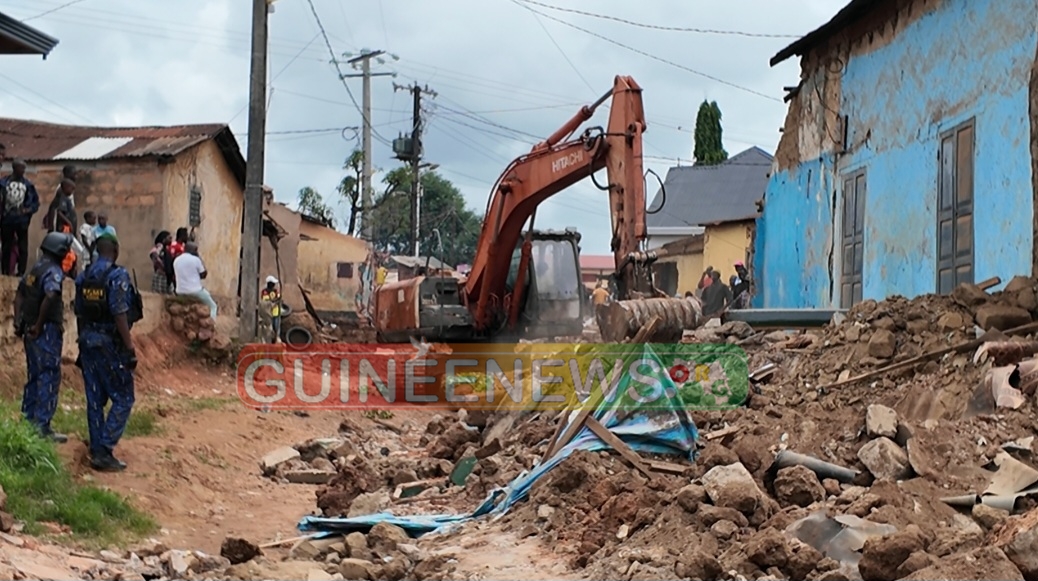
Guinea: Kindia Gare Forced Evictions Leave Families Homeless
Summary
- Multiple families in Kindia's Gare neighborhood were forcibly evicted due to an infrastructure project.
- The evictions are linked to the reconstruction of a bridge and the development of a reinforced concrete road.
- Affected residents acknowledge receiving advance notice but are now without housing.
- The operation has left numerous families in distress and without shelter.
- The situation raises concerns about property rights and the adequacy of resettlement provisions in Guinea.
Evictions Impact Kindia's Gare Neighborhood
Lawyers examining these Kindia Gare forced evictions would need to assess whether the process adhered strictly to national and international standards governing expropriation and resettlement.
A significant operation of forced displacement, locally known as déguerpissement, has left numerous families in Kindia's Gare neighborhood without shelter. These Kindia Gare forced evictions are a direct consequence of a major urban development initiative aimed at rebuilding a bridge and constructing a new reinforced concrete road in the area. The project, while intended to improve local infrastructure, has resulted in widespread distress among residents whose homes were demolished.
Despite acknowledging that they received advance notice regarding the impending operation, the affected individuals now find themselves in a precarious situation, lacking fundamental housing. The demolition of their residences has plunged these families into uncertainty, highlighting the immediate and severe human cost associated with large-scale public works projects in the region. The sudden loss of their homes underscores a critical challenge in balancing urban development with the protection of citizens' property rights and ensuring adequate resettlement provisions.
Legal Framework and Resettlement Challenges
The circumstances surrounding the Kindia road project compensation and the subsequent displacement raise important questions regarding the application of property rights Kindia Guinea. While the authorities provided prior notification, the current outcome—families being left without housing—suggests potential gaps in the resettlement process or the adequacy of compensation measures. Infrastructure project resettlement Guinea typically involves legal obligations to ensure that those displaced are not left in a worse situation than before, often requiring fair compensation or suitable alternative housing.
Lawyers examining these Kindia Gare forced evictions would need to assess whether the process adhered strictly to national and international standards governing expropriation and resettlement. This includes scrutinizing the valuation of properties, the transparency of the notification process, and the provisions made for alternative accommodation or financial support. The fact that families are now without housing, despite prior warning, indicates a potential disconnect between procedural compliance and the practical safeguarding of residents' fundamental rights during such development initiatives.
Displaced Families Face Lingering Uncertainty
The immediate aftermath of the déguerpissement Kindia operation has plunged multiple families into a state of profound distress and homelessness. These instances of Guinea Kindia housing displacement underscore the severe social repercussions when large-scale infrastructure projects do not adequately account for the human element. Families who once had stable homes now face the daunting challenge of securing new shelter, often with limited resources and support, leading to significant disruption in their lives and livelihoods.
The ongoing plight of these displaced residents highlights the critical need for robust legal advocacy and oversight. Legal professionals have a vital role to play in advising affected clients on their rights, assessing the adequacy of any Kindia road project compensation offered, and potentially challenging the provisions (or lack thereof) for alternative housing. Ensuring that future infrastructure project resettlement Guinea operations prioritize the well-being and legal entitlements of affected communities is paramount to prevent similar crises and uphold justice.
Practical Implications
Lawyers should assess the Kindia Gare evictions for adherence to property rights and resettlement laws in Guinea, advising clients on potential claims for compensation or challenging the adequacy of housing provisions related to infrastructure projects.
Source
How does this affect you?
Get an AI analysis of this article grounded in your jurisdictions, practice areas, and any policy documents you've uploaded to Wansom.
Wansom is AI and can make mistakes.