
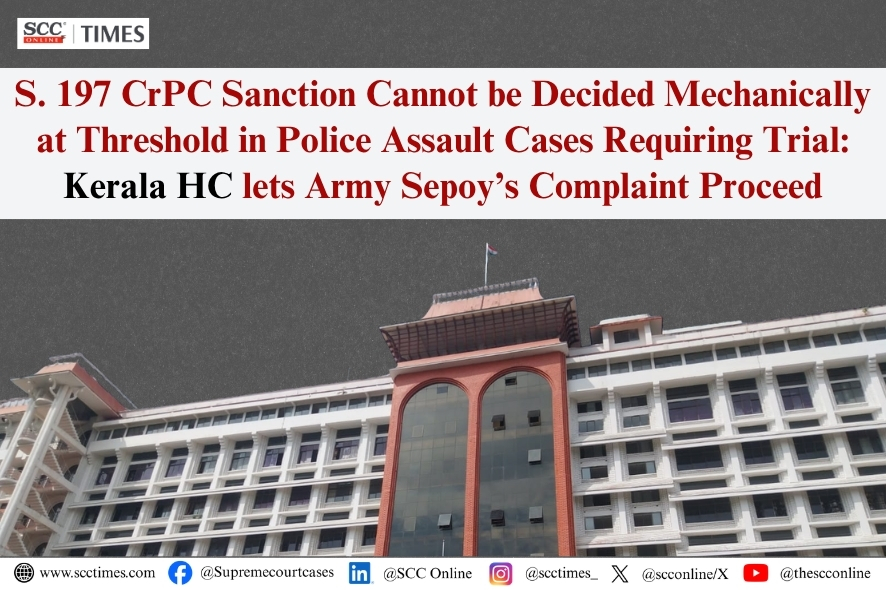
Kerala High Court: No Prior Sanction Under Section 197 CrPC for Police Assault Case
Summary
- The Kerala High Court has ruled that prior sanction under Section 197 CrPC cannot be decided mechanically at the threshold in police assault cases requiring trial.
- Police officers can no longer automatically invoke statutory protection as a defense against allegations of misconduct, according to the court's decision.
- The ruling allows complaints to proceed despite attempts by accused police officers to invoke statutory protection under Section 197 CrPC.
What Happened
The question of prior sanction under Section 197 CrPC must be deferred when the alleged misconduct of public servants and its nexus with official duty involve disputed facts.
The Kerala High Court has made a significant ruling in a police assault case, allowing the complaint to proceed despite the accused police officers' attempt to invoke statutory protection under Section 197 CrPC. The court's decision effectively removes the blanket shield of statutory protection that public servants often rely on when facing allegations of unjustified violence. In this particular case, the court ruled that the question of prior sanction under Section 197 CrPC must be deferred when the alleged misconduct of public servants and its nexus with official duty involve disputed facts. This means that police officers can no longer automatically invoke statutory protection as a defense against allegations of misconduct.
Legal Context
Section 197 CrPC is a provision in the Indian Criminal Procedure Code that allows public servants to be tried by a court only after obtaining prior sanction from their employer or the government. This provision has been used as a shield by police officers and other public servants against allegations of misconduct, often resulting in the dismissal of complaints without trial. However, the Kerala High Court's ruling suggests that this blanket protection may not be available in cases where the alleged misconduct involves disputed facts and its nexus with official duty is unclear. This decision has significant implications for the legal strategy employed by lawyers defending police officers against allegations of unjustified violence.
Why It Matters
The Kerala High Court's ruling has far-reaching consequences for police assault cases in India, particularly those involving public servants. By removing the blanket shield of statutory protection under Section 197 CrPC, the court has paved the way for more complaints to proceed to trial, potentially leading to greater accountability and transparency in the conduct of police officers. This decision also highlights the need for a more nuanced approach to dealing with allegations of misconduct against public servants, one that takes into account the complexities of each case rather than relying on automatic statutory protection.
Practical Implications
Lawyers should note that the Kerala High Court's ruling may impact their strategy in defending police officers against allegations of unjustified violence, as the court has effectively removed the blanket shield of statutory protection under Section 197 CrPC.
Source
Source: Original reporting via SCC Times
How does this affect your business?
Get an AI analysis of this article grounded in your jurisdictions, practice areas, and any policy documents you've uploaded to Wansom.
Wansom is AI and can make mistakes.