
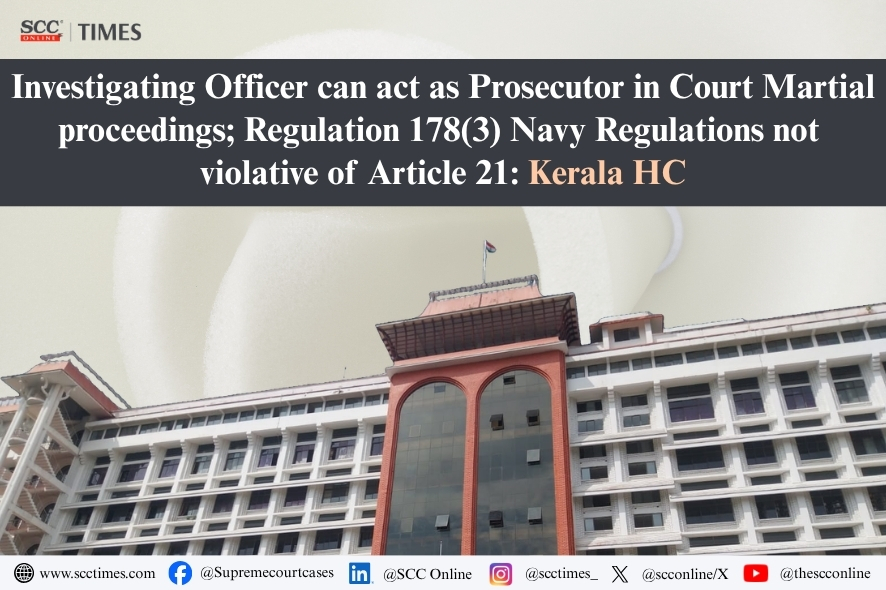
Kerala HC: Investigating Officer Prosecutor in Court Martial Not Fair Trial Violation
Summary
- The Kerala High Court ruled that an Investigating Officer can act as a prosecutor in court-martial proceedings.
- The court found that this appointment, by itself, does not violate the right to a fair trial.
- This observation considered the special statutory framework for military justice and Article 33 of the Constitution.
- Regulation 178(3) of the Navy Regulations was deemed not to violate Article 21.
What Happened
The Kerala High Court has clarified that the appointment of an Investigating Officer to also serve as a prosecutor in court-martial proceedings does not, by its very nature, infringe upon an accused's right to a fair trial.
The Kerala High Court recently issued a significant observation concerning the procedural aspects of military justice, specifically addressing the role of an Investigating Officer in court-martial proceedings. The court determined that the appointment of an individual who has served as an Investigating Officer to also act as a prosecutor in a court-martial does not, by itself, constitute a violation of an accused's fundamental right to a fair trial. This ruling provides clarity on a long-standing point of contention within military legal circles.
The pronouncement from the Kerala High Court underscores the unique nature of the legal framework governing the armed forces. It suggests that the standard civilian legal interpretations regarding prosecutorial impartiality might not apply identically within the specialized context of military tribunals. This specific finding by the Kerala High Court on the Investigating Officer prosecutor role in court martial cases is poised to influence future military justice proceedings across India.
Legal Context
Central to the Kerala High Court's determination was its consideration of the distinct statutory framework that underpins court-martial proceedings. The court explicitly referenced Regulation 178(3) of the Navy Regulations, concluding that this specific regulation does not infringe upon Article 21 of the Constitution of India. Article 21 guarantees the right to life and personal liberty, including the right to a fair procedure. The court's finding implies that the procedural mechanisms outlined in the Navy Regulations are deemed consistent with constitutional safeguards, even when an Investigating Officer assumes the prosecutorial function.
Furthermore, the High Court's observation was made with due regard to Article 33 of the Constitution. Article 33 grants Parliament the power to modify fundamental rights in their application to members of the armed forces, paramilitary forces, police forces, and intelligence organizations, to ensure the proper discharge of their duties and the maintenance of discipline. This constitutional provision highlights the unique legal standing of military personnel and the necessity for a specialized legal system that balances individual rights with the imperative of military discipline and operational efficiency. The court's decision reinforces the understanding that the Indian court martial procedure operates under a distinct legal paradigm.
Why It Matters
This ruling from the Kerala High Court carries substantial weight for the administration of military justice in India. By affirming that an Investigating Officer can act as a prosecutor without inherently violating fair trial rights, the court has provided a clear judicial precedent that supports existing military law prosecutor practices. This clarification is particularly relevant for legal practitioners involved in military law, as it sets a benchmark for challenging procedural appointments within court-martial settings.
The decision suggests that challenges to the fairness of a trial based solely on the dual role of an Investigating Officer and prosecutor are unlikely to succeed if they do not demonstrate actual prejudice or a systemic breakdown of justice. Instead, defense strategies in such cases may need to focus more on substantive arguments regarding the evidence and merits of the case, rather than procedural objections related to the prosecutor's prior involvement in the investigation. This judgment by the Kerala High Court on military justice matters reinforces the distinct operational and disciplinary requirements of the armed forces.
Practical Implications
This ruling clarifies that the appointment of an Investigating Officer as a prosecutor in court-martial proceedings, particularly under Navy Regulations, does not inherently violate fair trial rights. Lawyers representing military personnel or involved in court-martial cases should be aware that challenging the prosecutor's role solely on this ground is unlikely to succeed, and should focus on substantive defense arguments. For military legal advisors, it affirms the procedural validity of such appointments.
Source
How does this affect you?
Get an AI analysis of this article grounded in your jurisdictions, practice areas, and any policy documents you've uploaded to Wansom.
Finish Reading the Full Story and the Expert Analysis.
Get the latest legal & regulatory intelligence in India
Wansom is AI and can make mistakes.