
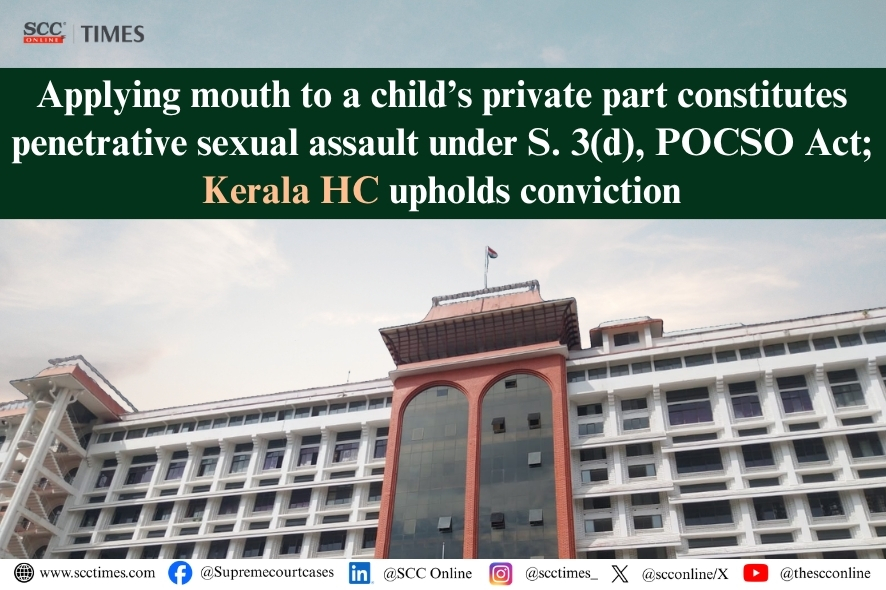
Kerala HC: POCSO S. 3(d) Mouth Private Part Is Penetrative Assault
Summary
- The Kerala High Court recently affirmed that intentionally applying one's mouth to a child's private part constitutes penetrative sexual assault.
- This ruling falls under Section 3(d) of the Protection of Children from Sexual Offences Act, 2012 (POCSO Act).
- The court upheld a conviction based on this interpretation, reinforcing the broad scope of the POCSO Act.
- The decision clarifies that penetrative sexual assault is not limited to traditional forms of penetration but includes other intimate acts.
- This judgment strengthens the legal framework for combating child sexual abuse and guides future prosecutions.
Key Ruling from Kerala High Court
For legal practitioners, this ruling clarifies the broad interpretation of 'penetrative sexual assault' under POCSO Act Section 3(d), requiring them to consider non-genital oral contact as falling within its scope when advising clients or preparing for prosecution or defense in child sexual abuse cases.
The Kerala High Court recently delivered a significant judgment, affirming that the intentional act of applying one's mouth to the private part of a child unequivocally falls within the scope of penetrative sexual assault under Section 3(d) of the Protection of Children from Sexual Offences Act, 2012 (POCSO Act). This ruling came as the court upheld a conviction previously made under the provisions of this crucial legislation.
The decision by the Kerala HC POCSO S. 3(d) mouth private part interpretation provides vital clarity on what constitutes penetrative sexual assault, particularly concerning acts that do not involve traditional penile-vaginal or penile-anal penetration. By explicitly including this specific act, the court reinforced the broad protective intent behind the POCSO Act, ensuring that various forms of child sexual abuse are adequately covered and perpetrators held accountable.
This judicial pronouncement underscores the judiciary's commitment to a comprehensive interpretation of laws designed to safeguard children. The upholding of the conviction sends a clear message regarding the severity with which such offenses are viewed and the determination to apply the law robustly to protect vulnerable minors from all forms of sexual exploitation and assault.
Understanding the POCSO Act's Framework
The Protection of Children from Sexual Offences Act, 2012, commonly known as the POCSO Act, was enacted with the primary objective of providing a robust legal framework for the protection of children from sexual abuse and exploitation. It defines various forms of sexual offenses against children, including penetrative sexual assault, sexual assault, and sexual harassment, and prescribes stringent punishments for offenders.
Section 3(d) of the POCSO Act specifically addresses penetrative sexual assault, outlining acts that constitute this grave offense. Historically, interpretations of 'penetrative sexual assault definition India' have sometimes focused narrowly on genital penetration. However, the legislative intent behind the POCSO Act was always to encompass a wider range of non-consensual sexual acts involving children, recognizing the diverse ways in which child sexual abuse can manifest.
This particular ruling by the Kerala High Court contributes significantly to the evolving jurisprudence surrounding the POCSO Act Section 3(d) interpretation. It clarifies that the definition of penetrative sexual assault is not limited to conventional understandings but extends to other forms of intimate contact, such as the application of the mouth to a child's private part, thereby broadening the protective umbrella of the statute.
Implications for Child Protection and Legal Practice
The Kerala High Court's decision has profound implications for the fight against child sexual abuse in India. By explicitly categorizing the application of the mouth to a child's private part as penetrative sexual assault, the court has provided a definitive interpretation that strengthens the legal recourse available to victims and streamlines prosecution efforts. This ruling ensures that such acts, which are undeniably traumatic and harmful, are not overlooked or categorized under lesser offenses.
This judgment from the child sexual abuse Kerala High Court serves as a critical precedent, guiding lower courts and law enforcement agencies in their handling of similar cases. It reinforces the principle that the welfare and protection of children are paramount, and legal definitions must be interpreted broadly to achieve this objective. For legal practitioners, this ruling clarifies the broad interpretation of 'penetrative sexual assault' under POCSO Act Section 3(d), requiring them to consider non-genital oral contact as falling within its scope when advising clients or preparing for prosecution or defense in child sexual abuse cases.
Furthermore, this interpretation contributes to a more comprehensive understanding of what constitutes sexual violence against children, moving beyond traditional definitions to address the full spectrum of abusive behaviors. It underscores the importance of a victim-centric approach, ensuring that the law is applied in a manner that truly protects children from all forms of sexual exploitation and assault, including those involving oral contact with private parts.
Practical Implications
This ruling clarifies the broad interpretation of 'penetrative sexual assault' under POCSO Act Section 3(d), requiring legal practitioners to consider non-genital oral contact as falling within its scope when advising clients or preparing for prosecution/defense in child sexual abuse cases.
Source
Source: Original reporting via SCC Times
How does this affect you?
Get an AI analysis of this article grounded in your jurisdictions, practice areas, and any policy documents you've uploaded to Wansom.
Finish Reading the Full Story and the Expert Analysis.
Wansom is AI and can make mistakes.