
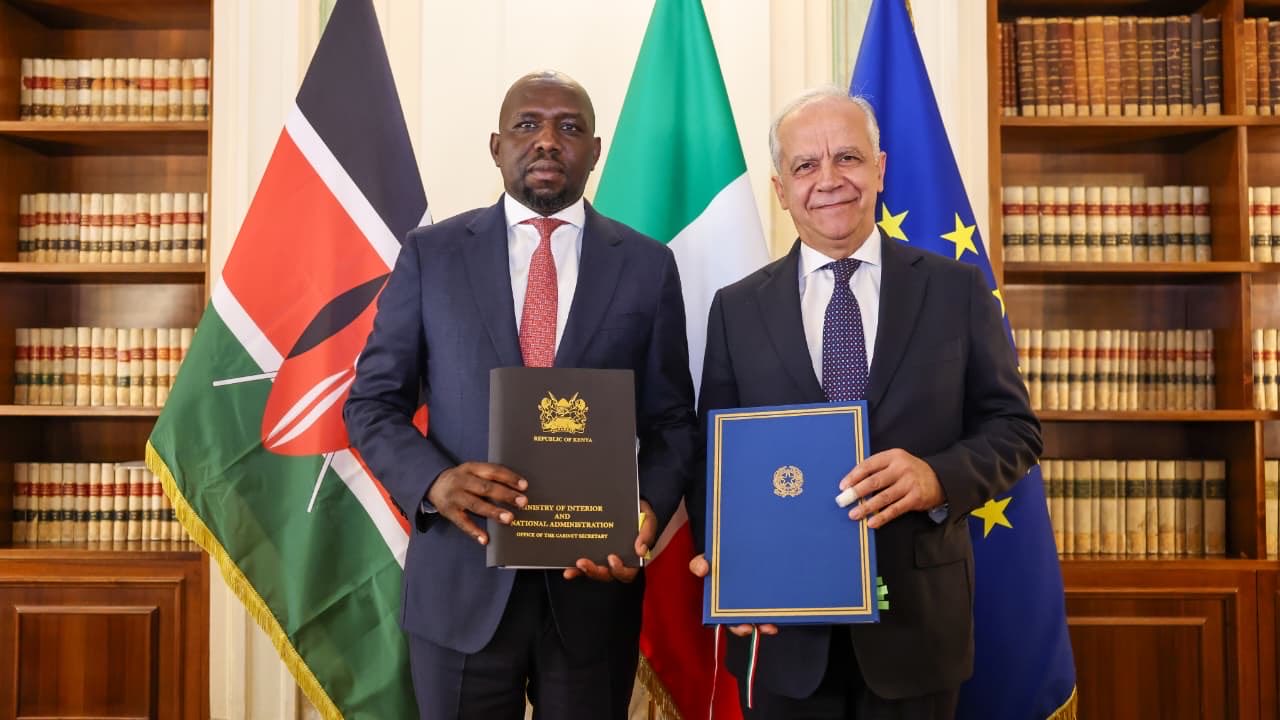
Kenya, Italy: Formalize Security Cooperation Agreement Against Crime
Summary
- Kenya and Italy signed an agreement in Rome to strengthen security cooperation.
- Interior Cabinet Secretary Kipchumba Murkomen and Italian counterpart Matteo Piantedosi formalized the pact.
- The agreement establishes a framework for collaboration in security, immigration, and law enforcement.
- Key areas of focus include combating terrorism financing, transnational organised crime, and cybercrime.
- The partnership will facilitate intelligence sharing, specialized training, and technological application, anchored in human rights and the rule of law.
A New Bilateral Security Framework
Murkomen emphasized that this cooperation would be firmly rooted in fundamental principles: respect for national sovereignty, adherence to constitutional principles, upholding the rule of law, and safeguarding fundamental human rights.
Kenya and Italy have formalized a significant pact to enhance their security relationship, following high-level discussions in Rome. Interior Cabinet Secretary Kipchumba Murkomen engaged in Kenya Italy bilateral security talks with his Italian counterpart, Matteo Piantedosi, culminating in the signing of a comprehensive accord. This Kipchumba Murkomen Matteo Piantedosi agreement establishes a structured framework designed to deepen collaboration across vital sectors including security, immigration, and law enforcement, building upon the existing robust ties between the two nations. The newly signed Kenya Italy security cooperation agreement signifies a mutual commitment to addressing shared security challenges through a unified approach.
Expanding the Scope of Joint Efforts
During the discussions, Secretary Murkomen underscored the critical need for intensified cooperation in tackling various forms of illicit activities and threats. The dialogue specifically highlighted the importance of strengthening joint efforts in combating terrorism and its financing, a key area of concern for both nations. Furthermore, the agreement targets transnational organised crime, illicit drug trafficking, and the pervasive issues of human trafficking and migrant smuggling. The scope of collaboration also extends to emerging threats such as cybercrime and maritime insecurity, alongside other evolving security challenges that demand a coordinated international response.
This broad mandate for cooperation reflects a comprehensive approach to security, acknowledging that modern threats are multifaceted and require diverse strategies. The commitment to addressing such a wide array of criminal enterprises and security risks demonstrates the depth of the Kenya Italy law enforcement collaboration envisioned by the agreement. By pooling resources and expertise, both countries aim to disrupt criminal networks and enhance their capacity to protect their citizens and national interests from these pervasive dangers. The emphasis on both traditional and contemporary threats ensures the framework remains relevant and adaptable to future security landscapes.
Operationalizing the Partnership
Beyond policy alignment, the new partnership is designed to unlock practical avenues for operational engagement. Secretary Murkomen articulated that the collaboration would create opportunities for extensive intelligence and security information sharing, which is crucial for preemptive action and effective response. The agreement also provides for specialized training initiatives, technical assistance, and institutional exchanges, fostering a deeper understanding and shared best practices between Kenyan and Italian security agencies. Capacity building is a central pillar, aiming to enhance the capabilities of personnel in both countries.
Moreover, the application of advanced technology in confronting contemporary security challenges is a significant component of this partnership. This technological integration is expected to provide innovative solutions and improve the efficiency of security operations. Murkomen emphasized that this cooperation would be firmly rooted in fundamental principles: respect for national sovereignty, adherence to constitutional principles, upholding the rule of law, and safeguarding fundamental human rights. With the agreement now in place, the immediate priority shifts to its effective implementation, which will necessitate strengthened institutional coordination and sustained engagement from both sides to ensure its success.
Strategic Importance and Future Outlook
Kenya's commitment to this alliance stems from its profound appreciation for its relationship with Italy. The Cabinet Secretary reiterated Kenya's dedication to partnerships that not only advance national security but also serve to protect its citizens and contribute meaningfully to regional and international peace and stability. This bilateral agreement is viewed as a vital instrument in achieving these overarching strategic objectives, reinforcing Kenya's role as a responsible actor in global security efforts.
The delegation accompanying Secretary Murkomen, which included Ambassador Fredrick Matwang’a, Deputy Inspector General of the Administration Police Service Gilbert Masengeli, and other ministry officials, underscored the high-level commitment to this initiative. Their presence highlighted the comprehensive nature of the discussions and the broad institutional support for the enhanced security cooperation. The successful execution of this agreement is anticipated to yield substantial benefits for both Kenya and Italy, fostering a more secure environment and strengthening their diplomatic and operational ties for the foreseeable future.
Practical Implications
Lawyers and compliance officers should anticipate increased enforcement and intelligence sharing between Kenya and Italy on transnational crimes, potentially impacting clients involved in cross-border activities or facing investigations related to terrorism financing, human trafficking, or cybercrime.
Source
How does this affect you?
Get an AI analysis of this article grounded in your jurisdictions, practice areas, and any policy documents you've uploaded to Wansom.
Finish Reading the Full Story and the Expert Analysis.
Get the latest legal & regulatory intelligence in Kenya
Wansom is AI and can make mistakes.