
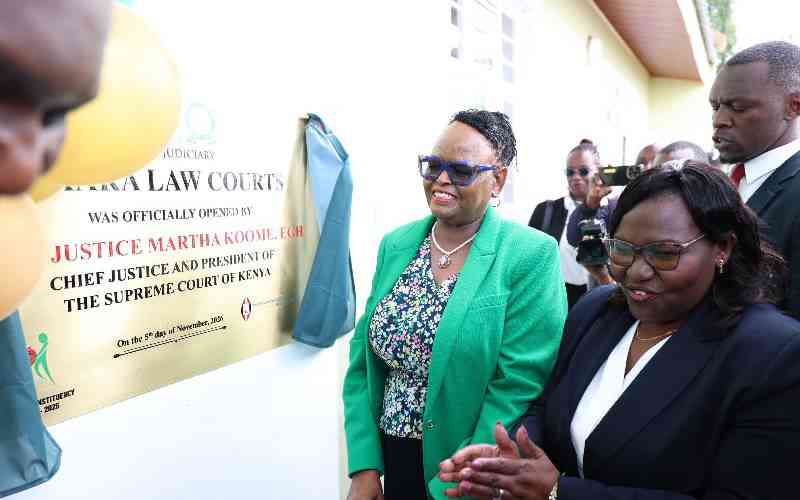
Kenya Chief Justice Koome: Serious Crimes Division Targets Goonism Financiers
Summary
- Chief Justice Martha Koome declared political goonism a serious organized crime violating the Rome Statute.
- She called for the arrest and prosecution of goon financiers and mobilizers under the Serious Crimes Act.
- A dedicated International and Organised Crimes Division has been gazetted at the High Court to support magistrates handling these cases.
- Koome's judicial strategy contrasts with Interior CS Murkomen's previous criticism of the judiciary's role in combating goonism.
- The Chief Justice emphasized the urgency of addressing this issue before the 2027 elections.
Chief Justice Targets Goonism Financiers
To bolster the judiciary's capacity to handle these complex cases, the International and Organised Crimes Division of the High Court has been officially gazetted within the High Court.
Chief Justice Martha Koome recently issued a stern condemnation of political goonism, categorizing it as a grave form of organized crime that violates both the Rome Statute and fundamental human principles. Speaking at the inauguration of the Maara law courts in Kieganguru, the Chief Justice asserted that those responsible for mobilizing and funding such activities deserve severe moral and legal repercussions. She explicitly called upon law enforcement agencies to shift their focus towards apprehending the orchestrators and financial backers of these groups, rather than solely targeting the foot soldiers. Koome emphasized that the time has come for a collective plea for divine protection for the nation and for the liberation of young people who are exploited and misled into participating in organized gangs.
The Chief Justice articulated a clear judicial strategy for addressing this menace, stating that while individuals involved in minor disturbances are constitutionally entitled to bail, the financiers and organizers of goonism would face charges under the Serious Crimes Act. To bolster the judiciary's capacity to handle these complex cases, the International and Organised Crimes Division of the High Court has been officially gazetted within the High Court. This specialized division is designed to provide crucial support to magistrates presiding over such proceedings. Koome underscored that the International Criminal Court frequently deals with cases of organized crime, drawing a parallel to the severity of the issue domestically.
Judicial Strategy and Legal Framework
The judiciary's approach, as outlined by Chief Justice Martha Koome, distinguishes between the direct perpetrators of minor public disorder and the masterminds behind widespread goonism. She highlighted that the existing legal framework mandates bail or bond for individuals arrested for petty crimes, a right enshrined in the constitution. However, for those identified as the architects and financiers of political violence, the legal landscape changes dramatically. Koome confirmed that these individuals would be prosecuted under the stringent provisions of the Serious Crimes Act Kenya. This move signals a more aggressive stance by the Kenya organised crime judiciary against those who exploit vulnerable youth for political gain.
The establishment of a dedicated International and Organised Crimes Division at the High Court is a pivotal development in this strategy. This newly gazetted division aims to streamline the judicial process for complex cases involving organized crime, ensuring that magistrates have the necessary resources and expertise. Chief Justice Koome's remarks also touched upon the broader international context, noting that goonism, as an organized crime, contravenes the principles of the Rome Statute, which governs international criminal law. She also suggested a long-term solution involving addressing the root causes of goonism by providing gainful employment for those exploited.
Divergent Views and Political Resolve
Chief Justice Koome's firm stance, particularly her directive to prosecute Martha Koome goonism financiers under the Serious Crimes Act, has brought the issue of political violence to the forefront. Her views, however, presented a contrast to those expressed by Interior Cabinet Secretary Kipchumba Murkomen, who had previously criticized the judiciary, labeling it as the weakest link in the fight against goonism. Despite this divergence, Tharaka Nithi Governor Muthomi Njuki, who also chairs the Council of Governors, publicly endorsed Koome's emphasis on arresting the planners of such activities. Njuki stressed that politicians must be held accountable and that the organization of goons against political opponents is unacceptable.
Governor Njuki employed a vivid analogy, stating that "every barking dog has an owner," to underscore the necessity of taking decisive action against individuals at all levels who orchestrate political thuggery. He further pledged that the Council of Governors would actively collaborate with county security teams to combat this escalating threat and ensure that all relevant cases are reported. This renewed focus on organized political violence comes amidst prior disagreements between Chief Justice Koome and DCI boss Mohammed Amin regarding the handling of arrested goons, with Amin having previously accused the judiciary of leniency. Koome has consistently maintained that this issue requires urgent and comprehensive attention to prevent it from destabilizing the country ahead of the 2027 elections.
Practical Implications
Lawyers should advise clients on the heightened legal exposure for financing or organizing political violence in Kenya, given Chief Justice Koome's directive to prosecute such individuals under a Serious Crimes Act and the gazetting of a dedicated serious crimes division at the High Court. This indicates a more aggressive judicial stance and increased risk of severe penalties for those involved in goonism.
Source
How does this affect you?
Get an AI analysis of this article grounded in your jurisdictions, practice areas, and any policy documents you've uploaded to Wansom.
Wansom is AI and can make mistakes.