
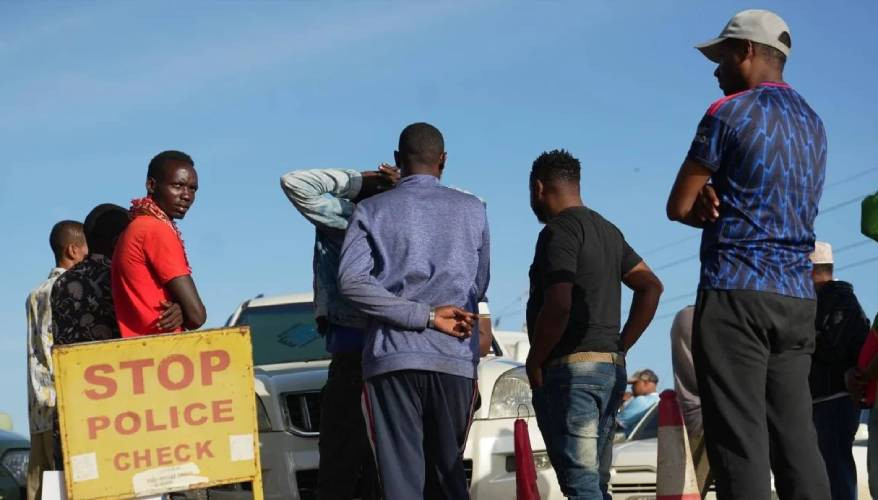
KDF: Detain MUHURI on Malindi-Lamu Highway, Violate Court Order
Summary
- Six members of Muslims for Human Rights (MUHURI) were detained for two hours by Kenya Defence Forces (KDF) officers on the Malindi-Lamu highway.
- The KDF officers reportedly concealed their faces and refused to identify themselves, prompting condemnation from human rights groups.
- This incident is seen as a violation of Justice Bahati Mwamuye's High Court ruling requiring security personnel to wear visible identification.
- Human rights organizations also called for adherence to a recent court order suspending the decade-long dusk-to-dawn curfew on the Minjila-Lamu highway.
- A senior Anti-Terror Police officer stated that security personnel conceal identities in high-risk areas for their personal and operational safety.
Incident Details Along Malindi-Lamu Highway
This detention incident has reignited calls for adherence to a significant High Court ruling issued by Justice Bahati Mwamuye.
Six members of Muslims for Human Rights (MUHURI), including five staff and a board member, recently experienced a two-hour detention by Kenya Defence Forces (KDF) officers along the Malindi-Lamu highway. The incident, which occurred on a Monday, saw the human rights team intercepted between Gamba and Minjila as they journeyed from Lamu to Mombasa following a field mission. The detained individuals included staff members Francis Auma, Abdulrahman Mwanga, Fredrick Okado, Lathan Yusuf, and Mohamed Abdla, alongside board member Khelef Khalifa.
Following their release, both MUHURI and the Kenya Human Rights Commission (KHRC) issued strong condemnations, highlighting concerns over the officers' conduct. The security personnel involved reportedly concealed their faces and declined to provide identification when challenged by the human rights advocates.
Judicial Directives and Rights Concerns
This detention incident has reignited calls for adherence to a significant High Court ruling issued by Justice Bahati Mwamuye. This judicial directive mandates that all security personnel must display clearly visible name tags or identifiable service numbers on their uniforms. Furthermore, the ruling explicitly prohibits officers from wearing hoods, balaclavas, or face masks that obscure their identities. Human rights organizations, including MUHURI and KHRC, contend that the KDF officers' actions during the Malindi-Lamu highway encounter directly contravened this court order, particularly given their refusal to identify themselves.
The groups also underscored the importance of complying with a separate, recent court order that suspended the dusk-to-dawn curfew, which had been in effect for over a decade along the Minjila-Lamu highway. They argue that such curfews historically fostered an environment conducive to arbitrary stops, harassment, and detentions of travelers, citing the recent Muslims for Human Rights detention as a prime example of these risks.
Conflicting Views and Accountability Demands
In response to the incident and the human rights groups' outcry, a senior Anti-Terror Police officer offered a contrasting perspective, explaining that officers from the Border Police Unit (BPU) often conceal their faces at roadblocks and tactical borders to safeguard their identities. This practice, according to the officer, is deemed essential for personal and operational survival in high-risk zones susceptible to insurgent or terrorist retaliation, citing areas like Kanyoyo in Kitui (towards Garissa), Moyale, and Lamu as examples.
Despite this operational rationale, the human rights organisations maintain their demand for immediate compliance with all court orders. They have urged the KDF and other security agencies to ensure officers who violate judicial directives face accountability and legal consequences. The groups emphasize the critical need for security forces to respect court mandates and uphold the rights of individuals traveling on routes such as the Malindi-Lamu highway, ensuring that security operations do not infringe upon fundamental freedoms.
Practical Implications
Lawyers should note Justice Mwamuye's High Court ruling requiring security officers to wear visible identification, as it provides grounds to challenge arbitrary detentions and demand accountability from KDF or other security agencies, especially along routes like the Malindi-Lamu highway where curfews have been lifted. This incident highlights the ongoing need to monitor security force compliance with court orders.
Source
How does this affect you?
Get an AI analysis of this article grounded in your jurisdictions, practice areas, and any policy documents you've uploaded to Wansom.
Finish Reading the Full Story and the Expert Analysis.
Get the latest legal & regulatory intelligence in Kenya
Wansom is AI and can make mistakes.